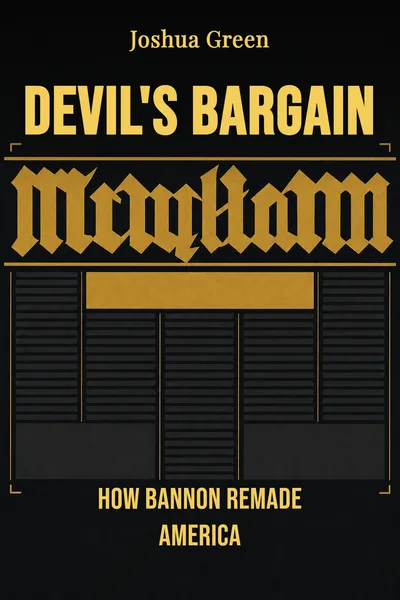
Devil's Bargain
How Bannon remade America
Description
On August 17, 2016, with the campaign eleven weeks from the vote and sinking in the polls, Donald Trump installed a new chief executive at the top of his operation: Stephen K. Bannon, the executive chairman of Breitbart News, a man with no experience running a presidential campaign. Most of Washington read the move as a sign of chaos, another lurch by a candidate who seemed determined to lose. Joshua Green, who had been reporting on Bannon since 2011, read it differently. He had watched this figure for years, circling the edges of Republican politics, assembling money, media and grievance, waiting for exactly the kind of candidate who could carry it.
Green's account, drawn from years of access that began long before anyone thought Trump would run, tells the story of a partnership that most observers only noticed at the end. The book's central claim is that Trump's victory was not a fluke of personality or a failure of Hillary Clinton alone. It was the collision of a candidate with an instinct for the electorate's anger and an operator who had spent a decade building the ideas, the institutions and the opposition research that could turn that anger into a governing coalition.
The result reframes the 2016 upset. Where the conventional telling makes Trump the whole story, Green insists on the second man in the room — the one who supplied the intellectual scaffolding, the media apparatus, and the sense that this was a movement rather than a candidacy. Understanding how these two very different men found each other is, in Green's telling, the key to understanding how the improbable became inevitable.
The question we’re asking : How did a fringe operator and a reality-television billionaire combine into the force that produced the greatest upset in modern American political history?What we’ll see : An inside account of the alliance between Steve Bannon and Donald Trump, and the long-building machinery that carried it to the White House.
Table of contents
01 Chapter 1 — The man who was waiting for a candidate
Green's Bannon is not the cartoon villain that emerged in 2016, nor the master strategist of his own self-mythology. He is something stranger: a man of many half-finished lives who kept converging on the same conviction. A Navy officer, then a Goldman Sachs banker, then a Hollywood producer who stumbled into a small fortune when a deal gave him a piece of the sitcom Seinfeld, Bannon spent decades accumulating money, contacts and a widening sense of grievance about the country's direction. By the time he took over Breitbart News after Andrew Breitbart's sudden death in 2012, he had a platform and a theory.
The theory was economic nationalism fused with cultural revolt. Bannon believed the 2008 financial crisis had exposed a governing class — bankers, bureaucrats, both political parties — that protected itself while ordinary Americans paid the bill. He read voraciously and idiosyncratically, absorbing everything from military history to fringe theories of civilizational cycles, and he built from it a story of decline that demanded a fighter. What he lacked was the fighter. He tried the Tea Party. He made incendiary documentaries. He courted Sarah Palin. None of them could carry the weight.

02 Chapter 2 — The machinery behind the outrage
What separated Bannon from the many operators who dreamed of a nationalist candidate was that he had spent years building the actual machinery. Green devotes much of the book to the institutions that surrounded Breitbart, because they are where the campaign's ammunition came from. Chief among them was the Government Accountability Institute, a nonprofit Bannon co-founded with the researcher Peter Schweizer, funded in part by the conservative financier Robert Mercer and his daughter Rebekah. Its purpose was not commentary but investigation — long, document-heavy research into the finances of politicians.
The institute's most consequential product was Schweizer's 2015 book Clinton Cash, which examined donations to the Clinton Foundation and speaking fees paid to Bill Clinton. Bannon's insight was tactical and, Green argues, brilliant in a cynical way. Rather than release the research through partisan outlets that mainstream readers would dismiss, he arranged exclusive arrangements with the New York Times and the Washington Post. Legacy institutions, chasing the story, laundered the opposition research into the center of respectable coverage. The attacks landed harder precisely because they did not arrive with a Breitbart byline.
03 Chapter 3 — The wilderness years that built the ideology
Green resists the tidy story in which Bannon simply appears in August 2016 and wins an election. The eleven weeks he ran the campaign were the payoff of a much longer effort, and the book keeps returning to the wilderness years when the ideas were forming without a national audience. Bannon's documentaries — earnest, overheated films about American decline, the financial crisis and Reagan-era conservatism — flopped commercially but rehearsed the arguments he would later hand to Trump. He was writing the script long before he found his lead.
A crucial thread is Bannon's cultivation of the online world that would come to be called the alt-right. Breitbart under his direction became a gathering point for a younger, internet-native right wing — meme-fluent, deliberately provocative, contemptuous of both liberal pieties and establishment Republicanism. Green treats this without either panic or excuse: Bannon saw an energy that traditional conservatism dismissed, and he chose to court it rather than police it, calculating that its intensity was worth its ugliness. That decision would define both the movement's momentum and the moral cost that trailed it.
04 Chapter 4 — What the partnership revealed about American politics
Step back from the two men and the deeper argument comes into focus. Green's book is less a character study than a case study in how a marginal ideology moves to the center. Economic nationalism had been waiting on the fringe for years, dismissed by both parties as either crankish or dangerous. What it lacked was not popular appeal — the appeal was real and measurable — but a vessel charismatic enough to carry it past the gatekeepers. The lasting lesson of the Bannon-Trump alliance is how thin those gates turned out to be.
The partnership exposed a vulnerability at the heart of mainstream politics. Both parties had converged on a consensus — free trade, managed immigration, a globalized economy — that left a large, aggrieved electorate without a champion. That consensus assumed the anger had nowhere to go. Green shows that an operator with money, media and patience could build the infrastructure to give it somewhere to go, and that a candidate willing to ignore every norm could activate it almost overnight. The establishment's confidence was, in retrospect, its weakness.
05 Conclusion
The partnership at the center of Green's book did not last. Bannon was pushed out of the White House within months, returned to Breitbart, then lost that too, and spent the following years chasing the movement across other countries and other causes. Trump, characteristically, minimized his old strategist's role once the victory was secured. The bargain, like many bargains, curdled the moment its purpose was fulfilled. But the thing it produced — a nationalist politics installed at the summit of American power — did not depend on the two men staying friends.
Related books