

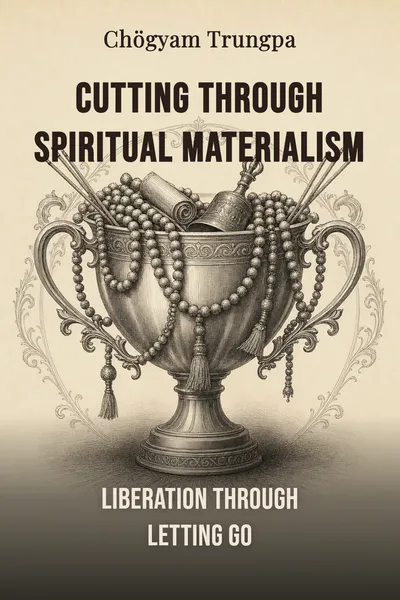
Cutting Through Spiritual Materialism
Liberation through letting go
Description
In the early 1970s, a Tibetan teacher named Chögyam Trungpa gave a series of talks in Colorado to a room full of Americans who had come looking for enlightenment. Many of them had already tried a great deal: mantras, retreats, gurus, altered states, stacks of books on the East. They were sincere, curious, and hungry for transformation. Trungpa listened to all of it and then told them something almost nobody wanted to hear — that most of what they were doing wasn't dismantling the ego at all. It was feeding it. The spiritual quest, he said, had quietly become the ego's newest and most sophisticated acquisition.
The talks became a book, Cutting Through Spiritual Materialism, published in 1973, and it has never really left circulation since. Its central accusation is uncomfortable precisely because it lands closest to the people who care most. We take up meditation, collect teachings, adopt a serene vocabulary — and then use all of it to reinforce the very self we claimed we wanted to see through. Trungpa gave this trick a name: spiritual materialism. The same grasping we bring to money, status and comfort, we simply redirect toward wisdom, calm and awakening, and congratulate ourselves for the upgrade.
What makes the book endure is that it doesn't offer a better technique. Trungpa isn't selling a faster route to the peaceful, improved self we imagine on the other side of practice. He's suggesting that the whole project of improving that self is the problem — and that liberation, if the word means anything, runs in the opposite direction entirely.
The question we’re asking : When we set out to become more spiritual, who exactly is doing the improving — and what is it quietly protecting?What we’ll see : How a Tibetan teacher took apart the comforting version of the spiritual path and pointed instead toward something far less flattering, and far more free.
Table of contents
01Chapter 1 — The self that collects
Trungpa starts from an observation that sounds almost too simple to be dangerous. The ego is not a thing but an activity — a constant effort to hold itself together, to feel solid, continuous and real. Left alone, that sense of a fixed self would dissolve, because there's nothing underneath it holding it up. So it works, ceaselessly, to reassure itself that it exists. It does this mostly by relating everything back to itself: my experiences, my progress, my insight, my calm.
The trouble is that spirituality turns out to be spectacular material for this work. When someone takes up a practice, the ego doesn't step aside. It moves in and takes over the operation. Meditation becomes something I am good at. Teachings become a collection I own. A retreat becomes an experience I can recount. Every genuine glimpse of openness gets converted, almost instantly, into a possession — evidence that I am the kind of person who has such glimpses. The raw material changes; the grasping doesn't.

02Chapter 2 — The three lords and the search for security
To describe how thoroughly the ego defends itself, Trungpa borrows an old image and gives it three faces, which he calls the three lords of materialism. The first is physical: the endless pursuit of comfort, of arranging the world so that it can never quite wound us. We surround ourselves with pleasures and securities, not because they satisfy, but because their busyness keeps the fear of emptiness at a distance. The point is never the objects; it's the reassurance that we are managing life rather than being exposed to it.
The second lord is psychological — the use of ideas, beliefs and systems as a kind of armor. Here the mind reaches for a worldview it can inhabit, a philosophy that explains everything and leaves no raw edges. It doesn't much matter whether the system is scientific, political or religious; what matters is the comfort of standing inside a total explanation. We convert living questions into fixed positions because a position can be defended, and a defended position feels safe.
03Chapter 3 — The guru who refuses to comfort
If the self keeps converting every gift into a possession, then a real teacher cannot simply hand over more gifts. Trungpa reframes the relationship with a spiritual friend around this problem. The seeker arrives wanting confirmation — wanting to be told they are progressing, that their insight is genuine, that they are on the right road. The teacher's actual work, he suggests, is often to withhold exactly that. Not out of cruelty, but because the reassurance is the very thing keeping the seeker stuck.
He tells the story of the great Tibetan figure Marpa and his disciple Milarepa, whom Marpa put through years of pointless, backbreaking labor — building stone towers only to be ordered to tear them down again. Read as spiritual materialism, this looks like abuse or arbitrary cruelty. Read the way Trungpa reads it, it's the systematic dismantling of Milarepa's hope that devotion could be exchanged for a reward. What Marpa refuses to sell is the one thing the ego most wants to buy: the promise that all this effort will pay off in a better, holier self.
04Chapter 4 — What letting go actually asks
Step back from the individual warnings and a single, quietly radical claim emerges. Almost every spiritual project we recognize is built on a hidden assumption: that there is a self here now which practice will gradually improve until it arrives somewhere better. Trungpa's whole method is an attack on that assumption. If the self is the activity of grasping, then anything undertaken to enhance the self can only strengthen the grasping. Improvement and liberation aren't points on the same road. They run in opposite directions.
This reframes what practice is even for. Meditation, in this light, is not a technique for producing calm or attaining states. It is the practice of stopping the manufacture — sitting still long enough to watch the self assemble itself and, for a moment, not helping it. Trungpa speaks of the path as a kind of undressing rather than an accumulation, a series of relinquishments rather than achievements. There is no summit to reach, no enlightened version of us waiting to be earned. There is only the letting go, again and again, of the one who wanted to reach it.
05Conclusion
The Americans in that Colorado room had come for a method, and Trungpa spent the talks taking their methods apart. What he left them with was not a technique but a warning that doubled as an offer: the self you are working so hard to perfect is the obstacle, and the moment you notice yourself collecting spiritual credit is the moment the path opens. Cutting through spiritual materialism doesn't mean abandoning practice. It means practicing without the accountant, without the running tally of progress that turns every insight into property.