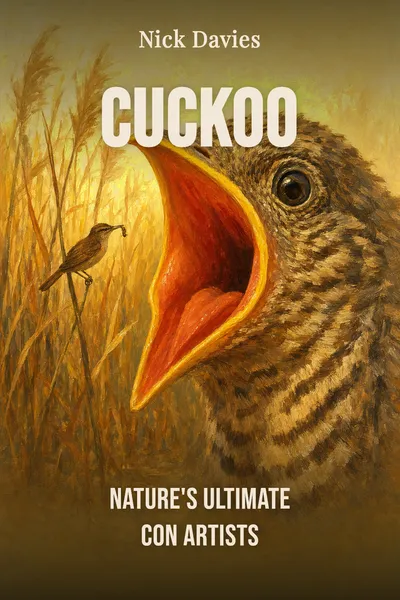
Cuckoo
Nature's ultimate con artists
Description
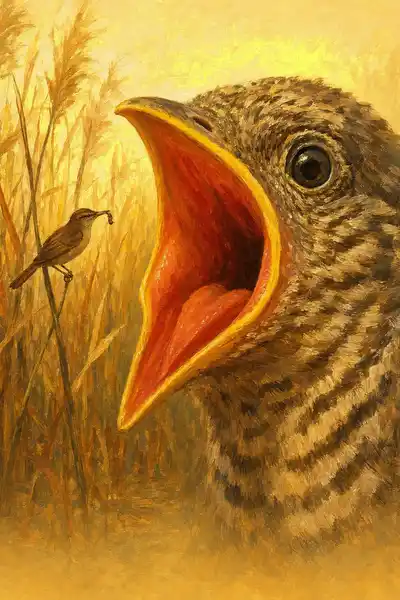
For nearly forty years, the biologist Nick Davies has spent his springs in the same place: Wicken Fen, a soggy stretch of reed bed in Cambridgeshire. He goes to watch a small brown warbler called the reed warbler, and the bird that has learned to cheat it. Every summer, a common cuckoo returns from central Africa, finds a reed warbler nest tucked low in the reeds, waits for the owners to look away, and in roughly ten seconds slips in, swallows one of the host's eggs, lays one of its own, and leaves. The whole heist is over before the warblers notice anything.
What the warblers get in return is a monster. The cuckoo chick hatches early, and while still blind and naked it heaves the host's own eggs out of the nest, one by one, until it is alone. Then it grows to several times the size of its foster parents, who wear themselves ragged feeding a chick that dwarfs them. It looks, to a human eye, like an obvious con. And yet the warblers keep falling for it, year after year, which is the puzzle Davies set out to understand with painted model eggs, stuffed cuckoos, and a great deal of patience in the mud.
His book turns that fieldwork into a portrait of one of nature's most accomplished swindlers — not a villain, but a specialist honed by a long, mutual struggle. Behind the trickery sits something stranger and more interesting than mere cruelty: two species locked together, each pushing the other to get cleverer. The cuckoo is only as good as its hosts force it to be.
The question we’re asking : How does a bird get away with dumping its young on strangers, generation after generation, and why don't the victims simply learn to refuse?What we’ll see : How one biologist decoded the cuckoo's con through decades of fieldwork, and what its tricks reveal about a struggle with no ending.
Table of contents
01 Chapter 1 — A researcher, a reed bed, and a fake egg
Davies's method is disarmingly simple. To find out what a reed warbler will and won't accept, you give it something it shouldn't. So he made model eggs — painted plaster and resin in every shade and pattern — and slipped them into nests to see which ones the owners tolerated and which they tossed. He set stuffed cuckoos beside nests to watch how the hosts reacted to a predator that isn't quite a predator. Over the seasons, thousands of small experiments accumulated into a picture of a relationship far more calculated than it first appears.
The first thing the fieldwork revealed was how deliberate the cuckoo's raid is. The female doesn't lay at random. She watches the reed bed for days, tracking which pairs are building and when they will start laying, because her egg has to arrive at exactly the right moment — too early and it's abandoned, too late and it won't hatch first. She lays in the afternoon, when hosts are least attentive, and she lays fast, in seconds, because lingering means being caught and mobbed.

02 Chapter 2 — The forgery in the nest
Once the cuckoo egg is in the nest, the contest shifts to the shell itself. If a reed warbler notices an egg that looks wrong, it will spear it, haul it out, or desert the whole clutch. So the cuckoo's counter-move is forgery: an egg that mimics the host's own closely enough to slip past inspection. Across Europe, the common cuckoo has split into distinct lines, each specializing in a particular host and each laying an egg tuned to match. The cuckoos that parasitize reed warblers lay greenish, spotted eggs; those that target redstarts lay plain blue ones. Same species, different forgeries.
Davies's model eggs pinned down just how sharp the hosts' eyes are. Reed warblers reject eggs that differ too much in color or markings, and they do it more readily when they've had reason to be suspicious. The mimicry, then, isn't a fixed trick but a response calibrated to exactly how picky each host has become. Where hosts inspect carefully, cuckoo eggs are near-perfect copies. Where a host barely checks — because cuckoos arrived too recently for it to have evolved any defense — the eggs can be sloppy, and the cuckoo gets away with it anyway.
03 Chapter 3 — The blind chick that plays a crowd
The strangest trick comes after hatching, and it's the one that troubled Darwin. Within hours of emerging, the cuckoo chick — blind, featherless, barely able to move — works host eggs and nestlings onto its hollow back and shoves them over the rim of the nest. It repeats this until it is the only occupant. That such a helpless creature performs so ruthless an act was one of the details that made Darwin uneasy about the cruelty built into nature. But the logic is plain: alone in the nest, the cuckoo commands all the food the foster parents can bring.
Then comes the problem of getting fed. A single cuckoo chick has to extract as much food as a whole brood of warbler young would have demanded, and it has to do it without a brood's worth of gaping mouths to trigger the parents. Davies and his colleagues found the solution in sound. The cuckoo chick begs with an astonishingly rapid call — a stream of cheeps that mimics not one chick but many hungry chicks at once. The warblers respond to the racket as though the nest were full, and work themselves into exhaustion feeding a single impostor.
04 Chapter 4 — The arms race that never ends
Step back from the reed bed and the cuckoo stops looking like a single clever cheat and starts looking like the visible edge of a much larger process. Every one of its tricks — the timed raid, the forged egg, the counterfeit begging call — exists because hosts have, at some point, built a defense against it. The stealth answers mobbing. The egg mimicry answers rejection. The multiplied begging call answers parents who might otherwise underfeed. The cuckoo is, in a sense, a museum of its hosts' past resistance, each adaptation a fossil of a defense it once had to overcome.
This is what makes the cuckoo such a clean illustration of coevolution — the idea that species don't evolve alone but drag each other forward, each becoming the selective pressure that shapes the other. Davies is careful to show that the race is uneven and unfinished. Some hosts are heavily defended; others, newly targeted, are almost naive. Populations move in and out of the fight as cuckoos switch hosts and hosts catch up. There is no equilibrium, no final settlement, just a contest that keeps shifting ground.
05 Conclusion
Every spring the cuckoo comes back to Wicken Fen, and every spring the reed warblers are waiting — a little warier than their ancestors, still not wary enough. The heist plays out again in its ten stealthy seconds, the forged egg settles into the clutch, the blind chick heaves out its rivals and cheeps like a crowd. Davies has watched it for the better part of a lifetime, and the fascination has never been in the cruelty. It's in the craft: a bird that reads its victims so precisely that its whole existence is an answer to their defenses.
Related books