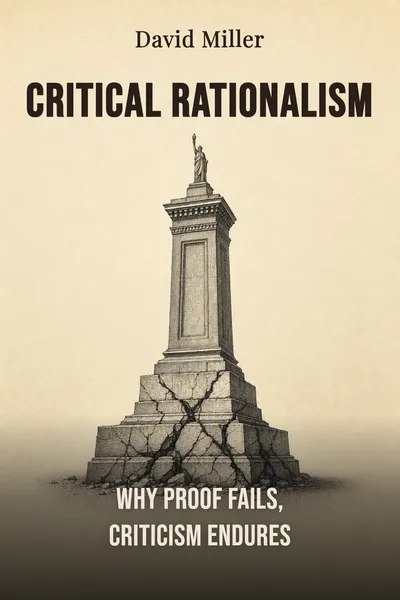
Critical Rationalism
Why proof fails, criticism endures
Description
In 1994, David Miller — one of the closest collaborators of the philosopher Karl Popper, and the man who helped edit some of his late work — published a book with a title that sounds like a manifesto and reads like a defense: Critical Rationalism. Miller had spent decades inside a tradition that most professional philosophers treated as a distinguished relic. Popper had died that same year, in London, at ninety-two, having spent his career arguing that we can never prove a scientific theory true, only expose it to the risk of being shown false. The idea had made him famous. It had also, by the 1990s, been declared answered, absorbed, or quietly buried by the mainstream theory of knowledge.
Miller's book was written against that consensus. It is not a gentle introduction and it is not a summary of Popper. It is a sustained, sometimes combative restatement of a claim most epistemologists had stopped taking seriously: that the whole project of justifying our beliefs — of finding good reasons that make them likely, probable, warranted, or secure — is a mistake from the ground up. Reason, on this view, does not build. It tears down. And what survives the tearing is all the knowledge we ever get.
That is a strange thing to hear, because it runs against how we normally talk. We ask for evidence. We say a claim is well-supported, that the data back it up, that we have grounds to believe. Miller wants to show that this ordinary language hides a broken promise, and that reason works better once we stop expecting the promise to be kept.
The question we’re asking : If no theory can ever be proven true or even made probable, what is left for reason to do?What we’ll see : How a philosophy built on refutation rather than proof answers its critics, and what it asks us to give up.
Table of contents
01 Chapter 1 — The oldest question, and a stubborn answer
The problem Miller starts from is ancient and embarrassingly simple. We believe a great many things — that the sun will rise, that water boils, that a bridge will hold. Where do we get the right to believe them? The traditional answer is justification: we have reasons, and good reasons make a belief rational. The trouble is that every reason itself rests on further beliefs, which need their own reasons, and so on. You either go on forever, or you argue in a circle, or you stop somewhere and simply assert. This trilemma is old, and most philosophy has spent its energy trying to soften the third option — to find a resting place that feels less like a raw assertion.
David Hume sharpened the knife in the eighteenth century. No matter how many times the sun has risen, nothing in logic forces it to rise tomorrow. Past cases cannot prove future ones, because the inference from observed to unobserved is exactly the thing in question. This is the problem of induction, and Miller treats it not as a puzzle to be dissolved but as a plain fact we have to live with. Induction, the move from evidence to a general conclusion, is invalid. There is no fixing it.

02 Chapter 2 — What justification never delivers
The core of Miller's argument is an attack, and it is aimed at a target almost everyone finds intuitive: the idea that evidence can raise the probability that a theory is true. This is the terrain of confirmation, of the notion that a well-tested law is more likely correct than an untested guess. Miller thinks this whole framework collapses under its own machinery, and he uses probability theory itself to show why.
A universal law — every metal expands when heated — makes an infinite number of claims, one for every piece of metal that ever was or will be. Any finite pile of evidence, however large, is a vanishingly small fraction of that. Run this through the mathematics of probability and the result is stark: the probability of a genuine universal law, given any finite evidence, is zero, and stays zero no matter how much evidence you add. You cannot inch toward certainty when the gap you are crossing is infinite. Confirmation, in the strict sense of making a theory more probable, simply does not happen.
03 Chapter 3 — Criticism does the work justification claimed to do
If justification is empty, something has to fill the space, or the whole thing slides into the relativism where any view is as good as any other. Miller's answer is that criticism does the real labor, and does it without ever needing to prove anything. We cannot show a theory is true, but we can often show it is false, or inconsistent, or in conflict with a rival that survives tests it does not. Refutation is logically clean in a way confirmation never is: a single genuine counterexample decides the matter, where no amount of positive instances ever settles it.
This asymmetry is the engine of the position. Falsifying a theory is a valid logical move — if the theory predicts X and we observe not-X, the theory is finished. Verifying it is not. So Miller reorients rationality around the thing that actually works. We do not ask what supports a belief; we ask what could refute it, and whether it has survived the trying. A claim that forbids nothing, that no possible observation could count against, is not admirably safe. It is empty, because it takes no risk.
04 Chapter 4 — When the ground itself is up for grabs
Step back from science for a moment and the deeper claim comes into view. Critical rationalism is, before it is a theory of physics or biology, a theory of what it means to be reasonable at all. And here Miller confronts the objection that has dogged the position since the beginning: is not critical rationalism itself just another belief, held without justification? If reason cannot justify anything, on what grounds does anyone commit to reason?
Popper had felt the force of this and conceded something remarkable — that the choice to be rational is, at bottom, a moral decision rather than a logically forced one. Miller pushes further and turns the objection into a feature. Critical rationalism does not exempt itself. It holds itself open to criticism like everything else; it survives because attempts to refute it keep failing, not because it has secured some foundation the other positions lack. A philosophy of criticism that claimed a justified starting point would be refuting itself in its first sentence. Its coherence lies precisely in refusing the exemption others quietly grant themselves.
05 Conclusion
Miller wrote his defense knowing it would find few takers among professional epistemologists, who had largely moved on to refining the very notions of support and warrant he was rejecting wholesale.
Related books