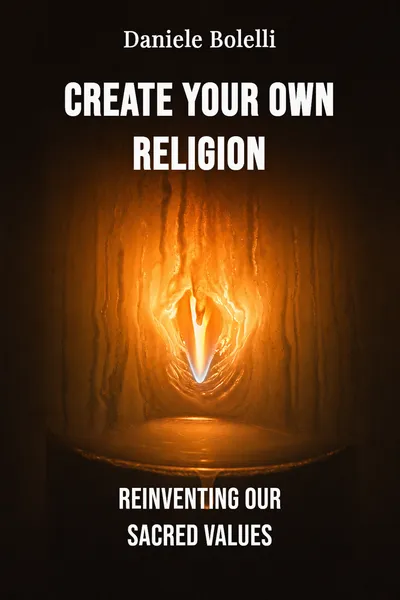
Create Your Own Religion
Reinventing our sacred values
Description
Daniele Bolelli teaches philosophy and history of religions in California, holds a black belt, and once made his living partly as a martial arts instructor — which tells you something about the tone of the book he published in 2013 under the title Create Your Own Religion. It is not a gentle interfaith seminar. It opens by pointing at the thing most people are quietly trained never to touch: the idea that the deepest values we live by, the ones we inherited without ever choosing them, might simply be wrong. Not incomplete. Not in need of a softer interpretation. Wrong, and worth throwing out.
The provocation in the title is deliberate, but it is not what it sounds like. Bolelli is not selling a starter kit for a new cult, robes and rituals included. His argument is narrower and stranger than that. He notices that across human history, an enormous share of our suffering — holy wars, guilt about the body, contempt for this world in favor of the next — comes not from bad people but from good people faithfully obeying values they never examined. His question is what happens if we stop treating those values as untouchable and start treating them as tools we are allowed to redesign.
The book moves through the big inheritances one by one — the nature of God, the fear of death, sexuality, morality, violence dressed up as righteousness — and asks the same rude question of each. Not "is this true?" so much as "does this actually help us live?" It is a book with a temper, and it wears its influences openly, from the Taoists to Nietzsche to a handful of Native American traditions. What it wants from the reader is not agreement. It wants participation.
The question we’re asking : What does it mean to build your own religion instead of inheriting one — and is that even a coherent thing to attempt?What we’ll see : How Bolelli takes the values we treat as sacred, holds each one up to the light, and asks whether it earns its keep.
Table of contents
01 Chapter 1 — The god who stopped answering questions
Bolelli begins where most people are told never to push: the concept of God itself. He has no interest in the tired debate between believers and atheists, which he finds mostly boring — two teams arguing about the existence of something neither can define. What interests him is the quiet damage done by a very particular idea of God: an all-knowing, all-powerful authority who hands down fixed commands, and whose word ends every conversation. The problem with that God, he argues, is not metaphysical. It is practical. He is a conversation-stopper.
Once a value is declared divine, it becomes unarguable. You cannot revise a commandment; you can only obey it or sin against it. Bolelli walks through the strange results — dietary rules from Bronze Age deserts still binding people millennia later, prohibitions on love between the wrong people, the sense that questioning is itself a kind of betrayal. The trouble, he says, is that a God who answers everything in advance leaves human beings with nothing to think about. Faith becomes a substitute for judgment rather than a support for it.

02 Chapter 2 — What certainty does to a mind
The second target is subtler than God, and in Bolelli's view more dangerous: certainty. He notices that the worst things people do in the name of religion are rarely done by the doubtful. They are done by the sure. The Crusader, the inquisitor, the suicide bomber all share one trait — a total confidence that they possess the truth and that everyone else is dangerously mistaken. Certainty, he argues, is the psychological engine behind most holy violence, and it is treated as a virtue precisely when it should be treated as a warning sign.
He is careful not to swing to the opposite error, the fashionable relativism that insists nothing is true and every belief is as good as any other. That, he thinks, is just certainty wearing a disguise — the certainty that certainty is impossible. What he wants is something harder: the willingness to hold strong convictions and act on them while remaining genuinely open to being wrong. He points to the scientific temperament as one model, not because science is holy but because it is one of the few human enterprises that treats being proven wrong as a success rather than a humiliation.
03 Chapter 3 — The values worth keeping, the ones worth burning
Having cleared the ground, Bolelli gets specific. He is not against religion wholesale — he insists on this repeatedly — and he refuses the smug posture of dismissing all of it as superstition. His method is closer to triage. Some inherited values are magnificent and worth defending fiercely. Others are toxic and should be abandoned without nostalgia. The task is to stop swallowing traditions as package deals and start evaluating their parts one at a time.
He devotes real attention to the body and sexuality, where he thinks the damage runs deepest. Large stretches of religious history, he argues, are built on a suspicion of physical pleasure and of the body as something shameful, a prison the soul must escape. He traces how contempt for this life in favor of an imagined next one produces people who are, in a precise sense, absent from their own existence — waiting to live rather than living. Against this he sets traditions that treat the body and the earth as sacred rather than as obstacles, and he clearly prefers them.
04 Chapter 4 — Religion as a verb, not a noun
Step back from the individual arguments and the shape of Bolelli's whole project comes into focus. His real quarrel is not with any particular belief but with the idea that belief is something you receive finished and then defend for life. He treats religion as most people treat a noun — a fixed object, an inheritance, a thing you belong to. He wants it treated as a verb: something you do, badly and then better, an ongoing act rather than a settled possession.
This reframes the provocative title. "Create your own religion" is not an invitation to grandiosity, to declare yourself a prophet and gather followers. It is closer to a demand for authorship over your own inner life — the recognition that whether you notice it or not, you are already choosing which values to live by, and that pretending otherwise just means someone else is choosing for you. The only question is whether that authorship is conscious or borrowed on autopilot.
05 Conclusion
Bolelli ends more or less where he began: pointing at the values we were trained never to touch and insisting, again, that we are allowed to touch them. The book closes without a doctrine, which is the point — a manual for building your own religion that handed you a finished religion would have refuted itself on the last page. What he leaves instead is a posture. Hold your convictions strongly, examine them honestly, revise them without shame, and refuse to let anyone convince you that questioning the sacred is the same as destroying it.
Related books