Cradle to Cradle
Design without waste
Description
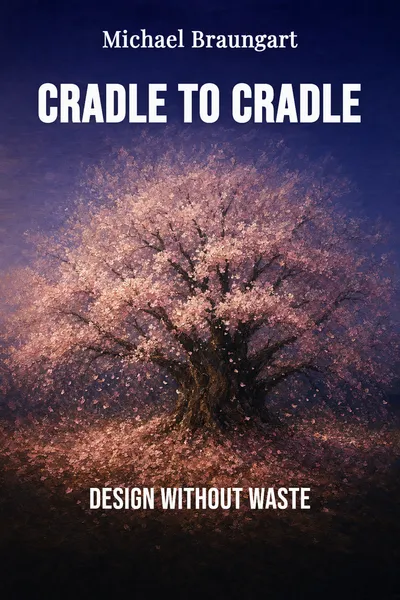
Picture a cherry tree in April. It throws off thousands of blossoms, far more than will ever become fruit, and most of them fall to the ground and rot. By any factory accounting sheet this is grotesque waste — a wildly inefficient use of resources. And yet nobody looks at a cherry tree in bloom and thinks it should tighten up its numbers. The fallen blossoms feed the soil, the insects, the microbes; nothing is thrown away because in that system there is no such place as away. This is the image the chemist Michael Braungart and the architect William McDonough put at the front of their 2002 book Cradle to Cradle, and it is doing a lot of work.
The book was itself an object lesson. It was printed not on paper but on a synthetic made from plastic resins and inorganic fillers — waterproof, durably recyclable, designed to be unmade and remade rather than pulped. The gesture was pointed. For thirty years, mainstream environmentalism had been asking us to consume less, drive less, use less, feel worse. Braungart, who came out of Greenpeace's chemistry work in the 1980s, and McDonough, who designs buildings, thought that entire framing was the problem — not the solution running slightly behind schedule.
Their claim is blunt: the modern industrial system was never designed at all. It grew, and it grew badly, on the assumption that the planet was an infinite supply cupboard and a bottomless bin. Reducing the damage, they argue, still points the whole machine at the same destination, just more slowly. What if we designed things, from the first sketch, so that they had nowhere harmful to end up?
The question we’re asking : What if the goal of good design were not to do less harm, but to do positive good — to make things the way a cherry tree makes blossoms?What we’ll see : How two men from chemistry and architecture rebuilt the logic of manufacture around a single idea, and what it asks of the whole environmental project.
Table of contents
01 Chapter 1 — The cherry tree, not the guilt trip
Braungart and McDonough open by taking apart a word most of us treat as obviously good: efficiency. The efficient factory, the efficient engine, the efficient household — these are the heroes of conventional green thinking. Their objection is that efficiency only tells you to do the same thing with less. If the thing itself is badly conceived — a product that sheds toxins, a building that poisons its own air — then making it efficiently just means producing the harm more cheaply and at greater scale. Efficiency, they write, is a way of being less bad, and less bad is not good. It is a slower road to the same place.
Behind this sits a diagnosis of the entire industrial model, which they call cradle to grave. A material is dug up, turned into something, used briefly, and thrown away. Roughly ninety percent of the stuff pulled through the system, by their reckoning, becomes waste within a few months. The grave is a landfill or an incinerator, and the design brief never once considered what happens after the customer is done. The product was built to be discarded, even when it was built to be recycled — because most recycling, they argue, is really downcycling, a slide toward lower-grade uses.

02 Chapter 2 — Waste equals food
The core principle of the book fits in three words: waste equals food. In a cherry tree, in a forest, in any living system, the output of one process is the input of the next. There is no leftover. Braungart and McDonough want manufactured goods to obey the same rule — every material in a product should become nourishment for something afterward, either for the living world or for industry itself.
The trouble is that today most products are hybrids, and messy ones. A running shoe blends leather, rubber, foams and glues so thoroughly that none of it can be recovered cleanly; a car seat combines fabrics and metals and coatings that can only be shredded together. These are what the authors call monstrous hybrids — objects fused so tightly that their materials can never go back to being food for anything. They end up downcycled into something worse, or buried, or burned. The problem is not that we throw them away. The problem is that they were never designed to come apart.
03 Chapter 3 — One material, two metabolisms
To make waste-equals-food practical, Braungart and McDonough split the material world in two. There is the biological metabolism — the cycle of living things, soil, water, growth and decay. And there is the technical metabolism — the closed loop of industrial materials like metals and durable polymers that never came from nature and should never be returned to it. A well-designed product belongs cleanly to one cycle or the other. It should never mix them in a way that traps its materials in neither.
Some things are meant to be consumed. A shoe sole, a shampoo, a packaging film, the fibres that rub off a carpet — these are biological nutrients, and they should be made so that when they wear out or are discarded, they compost back into the earth without poisoning it. The design goal for such products is that they safely disappear. Others are meant to last and then be reclaimed: a television, an engine, a washing machine. These are technical nutrients, and the aim is that the manufacturer takes the object back at the end of its life and recovers the materials at full quality, again and again.
04 Chapter 4 — Abundance, not less
Step back and the argument of Cradle to Cradle turns out to be less about recycling than about a whole disposition toward the world. Braungart and McDonough are pushing against a mood that had defined environmentalism for a generation: the sense that the earth is small, resources are running out, and the honest response is restraint. Fewer children, fewer flights, smaller footprints, human presence treated as a stain to be minimised. The best you could hope for, under that view, was to do less harm before you left.
Their counter is that a world designed on cradle-to-cradle principles has no reason to fear human abundance. A tree is not a burden on its ecosystem; it is a contributor. If our products fed the soil or fed industry the way blossoms feed the ground, then more of them would mean more nourishment circulating, not more damage accumulating. The question shifts from how do we shrink our impact to what kind of impact do we want to have. That reframing is the real payload of the book — the technical schemes are downstream of it.
05 Conclusion
The book that was printed on plastic so it could be unmade and remade was making its whole case in a single object. Cradle to Cradle asks us to stop admiring the cherry tree from a distance and start building like it — designing every product from the first line so that its ending is already accounted for, either as soil or as salvaged industrial stock. Waste, in this account, is not an unfortunate by-product to be minimised. It is evidence of a design that was never finished thinking.
Related books