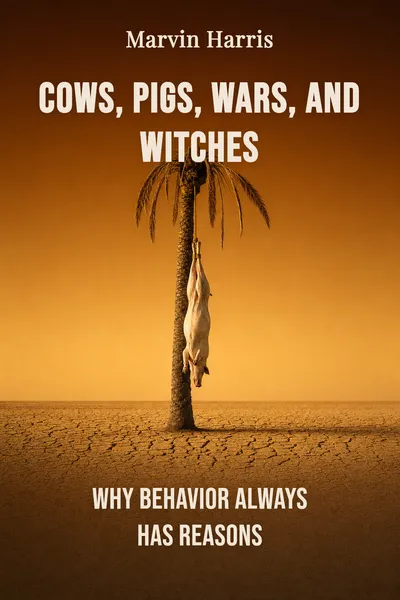
Cows, Pigs, Wars, and Witches
Why behavior always has reasons
Description
In the late 1960s and early 1970s, a certain mood had taken hold: change your head, and the world will follow. Consciousness-raising, mystical revival, the sense that reality was mostly a matter of perception. Into that mood, in 1974, the American anthropologist Marvin Harris published a slim, combative book with an unforgettable title — Cows, Pigs, Wars, and Witches — and argued something almost rude by comparison. Riddles that look like pure irrationality, he said, are not riddles of the mind at all. They are answers to problems of food, land, protein, and power.
Harris took the cases that Westerners love to file under "exotic superstition." Why do millions of hungry Indians refuse to eat their cattle? Why did Middle Eastern peoples turn against the pig? Why did some tribes eat their enemies while others merely fought them? Why did Europe, at a moment of crisis, decide the problem was witches? In each case the standard explanation reached for belief, tradition, or the mysteries of the human spirit. Harris reached instead for the ledger — what a practice costs, what it yields, who ends up better fed and who ends up blamed.
The method has a name he gave it: cultural materialism. It is unglamorous on purpose. It refuses to treat a custom as sacred, senseless, or self-explaining, and insists that behind even the strangest habit lies a set of concrete conditions that made it, at some point, the practical thing to do. That refusal is also an argument — against a whole generation of thinkers who promised liberation through altered awareness.
The question we’re asking : If a custom looks completely irrational, what happens when we stop asking what people believe and start asking what the practice actually costs and yields?What we’ll see : How Harris runs the same unsentimental accounting through sacred cows, forbidden pigs, tribal war, and witch-hunts — and why he turns it on the counterculture itself.
Table of contents
01Chapter 1 — The sacred cow that pays its own way
Start with the image everyone thinks they understand: gaunt cattle wandering Indian streets while people go hungry, protected by a religion that would rather worship a cow than cook one. To the Western eye this is superstition winning out over common sense — a textbook case of belief defeating survival. Harris asks a blunter question. What would actually happen if the ban lifted and the cows were eaten? His answer is that the famine everyone imagines the taboo causes is closer to the famine the taboo prevents.
The Indian zebu, he points out, is not raised for meat and never was. It is a working animal. Oxen pull the plows on tens of millions of small farms too poor to own a tractor or the fuel to run one. A farmer who slaughters his cattle in a bad year eats for a few weeks and then has nothing to plow with when the rains return — he has traded next year's harvest for one meal. The taboo, in Harris's reading, is a rule that stops desperate people from making a catastrophic short-term choice.

02Chapter 2 — A pig too costly to keep
The pig taboo of Judaism and Islam is usually explained one of two ways. Either it was a health rule — the ancients somehow intuited trichinosis — or it was arbitrary, a line drawn to mark a people off from its neighbors. Harris finds both unsatisfying. The health argument fails because plenty of animals people happily ate carried worse diseases, and no one banned them; nobody in the Bronze Age was diagnosing parasites. And pure arbitrariness explains nothing, because you still have to ask why this animal and not another.
His account is ecological. The pig is a creature of forest and shade; it does not sweat, cannot graze grass, and needs to wallow in water to stay cool. It thrives where there are woods and moisture and food it does not compete with humans for. The Middle East, as it dried out and deforested under growing populations, became close to the worst place on earth to raise one. A pig there had to be fed grain and shade and water that people needed for themselves — it competed directly with its own keepers.
03Chapter 3 — Cannibals, war, and the arithmetic of protein
Harris turns next to the practices that resist economic reading most fiercely: warfare and cannibalism. Surely these are about honor, bloodlust, the dark side of human nature — the very things that no ledger can touch. He is not convinced. Primitive war, he argues, is not the pointless savagery of legend but a mechanism, and like the food taboos it does real work under conditions people rarely name aloud.
Chronic small-scale warfare among tribal peoples, in his reading, functions to disperse populations and keep them from pressing too hard on a fragile environment. It creates unpopulated buffer zones between hostile groups where game can recover, and — more disturbingly — it props up the value placed on fierce sons over daughters, encouraging the neglect and selective survival that hold population growth in check. The war is not caused by aggression; the aggression is cultivated because it does something.
04Chapter 4 — The witch and who profits from the fear
The final riddle brings Harris home to Europe, and to a case where his method turns openly political. The great witch-hunts of the sixteenth and seventeenth centuries killed tens of thousands of people, mostly poor women, on charges of consorting with the devil. Why would societies in genuine crisis — war, plague, inequality, peasant revolt — spend their energy hunting imaginary night-fliers? Harris's answer is that the hunt was not a distraction from the crisis. It was a use of it.
A population furious at landlords, clergy, and princes is dangerous. A population convinced that its suffering comes from witches in the next village is not. The witch craze, in Harris's reading, redirected explosive social discontent downward and sideways, onto the powerless, and away from the people who actually controlled land and wealth. It individualized a structural catastrophe: your misery is not the system, it is your neighbor's pact with Satan. The Church and the state did not have to plan this cynically for it to serve them.
05Conclusion
Come back to the cow in the road, chewing its scraps while a Western observer shakes his head at all that wasted beef. Harris has spent the book teaching us to distrust our own head-shaking. The cow, the forbidden pig, the endless tribal skirmish, the sacrificed captive, the burned woman — none of them yields to the explanation we reach for first, which is that other people are irrational and we are not. Each yields instead to a patient question about land, protein, labor, and who ends up better off. The strangeness dissolves; the reasons remain.
Related books