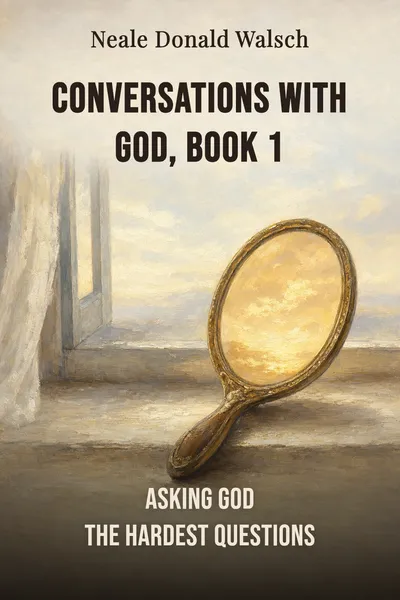
Conversations with God, Book 1
Asking God the hardest questions
Description
In the early 1990s, a man in Ashland, Oregon, was going through what he later called the worst stretch of his life. Neale Donald Walsch was in his mid-forties, recently divorced, out of steady work after a car accident, living for a while in a tent and collecting cans for the deposit. One sleepless night he did what plenty of us do in the dark — he started an angry letter. He grabbed a yellow legal pad and wrote out his grievances to God, the accusatory kind: why does my life keep falling apart, what does it take, what am I doing wrong. And then, he says, something answered.
That answer became Conversations with God, Book 1, published in 1995. Walsch presents the entire book as a transcript: he writes a question, a voice writes back through his own hand, and he keeps the pen moving. The format is disarmingly plain. No pulpit, no doctrine, no thou-shalt. Just a bruised man asking the questions people usually only mutter, and a patient interlocutor answering them in ordinary, almost conversational English. The book sat on the New York Times bestseller list for years and sold in the millions, in dozens of languages.
What makes it worth slowing down over is not whether the voice was really God — Walsch himself sidesteps that fight — but what the questions and answers actually are. This is a book built entirely around the hardest things we ask when no one is listening: about love, fear, death, right and wrong, and why suffering exists at all. It reads less like scripture handed down than like a long night of talking something through.
The question we’re asking : When we put our most unanswerable questions to God directly, what kind of God answers back — and what does the answer ask of us?What we’ll see : How a broke, furious man's late-night letter turned into a dialogue that reframes God less as a lawgiver than as a mirror.
Table of contents
01Chapter 1 — A pen, a legal pad, and a fight with the sky
Walsch is careful about how the conversation begins, because the beginning is the whole method. He isn't meditating, chanting, or waiting on a mountaintop. He's furious. The first thing he writes down is essentially a complaint: he has done the things you're supposed to do, he has tried, and life keeps handing him wreckage. The tone matters because the book's opening claim is that this is exactly the state in which we reach honesty. Politeness with God tends to be performance. Rage, at least, is real.
The response, as he records it, doesn't scold him for the rage. It welcomes the questions and then makes an unsettling move: it tells him that all of us are in communication with God all the time, and that most of what we call intuition, inspiration, or the sudden right thought is that communication, unrecognized. The rare thing, on this account, is not that God speaks. The rare thing is that someone sits still long enough, and writes fast enough, to catch what comes back without editing it into what they expected to hear.

02Chapter 2 — The answer that reverses every question
The core of Book 1 is a single reversal that Walsch keeps circling back to: the idea that there is nothing to earn, because there is no separation to bridge. In the picture the book paints, God is not a distant sovereign we must please, but the ground of everything, expressing itself through each of us. We are, in the book's phrase, God experiencing God. That sounds abstract until the voice applies it to the questions Walsch actually asked, and then it lands with some force.
Take right and wrong. The book declines to hand over a moral code. Instead it reframes every choice as a statement about who you decide to be. There are no divine punishments waiting, it argues, only the natural consequences of choices, the way fire is hot without fire being cruel. What we call sin is mostly misunderstanding — acting from fear rather than from love. And fear, in this telling, is the one great opponent. Every destructive act traces back to it; every generous one traces back to love. The whole of ethics collapses into a single ongoing decision between the two.
03Chapter 3 — What we call God, and why we keep looking away
If the answers are so available, the obvious question is why we don't hear them. Book 1 spends real energy on this, and its diagnosis is that we have built a God we can't stand to listen to. We imagine a being who needs our worship, punishes our failures, and plays favorites among nations and faiths. Such a God is useful for controlling behavior and useless for honest conversation. Walsch's interlocutor spends much of the book quietly taking that figure apart, insisting it is a human invention projected onto the sky.
The replacement it offers is a God with no requirements. It does not need praise, cannot be offended, and has no stake in whether we believe in it correctly. That's a genuinely destabilizing idea for anyone raised on obligation. If God asks nothing, what holds a life together? The book's answer is that meaning was never supposed to come from meeting external demands. It comes from choosing, moment by moment, the grandest version of who we might be — a phrase Walsch returns to like a refrain.
04Chapter 4 — Reading a bestseller as a self-portrait
Step back from the specific answers and a larger fact about the book comes into view: its enormous success says as much as its content does. Millions of people, across faiths and none, bought a book that presents God as saying, in effect, that there are no rules, no judgment, and nothing to earn. That is not the God of most sermons. The appetite Conversations with God fed was for a divinity who explains rather than commands — who sits across the table instead of looming over the altar. The book arrived at a moment when a lot of Western readers had drifted from institutional religion but not from the questions religion used to hold.
This helps explain both the devotion and the suspicion the book attracts. Critics point out, reasonably, that a God who agrees with your instincts, flatters your autonomy, and demands nothing is suspiciously convenient — the very self-portrait a bruised, self-help-era reader might paint. Walsch's method, writing down whatever comes and calling it divine, offers no way to test that objection. The book's warmest defenders and its sharpest doubters are often looking at the same page and disagreeing only about the source of the voice.
05Conclusion
The book ends more or less where it began — with a man and a pen, having talked himself, or been talked, out of the corner he started in. Walsch went from a tent and a stack of cans to the author of a series translated worldwide, and the first volume remains the one people reach for, because it's the one where the questions are freshest and the answers still feel wrested out of genuine distress. It never resolves the thing that would seem to matter most, whether the second voice was God or Neale, and it treats that ambiguity as a feature rather than a flaw.
Related books