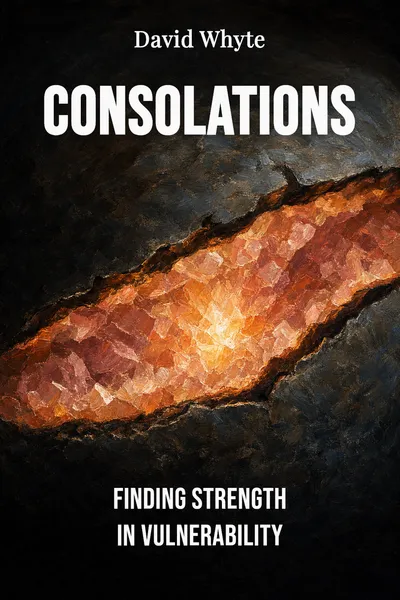
Consolations
Finding strength in vulnerability
Description
David Whyte is a poet who spent years leading corporate retreats, standing in front of rooms full of executives and asking them to think about words like courage and honesty as if they had never really heard them before. Out of that work came a small book, published in 2015, called Consolations. Its subtitle promised something oddly specific: the solace, nourishment and underlying meaning of everyday words. Fifty-two of them, from alone to work, each given a few pages of prose that reads less like a definition and more like a slow conversation about what the word costs to live.
The premise sounds modest, almost like a novelty. A glossary of feelings. But Whyte's wager is larger than that. He believes we have inherited these words secondhand, worn smooth by overuse, and that most of them have been quietly falsified. Vulnerability, in the version we've absorbed, is a wound to be hidden. Ambition is a virtue to be flaunted. Whyte takes each word back to something closer to its lived truth, and the reversals can be startling. Vulnerability, he writes, is not a weakness we can choose to leave behind. It is the one constant we can never fully step out of.
That single move — turning a word we've been taught to fear into the very thing that makes us human — runs through the whole book. It's what makes Consolations feel less like a reference work and more like being talked through the harder parts of a life by someone unusually patient. And it raises a quieter question about why a poet would spend a book rehabilitating ordinary language at all.
The question we’re asking : How does a book of short reflections on everyday words end up reframing vulnerability, grief and belonging as sources of strength rather than things to be managed away?What we’ll see : We follow Whyte from the shape of the book itself down into the words he treats most tenderly, and out to what his whole quiet project is really arguing.
Table of contents
01 Chapter 1 — The book that redefines the words we use
Consolations doesn't read like anything in the self-improvement aisle. There are no steps, no exercises, no promises that we'll feel better by Friday. Instead there are fifty-two short essays, arranged alphabetically, each one taking a single familiar word and turning it slowly in the light. Whyte lands on Alone, Anger, Beginning, Denial, Forgiveness, Hiding, Maturity, Regret, Vulnerability. Words we use every day without thinking. His method is to stop and think about them, at length, as if each one were a small country we'd been passing through without ever learning the language.
What holds the pieces together is Whyte's conviction that these words have been misread. We treat most of them as either praise or accusation — courage good, denial bad, ambition admirable, regret shameful. Whyte refuses the scorecard. He tends to find, inside each word, a paradox that the everyday usage has flattened out. Denial, he suggests, is not simply a failure to face reality; it can be a necessary mercy, the mind's way of buying time until we're strong enough to see clearly. Regret, handled well, becomes a form of tenderness toward the person we used to be.

02 Chapter 2 — Vulnerability as the ground we stand on
Whyte's entry on vulnerability is the hinge of the book, and it does something counterintuitive. Most of the culture treats vulnerability as a state we occasionally fall into — an exposure, a risk, a soft spot to be armoured over as soon as possible. Whyte argues the opposite. Vulnerability, he writes, is not a temporary condition. It is the underlying, ever-present and abiding nature of our existence. We do not enter and leave it. We live inside it always, whether we admit it or not.
The strength he finds there follows directly from that reframing. If vulnerability is not a weakness but simply the truth of being alive — mortal, changeable, dependent on others — then trying to eliminate it isn't strength at all. It's a kind of pretending, an exhausting refusal of reality. The person who admits they can be hurt, who lets themselves be seen and moved and changed, is not the weaker one. They are the one living in contact with what is actually happening. The armour, in Whyte's account, is what makes us brittle.
03 Chapter 3 — Grief, longing, and the words for what hurts
When Whyte turns to grief, he refuses the language of recovery. Grief is not a problem to be solved or a phase to be completed on schedule. In his reading, grief is the internal experience of finding ourselves changed by love — a measure, not of how much we've lost, but of how much we belonged to what is now gone. To grieve deeply is to have loved deeply, and the two cannot be pulled apart. He treats the attempt to move on quickly as a kind of second loss, a way of abandoning the person we mourned a second time.
What he offers instead is integration. The point is not to get over the sorrow but to let it enter and reshape us, to carry it in a way that keeps faith with what mattered. Whyte writes about heartbreak in the same spirit — as something that is not an accident or a failure of a relationship but almost its natural culmination, the price of having cared enough to be changed. Heartbreak, he suggests, is unpreventable for anyone who commits to anything at all. It is the shadow cast by full participation in a life.
04 Chapter 4 — Why the dictionary was never neutral
Step back from any single entry and Whyte's larger argument comes into view. It's a claim about language itself: that the words we inherit are not neutral containers but instructions for how to feel. When a culture teaches us that vulnerability means weakness, it isn't describing reality — it's issuing a quiet command about what to hide. When it treats grief as a problem with a timeline, it's shaping in advance how long we're permitted to hurt. We think we're using words. Whyte's suggestion is that, more often, the words are using us.
This is why Consolations takes the form it does. A poet spending a whole book on fifty-two everyday words is not writing a glossary; he's performing an act of repair. Each entry pries a word loose from its worn-down meaning and returns it to something closer to lived experience. And because so many of these words concern our hardest moments — anger, denial, regret, heartbreak — the repair is not academic. To be handed a truer word for grief is to be given permission to grieve differently. The reframing changes what we're able to bear.
05 Conclusion
Whyte came to this book by way of the retreat room and the road, years of watching capable people flinch at words like courage and honesty as if they were being asked to do something impossible. Consolations is the answer he arrived at: not advice, but a slow rehabilitation of the language we already carry. Fifty-two words, each returned to a truer weight, so that the ones we'd learned to fear — vulnerability, grief, regret, heartbreak — stop reading as verdicts against us and start reading as the marks of a life fully entered.
Related books