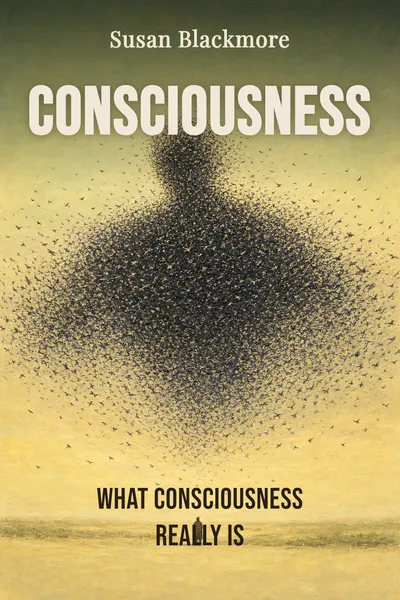
Consciousness
What consciousness really is
Description
Right now, as these words go in, something is happening that nobody can fully account for. There is a taste in the mouth, a hum somewhere in the room, the faint pressure of a chair. All of it is being experienced by, apparently, someone — you. That last part sounds like the safest fact in the world. Susan Blackmore, a psychologist who spent decades chasing this exact intuition through parapsychology, neuroscience and long hours on a meditation cushion, thinks it might be the shakiest. Her short book Consciousness circles one deceptively simple riddle: what is it, really, that has all these experiences?
The trouble starts the moment we try to answer. We know, roughly, how light hits the retina and how signals travel to the visual cortex. We can watch neurons fire on a scanner. But none of that explains why there is something it is like to see red rather than just processing a wavelength. The philosopher David Chalmers gave this gap a name in the 1990s — the hard problem — and it has refused to close. Blackmore's move is not to solve it head-on but to keep pressing on the assumptions hidden inside the question, until some of them start to give way.
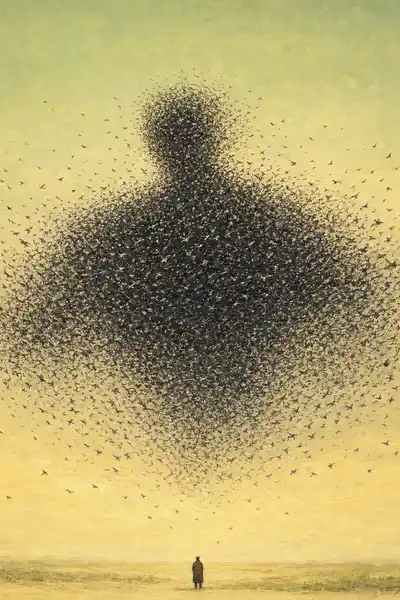
What makes her a useful guide is that she doesn't flinch from where the evidence leads, even when it points somewhere unsettling. Consciousness, in her telling, is not a cozy inner theater with us seated in the front row. It's something stranger, more distributed, and harder to locate than anyone comfortable would like. She spent years trying to prove there was a soul-like self that could leave the body. She came back convinced of almost the opposite.
The question we’re asking : What is the thing that has our experiences — and is there really a single self at the center of them at all?What we’ll see : How the science and philosophy of consciousness keep dismantling the one thing we were most sure of: that someone is home.
Table of contents
01Chapter 1 — The hard problem nobody can shake
Blackmore opens where every honest account of consciousness has to open: with the fact that we cannot even agree on what needs explaining. There are the easy problems — how the brain discriminates a smell, directs attention, controls behavior. These are hard in the everyday sense, requiring enormous work, but they are the kind of thing science knows how to chip away at. Then there is the other one. Why is any of this accompanied by experience? Why isn't the brain just a very good machine, doing its business in the dark, with nobody inside to feel it?
This is what Chalmers called the hard problem, and Blackmore treats it as the axis the whole subject turns on. The temptation is to imagine a philosophical zombie — a being physically identical to us, processing everything we process, yet with the lights entirely off, no inner life at all. If such a thing is even conceivable, then experience seems to be something extra, floating above the physical facts. And if it's extra, science is stuck, because science deals in physical facts.

02Chapter 2 — What the brain does when we look for the self
Follow consciousness into the laboratory and it starts to fragment in ways that trouble the tidy picture. Blackmore walks through the classic findings of neuroscience and cognitive psychology, and the pattern is consistent: wherever we expect to find a central controller, we find instead a crowd of parallel processes with nobody obviously in charge. Split-brain patients, whose two hemispheres have been surgically disconnected, can behave as though two separate agents share one skull — one hand buttoning a shirt while the other tries to unbutton it. If the self were one indivisible thing, this shouldn't be possible.
Then there is timing. In the 1980s, Benjamin Libet ran experiments suggesting that the brain begins preparing a movement a fraction of a second before we're aware of deciding to make it. The readiness potential comes first; the conscious intention arrives late, as if narrating a decision already underway. Blackmore is careful about how much this proves — the interpretation is fiercely contested — but she uses it to loosen our grip on the idea that a conscious self initiates our actions from some command center.
03Chapter 3 — The grand illusion of the stream
The phrase Blackmore keeps returning to is the grand illusion. Not that consciousness doesn't exist — clearly something is going on — but that its most obvious features may be misleading. We assume there is a continuous stream of experience, flowing along whether or not anyone asks about it, with a definite content at every instant. Blackmore's provocation is to ask how we know. The only evidence we ever have is what shows up the moment we turn and look. And perhaps the looking is what creates the content, rather than catching a stream that was already running.
She tests this against altered states, where the ordinary sense of a single continuous self comes apart most visibly. In dreams, the narrator is unreliable and the world reassembles itself scene by scene; on waking we stitch it into a story that was never that coherent. Under psychedelics, the boundary between self and world can dissolve entirely, which tells us that boundary was a construction all along, not a fixed fact of nature. In deep meditation, practitioners report attention resting without any felt center doing the attending — no watcher, just watching.
04Chapter 4 — Machines, meditation, and the vanishing I
Step back from the experiments and a bolder claim comes into focus, the one the whole book has been building toward. Blackmore's wager is that consciousness may not be a thing to be explained so much as a question that dissolves once we stop assuming there is someone at the center having the experiences. The hard problem felt impossible because it asked how the physical brain produces an inner life for the self. Remove the self as a separate recipient, and the shape of the problem changes. There is no ghost to be located, no theater to be lit — only a brain modeling a world, and, as part of that model, modeling a self who seems to be watching.
She presses the same logic onto machines. If consciousness were an extra ingredient, we could ask whether a sufficiently clever robot had been given it or left out. But if it's the kind of self-model a complex system spins up while making sense of itself, then the question of whether a future machine is 'really' conscious may be no more answerable — and no more meaningful — than the same question about us. Blackmore doesn't promise that artificial minds will crack the puzzle. She suggests instead that building them might force us to admit the puzzle was malformed, that we were always demanding a fact of the matter where there isn't one.
05Conclusion
Blackmore began, decades ago, hoping to prove there was a self solid enough to slip free of the body and survive it. The evidence took her the other way. What she found, in the scanners and the split-brain studies and the long silences of practice, was not a self growing more distinct under scrutiny but one that thinned out the harder she looked. The book she wrote is honest about leaving the hard problem unsolved. Its move is subtler: to show that the problem may be shaped by an assumption — that experiences must belong to an experiencer — which the facts don't oblige us to keep.
Related books