
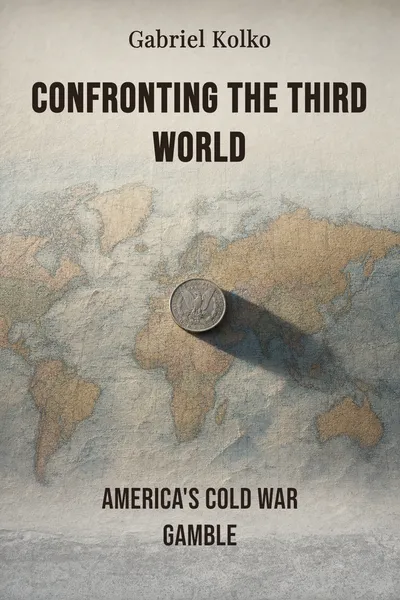
Confronting the Third World
America's Cold War gamble
Description
In 1945, the United States emerged from the Second World War with something no nation had ever quite held: roughly half the world's manufacturing output, most of its gold reserves, and a navy that ranged across every ocean. The colonial empires that had carved up Asia and Africa were cracking. Britain, France, and the Netherlands were exhausted, their grip on their possessions loosening by the year. Into that opening walked American planners who believed, with real conviction, that the postwar world could be organized on terms favorable to open trade, private investment, and stability. What they were less prepared for was the sheer number of people who wanted something else.
The historian Gabriel Kolko spent much of his career arguing that what followed was not a series of improvised responses to Soviet threats, but a coherent project with its own internal logic. In "Confronting the Third World," he traces how Washington approached the vast arc of newly independent and soon-to-be-independent nations across Asia, Africa, and Latin America. His claim is uncomfortable and deliberate: that American policy toward these countries was driven less by the fear of communism than by a determination to keep the global economy structured in ways the United States could live with.
It is a revisionist account, and it reads against the grain of the official story most Americans grew up with. Kolko does not treat the Cold War as a morality play between freedom and tyranny. He treats it as a question of who would set the rules for two-thirds of humanity, and at what cost to the people living there. The book is dense with cases, but the argument beneath them is singular and worth following on its own terms.
The question we’re asking : Why did the United States, having declared itself the champion of self-determination, so often end up on the side of those resisting it?What we’ll see : How a superpower came to define its own security through the internal affairs of distant, poorer nations — and what that cost.
Table of contents
01Chapter 1 — The world America decided to manage
The term "Third World" was coined in the early 1950s to name the countries that belonged to neither the Western bloc nor the Soviet one — the nonaligned, the newly independent, the still-colonized. For Kolko, the category matters less as geography than as a problem American planners set for themselves. These were the places where the postwar order was genuinely unsettled, where the shape of the future had not yet been decided, and where the United States believed it had both the right and the obligation to weigh in.
Kolko's starting point is that Washington saw these nations not primarily as sovereign actors but as pieces of a larger economic and strategic system. Their raw materials mattered — the oil, the tin, the rubber, the minerals that fed industrial economies. Their markets mattered. Their alignment mattered, in the sense that a country tilting toward economic nationalism or land reform or the nationalization of foreign holdings was, in this reading, a country stepping outside the system the United States wanted to preserve.

02Chapter 2 — Where the numbers came from
A central move in Kolko's argument is to insist that economic interest was not incidental to Cold War policy but foundational. He devotes considerable attention to what American exports, investments, and access to raw materials actually depended on, and to how planners themselves described those dependencies in their own memoranda. The point is not that individual officials were greedy. It is that the machinery of policy was built to serve a particular vision of a functioning world economy, one in which capital could move, resources could be extracted, and no large region would opt out.
In this framework, the Soviet Union was real but often secondary. Kolko does not deny Moscow's ambitions or the genuine rivalry between the two powers. What he questions is the automatic assumption that every disturbance in the Third World was a Soviet operation. A peasant revolt over land, a government nationalizing a foreign-owned company, a leader refusing to grant military bases — these were frequently local phenomena with local causes. But they were repeatedly read through the single lens of the global struggle, and that reading turned domestic reformers into presumed agents of an external enemy.
03Chapter 3 — Guatemala, Iran, and the reflex of intervention
The abstractions become concrete in the cases, and two from the 1950s do much of the work in Kolko's argument. In Iran in 1953, the elected government of Mohammad Mossadegh had nationalized the country's oil industry, previously controlled by a British company. In Guatemala in 1954, the government of Jacobo Arbenz had begun expropriating unused land held by the United Fruit Company as part of an agrarian reform. In both cases, the United States helped orchestrate the removal of the government in question. In both, the language of anticommunism supplied the public rationale.
For Kolko, these are not aberrations but demonstrations. Neither Mossadegh nor Arbenz was a Soviet instrument. Both were nationalists pursuing policies with strong domestic support, aimed at recovering national control over resources that foreign firms had long dominated. What they threatened was not American security in any literal sense but a principle: that governments could reorganize property and challenge foreign holdings without consequence. The interventions answered that threat directly, and the fact that both succeeded, in the short term, made the reflex easier to repeat.
04Chapter 4 — Order as the only doctrine
Step back from the individual coups and alliances, and Kolko's larger point comes into view: what he is describing is what happens when a great power makes stability, rather than any positive vision, the organizing aim of its foreign policy. The United States did not, in his reading, set out to build particular societies in the Third World. It set out to prevent certain outcomes — expropriation, realignment, economic experiments it could not control. The goal was negative and defensive, and a negative goal tends to make you the ally of whoever can deliver order, regardless of what that order contains.
This is where Kolko's account reaches beyond the specifics of the Cold War. A policy built around preventing change will nearly always find itself opposing the people who want change, and in poor countries emerging from colonial rule, that meant opposing majorities. The commitment to a stable global system, sincere as it may have been, carried a hidden bias: it treated the existing distribution of wealth and power as the baseline to be defended, and thereby treated most demands for redistribution as disorder. The neutrality of "stability" was, in practice, not neutral at all.
05Conclusion
Kolko began with an image of unrivaled American strength in 1945 and ended with an account of how that strength was spent — not defending a free world into being, but managing a poorer one into an order it had not chosen. The cases he assembles, from Iran and Guatemala through to Vietnam, are meant to add up to a single claim: that the confrontation with the Third World was driven by the requirements of an economic and strategic system, and that anticommunism functioned largely as the justification. The official story of reluctant defense, in his hands, becomes a rationalization laid over a more consistent set of interests.