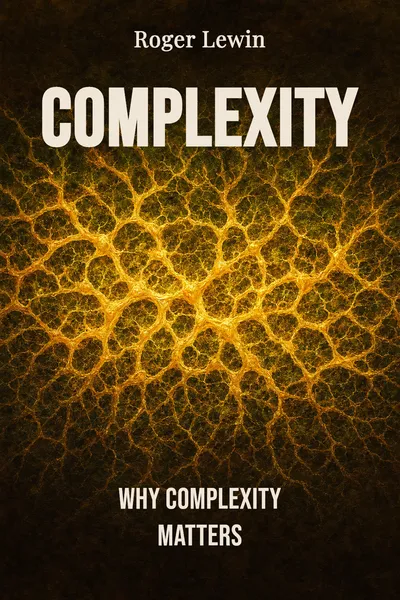
Complexity
Why complexity matters
Description
In the late 1980s, in a converted convent in the high desert of northern New Mexico, a strange sort of institute was taking shape. The Santa Fe Institute had no departments, no undergraduates, and a founding suspicion that the walls between disciplines were doing more harm than good. Physicists sat down with economists. Biologists argued with computer scientists. A Nobel laureate in particle physics, Murray Gell-Mann, spent his afternoons talking about how ant colonies solve problems no single ant could name. The science writer Roger Lewin walked into that world to find out what these people thought they had in common, and came away with a book, Complexity, that tries to hold the whole conversation in one frame.
What drew them together was a hunch, not yet a theory. Systems made of many simple parts — cells, traders, neurons, species — sometimes produce behavior that none of the parts contains. A market crashes. A slime mold organizes. A brain becomes a mind. The word for this is emergence, and it kept surfacing in fields that had never spoken to each other. The people at Santa Fe suspected that emergence was not a curiosity at the margins of each science but the central fact all of them had been missing, and that it might obey rules general enough to write down.
Lewin's book is a reporter's account of a discipline arguing itself into existence — brilliant, ambitious, and unsure whether it has found a new science or a very persuasive metaphor. That uncertainty is the story. He talks to the enthusiasts and the skeptics, follows the claims to their edges, and lets the tension stand rather than resolving it into a tidy verdict.
The question we’re asking : What does it mean to say that ant colonies, economies and ecosystems obey the same hidden rules — and is that a science or a hope?What we’ll see : How a handful of researchers tried to turn emergence into a discipline, and what they had to bet to do it.
Table of contents
01 Chapter 1 — A meeting at the edge
Roger Lewin structures Complexity as a journey through the people rather than the equations, and the first thing that strikes him is how many of them are refugees from their own fields. The Santa Fe Institute, founded in 1984 largely at the urging of Los Alamos physicist George Cowan, was built for scientists who had grown frustrated that their disciplines could describe the parts of a system beautifully and the whole not at all. Physics had spent a century reducing matter to fundamental particles. What it could not do was explain why a flock of birds turns as one, or why an economy behaves like a living thing.
The common thread Lewin keeps pulling is emergence: the appearance, in a system of many interacting parts, of properties and patterns that exist at no lower level. Water is wet; a single water molecule is not. A neuron does not think; a hundred billion of them, wired together, somehow do. The complexity researchers argued that these leaps were not accidents to be explained away but the main event — the way nature actually builds most of the interesting things in it, from cells to civilizations.

02 Chapter 2 — The four regimes of a rule
To see why the edge of chaos captured so many imaginations, Lewin turns to the simplest laboratories the field had: cellular automata. These are grids of cells that switch on and off by mechanical rules, each cell looking only at its neighbors before deciding what to do next. There is no plan, no central controller, nothing but a rule applied everywhere at once. And yet Stephen Wolfram, studying them in the early 1980s, found that these trivial systems fell into just four broad classes of behavior, and that the classification told a story far larger than the toy suggested.
The first class settles instantly into a dead, uniform state — everything freezes. The second locks into simple repeating patterns, orderly but sterile. The third dissolves into chaos, patterns churning with no structure that lasts. The fourth class is the strange one: it produces complicated, long-lived structures that move, collide, combine, and persist without ever settling down or breaking apart. Langton mapped these four regimes onto a single dial he called a tuning parameter, and found that the fourth, fertile class sat precisely at the transition between order and chaos.
03 Chapter 3 — Where life likes to live
The stakes rise when the complexity researchers turn from grids of cells to life itself. Stuart Kauffman, a physician turned theoretical biologist and one of the book's most compelling figures, spent decades arguing that Darwin gave us only half the story. Natural selection explains how life is shaped, Kauffman granted, but not why there was anything organized enough to be shaped in the first place. Selection needs raw order to work on, and Kauffman's claim was that order arises spontaneously, for free, in systems complex enough to produce it.
His evidence came from networks. Kauffman modeled genes as switches wired to one another, each turning others on or off, and asked what such a tangle would do left to itself. The naive expectation was chaos: thousands of switches flickering endlessly through astronomical numbers of states. Instead, when each switch was connected to only a couple of others, the networks fell rapidly into a small number of stable, repeating cycles. Lewin relays Kauffman's striking observation that the number of these stable states tracked roughly the number of cell types in real organisms — hinting that the order in biology might be a property of networks as such, not only of selection's slow carving.
04 Chapter 4 — The stories we tell about order
Step back from the ants and the automata and Complexity is really a book about explanation — about what kind of answer counts as understanding. The dream at Santa Fe was not merely to study complicated things but to end the isolation of the sciences, to show that the same handful of principles governed a stock market, a rainforest, an immune system and a mind. If emergence, self-organization and the edge of chaos were universal, then the fracture lines between physics, biology, economics and cognition were bookkeeping conventions, and a single mathematics of complex adaptive systems could run beneath them all. Lewin treats this as the deepest and most exciting claim in the book, and also the most exposed.
The exposure is philosophical. For three centuries the prestige of science rested on reduction: explain the whole by taking it apart and understanding the pieces. Complexity science makes the opposite wager — that the whole has laws of its own, that you lose the phenomenon precisely when you break it into parts. Emergence, taken seriously, says there are truths about colonies that no amount of knowledge about individual ants will ever yield. That is either a profound correction to how science works, or, as skeptics in Lewin's pages insist, a comforting way of naming our ignorance and calling it a law.
05 Conclusion
Lewin leaves us where he began, in the desert institute where physicists and biologists and economists kept arriving at the same word from opposite directions. The conversation he recorded was young, and its central bet — that emergence, self-organization and the edge of chaos are three faces of one deep process — was still a bet when the book closed. What he documents is not a triumph but a threshold: a group of serious people convinced they had glimpsed a general logic of living, thinking, adapting systems, and honest enough to admit they could not yet prove it.
Related books