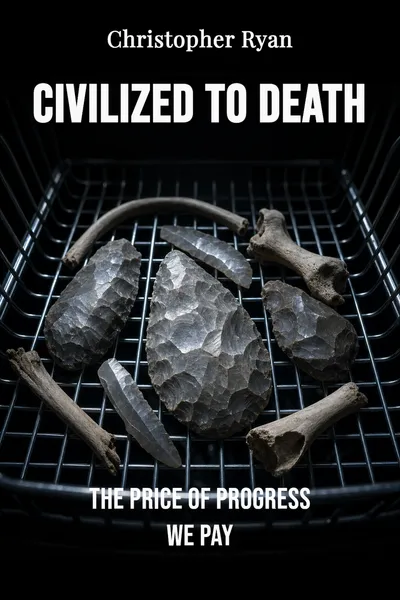
Civilized to Death
The price of progress we pay
Description
Christopher Ryan opens Civilized to Death with a hunch most of us have felt and then talked ourselves out of: that something about modern life, for all its miracles, feels quietly wrong. We have vaccines and hot showers and food that arrives in minutes, and we are also, by many measures, more anxious, lonelier, and sicker in body and mind than the story of progress says we should be. Ryan, an American psychologist best known for the 2010 book Sex at Dawn, spends this 2019 book worrying at that gap between what we were promised and what we got.
His claim is deliberately provocative. The upward line we draw from cave to condo — the assumption that each century leaves us better off than the last — is, he argues, mostly a flattering myth. Not a lie exactly, but a narrative we've mistaken for a law. Drawing on archaeology, anthropology, and evolutionary psychology, he assembles a case that the great turn toward farming, cities, and eventually consumer capitalism cost us things we barely have words for anymore: time, belonging, physical ease, a sense that our lives are our own.
None of this is a call to go back to the caves, and Ryan says so plainly. It's harder than that, and more useful. He wants us to notice the trade, to stop treating civilization as an unambiguous rescue mission and start counting what we handed over to get here — because a bill we refuse to read still comes due.
The question we’re asking : Has the long march we call progress made us better off, or just better at not noticing the losses?What we’ll see : How Ryan weighs the promise of civilization against the evidence buried in bones, forager camps, and our own restless bodies.
Table of contents
01Chapter 1 — The story we tell ourselves about getting better
Every culture has a founding myth, and Ryan thinks ours is the myth of progress — what he calls the Narrative of Perpetual Progress, the assumption that human life is a steady climb from misery toward comfort. It shows up everywhere, in the offhand confidence that ancestral life was, in the famous line Ryan borrows from Thomas Hobbes, "nasty, brutish, and short." We picture cavemen as terrified, starving brutes clubbing each other in the dark, and we picture ourselves as the lucky heirs of everything that fixed all that.
The trouble, Ryan argues, is that this story mostly grades civilization on its own exam. We measure progress by the things civilization is good at producing — output, gadgets, life expectancy averages skewed by infant mortality — and quietly leave off the ledger everything it's bad at, like leisure, close community, or the simple experience of an unhurried day. It's a bit like a company auditing itself and, unsurprisingly, awarding itself top marks.

02Chapter 2 — What the bones and the foragers actually say
The strongest thread in the book runs through the skeletons. When archaeologists compare human remains from before and after the shift to farming, a striking pattern emerges: early agriculturalists were generally shorter, sicker, and more worn-down than the foragers who came before them. Farming brought a monotonous, grain-heavy diet, new infectious diseases that spread through crowded settlements and domesticated animals, tooth decay, and bodies broken by repetitive labor. The move to farming, Ryan argues, was less a triumph than a trap — one that fed more people while making the average life measurably worse.
So why did anyone stay? Because agriculture is very good at one thing: producing surplus and, with it, population. More mouths meant more farming, which meant more mouths, a ratchet that turned one way. Ryan leans on a point the scientist Jared Diamond made memorably, calling agriculture a mistake we've never recovered from. A society could grow larger and denser on grain than any forager band ever could, and size, not happiness, is what wins the long game of history.
03Chapter 3 — The comforts that quietly cost us
If the deep trade happened at the dawn of farming, Ryan argues the bill keeps arriving in modern forms. Consumer capitalism, in his telling, took the surplus civilization is good at making and pointed it at a strange target: manufacturing dissatisfaction. An economy built on endless growth needs us to keep wanting, so it works hard to make sure we never feel we have enough — a machine that runs on the very restlessness it creates.
The results, he suggests, are written across our health. Rates of obesity, diabetes, depression, anxiety, and addiction don't look like the achievements of a species that has finally figured out how to live. They look like what happens when bodies and minds shaped over hundreds of thousands of years for movement, sunlight, close company, and real food are dropped into a world of chairs, screens, sugar, and strangers. Ryan calls this a mismatch: our environment changed faster than our biology could, and the gap is where the suffering pools.
04Chapter 4 — When the map runs out of road
Step back from the bones and the loneliness statistics and Ryan's larger target comes into focus: not any single comfort, but the idea of progress itself as a self-grading system. A civilization that measures success only by its own outputs — more, faster, longer — has no instrument that can detect what it traded away. The losses don't show up because nothing in the accounting is designed to see them. That, more than any specific harm, is what worries him. We are driving with a dashboard that reports only the gauges we chose to install.
This is why he refuses the easy fixes. Civilized to Death is not a survivalist manual, and Ryan has little patience for the fantasy of quitting society for a cabin. You can't opt out of ten thousand years of momentum by force of will. But he does think the diagnosis changes what a person might reasonably reach for: not escape, but realignment — pulling the pieces of forager life that are still within reach back into a modern day. More time in nature and daylight. More movement. Fewer, deeper relationships. Work that feels connected to something rather than abstracted into a spreadsheet.
05Conclusion
Ryan began with a hunch — that modern life feels wrong in ways our success story can't account for — and he ends more or less where he started, only with the ledger open. The archaeology, the ethnography, the health data all point the same direction: we gained scale, safety in numbers, and staggering technical power, and we paid for it in time, belonging, physical ease, and a certain animal contentment we can no longer quite name. The trade was never announced. It just accumulated, comfort by comfort, until we mistook the whole arrangement for the natural order of things.
Related books