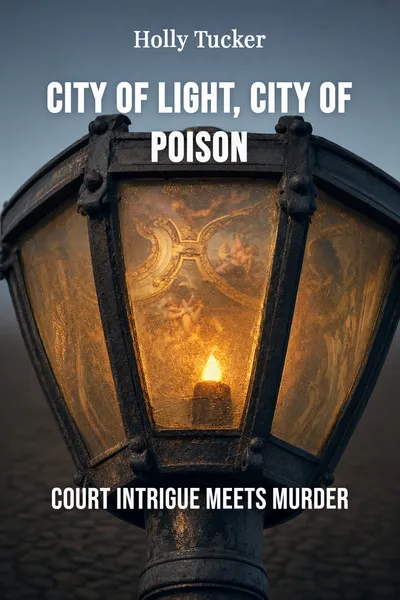
City of Light, City of Poison
Court intrigue meets murder
Description
In 1667, Paris was a city where a body in the river drew no more than a shrug. The streets had no lighting after dark, no numbering, no organized watch worth the name; robbery, arson, and quiet disappearances were simply the weather of urban life. That March, Louis XIV created something France had never had: a single office, held by one man, responsible for order in the capital. The man he chose was Nicolas de La Reynie, a magistrate from Limoges with no great fortune and no famous name, and the title he was given — lieutenant general of police — was invented more or less for him.
What La Reynie built over the next years was extraordinary and, to modern eyes, uncomfortably familiar: street lamps, informants, a filing system, a network that reached into every parish and every gutter. He wanted to know his city, and in wanting to know it he began pulling on a thread that ran from the tenements of the Left Bank up through the salons and eventually, unmistakably, toward Versailles. It began with a couple of poisonings. It ended somewhere no one had authorized him to go.
Holly Tucker reconstructs the whole affair from La Reynie's own notebooks, from letters, from thousands of pages of interrogation transcripts that survived the fire Louis ordered. What emerges is not a tidy detective story but a portrait of how thin the wall was between a court that ran on flattery and a criminal trade that ran on arsenic — and how a policeman came to understand that solving a crime and serving a king were not always the same job.
The question we’re asking : What did the first police chief of Paris find when he followed a poisoning case as far as it would go?What we’ll see : A magistrate builds a modern police force, uncovers a network of poisoners and false priests, and edges toward a truth about the court he was sworn to protect.
Table of contents
01 Chapter 1 — A city that swallowed its own
To understand why La Reynie's job had to be invented, we have to picture the Paris of the 1660s, which was less a city than a knot. Roughly half a million people were crammed into medieval streets that had grown without plan. There was no public lighting, so nightfall handed the town to whoever moved through it with a knife or a torch. Sewage ran open. Fires spread unchecked. The various overlapping authorities — the provost, the church courts, the guilds — each guarded a scrap of jurisdiction and none of them answered for the whole.
Crime, in that environment, was not an aberration; it was infrastructure. Beggars organized into hierarchies. Thieves worked the crowds around Notre-Dame. And in the shadows of ordinary commerce ran a quieter trade that Tucker keeps returning to: the buying and selling of remedies, love charms, abortifacients, and — for those who asked the right person the right question — something to make an inconvenient husband, rival, or parent sicken and die. The line between a midwife, a fortune-teller, and a poisoner was blurry, and everyone involved preferred it that way.

02 Chapter 2 — The lieutenant who read the streets
What made La Reynie effective was not force but patience. He treated the city as a text to be read, and he understood that the most valuable currency in Paris was not money but information. He cultivated informants across every class — servants, priests, apothecaries, the women who sold powders in back rooms — and he wrote everything down. His notebooks, which Tucker leans on heavily, are the record of a mind assembling a picture that no one else could see because no one else was collecting all the pieces in one place.
The break came, as such breaks often do, almost by accident. In 1676 the Marquise de Brinvilliers was arrested after a scandal in which private papers surfaced suggesting she had poisoned her own father and two brothers to secure their inheritances, with the help of her lover. Her trial and public execution were a sensation. But for La Reynie the trial was less an ending than an opening question: if a woman of that rank could quietly murder her family with purchased poison, how many others were doing the same, and where were they all getting the arsenic?
03 Chapter 3 — The trail that led to the poisoners
At the center of the tangle sat a woman named Catherine Monvoisin, known to all of Paris as La Voisin. She was a fortune-teller, an abortionist, a dealer in charms and powders, and she was very good at all of it. Fashionable women climbed the stairs to her house to have their palms read and their futures arranged; some left with love potions, some with something darker. When La Reynie's men arrested her in 1679, the door they opened led not to one criminal but to an entire economy of the occult and the lethal.
Under interrogation, La Voisin and her associates described a trade that mingled superstition and pharmacology in ways that horrified the investigators. There were powders of Spanish fly and arsenic, but there were also black masses — obscene rituals performed by renegade priests, most notoriously a defrocked cleric named Étienne Guibourg, over the bodies of women, sometimes involving the sacrifice of infants, all commissioned to bind a lover or curse a rival. Tucker is careful here: some of this testimony came under torture and cannot be taken at face value. But the sheer volume and consistency of it, drawn from many mouths, told La Reynie he was dealing with something real and organized.
04 Chapter 4 — When the trail reached the king's bed
The name was Madame de Montespan, the king's official mistress for more than a decade and the mother of several of his children. Witnesses from the poison network claimed she had, over the years, bought love powders to keep the king's affection and, more damningly, that she had participated in black masses and later sought poison to be rid of a younger rival. Whether every detail was true is impossible to know; the testimony came from desperate people facing execution, and torture manufactures the confessions it wants. But the accusations, once made, could not be unmade.
This is where Tucker's story stops being a detective tale and becomes something colder. La Reynie now held knowledge that threatened the emotional and political center of the regime. If Montespan were tried, the king's private life, his children's legitimacy, and the dignity of the crown itself would be dragged through a public court. The lieutenant of police had done exactly what he was appointed to do — follow the crime wherever it went — and doing his job had brought him to a door he was not permitted to open.
05 Conclusion
Montespan was never charged. She kept her apartments and her pension for years, drifting slowly out of favor by the ordinary means of a younger woman arriving, and died in 1707 without ever answering for what the testimony had claimed. La Reynie stayed at his post until near the end of his long life, expanding the police force he had built, keeping his copied papers, saying nothing. The Sun King's Paris got its lanterns and its order, and it kept its secret in the same stroke.
Related books