
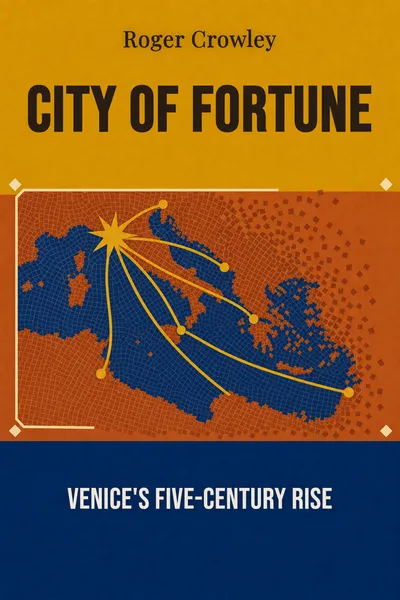
City of Fortune
Venice's five-century rise
Description
Sometime around the year 1000, the Venetians did something that reads today like a founding myth but was, in Roger Crowley's telling, ordinary municipal business: they married the sea. Every year on Ascension Day the Doge would sail out into the Adriatic, drop a gold ring into the water, and declare that Venice took the sea as a bridegroom takes a bride. It was theatre, but honest theatre. Venice had no farmland worth the name, no hinterland, no natural resources beyond salt and fish. Built on mudflats in a lagoon, it could grow only one way — outward, across the water. The wedding to the sea was less a boast than a statement of the obvious. There was nowhere else to go.
From that unpromising start, over roughly five centuries, this refugee settlement became the richest city in Europe and the dominant naval and commercial power in the Mediterranean. It fought Genoa and Byzantium, hijacked a crusade, ran a colonial empire of ports and islands stretching to the eastern edge of the sea, and organised long-distance trade with a precision that anticipated the modern corporation by centuries. At its height Venice was less a country than a business — a state engineered from top to bottom to move goods and count money.
Crowley's City of Fortune is the biography of that machine, from the shrewd opportunism of the early republic to the moment the whole enterprise ran out of sea to conquer. It is a story of galleys and spices, plague and ambition, sieges and account books. And it carries a question that outlives Venice itself: what happens to a power that has bet everything on one thing, and done it better than anyone alive?
The question we’re asking : How did a settlement on a mudbank with no land and no resources become the greatest power in the Mediterranean — and why couldn't it last?What we’ll see : We follow the Venetian voyage from lagoon survival to Mediterranean mastery, and into the reckoning that came when the world changed shape around it.
Table of contents
01Chapter 1 — A city with no land and everything to gain
The Venice that Crowley opens with is a place that should not have worked. Its founders were mainland refugees fleeing the wreckage of the Roman world, and they settled the lagoon not because it was rich but because it was defensible — a maze of channels and sandbanks that invaders on horseback could not cross. They built on wooden piles driven into the mud, drank rainwater from cisterns, and imported nearly everything else, including the stone their churches were made of. A city with no agriculture has to buy its bread, and to buy its bread it has to sell something. Venice's answer was to become a middleman between worlds.
Geography, which had given the Venetians nothing to farm, had given them one enormous asset: position. The lagoon sat at the hinge between the Christian West and the markets of Byzantium, at the head of the Adriatic where goods from the East could be funnelled north into Europe. The Venetians grasped early that they did not need to produce wealth — they only needed to handle it. Salt and fish paid the first bills; then came the carrying trade, moving other people's cargoes for a cut, and the slow accumulation of ships, skills and contacts that turned a fishing community into a commercial power.

02Chapter 2 — The Fourth Crusade, or how to buy an empire
The turning point in Crowley's narrative is one of the strangest episodes in medieval history: the Fourth Crusade of 1202–1204, which set out to reclaim Jerusalem and instead sacked Constantinople, the greatest Christian city on earth. Venice was at the centre of it, and the story shows the republic at its most ruthlessly commercial. The crusaders had commissioned an enormous fleet from Venice — then arrived unable to pay for it. The republic, led by the aged and nearly blind Doge Enrico Dandolo, had sunk a fortune into building the ships and would not write off the debt.
What followed was less a holy war than a series of transactions. Dandolo proposed the crusaders work off their debt by helping Venice recapture the rebellious port of Zara, a Christian town on the Adriatic — an operation so scandalous it got the whole expedition excommunicated by the Pope. From there the crusade was steered, by circumstance and Venetian design, toward Constantinople itself, drawn in by a claimant to the Byzantine throne who promised riches he could not deliver. In 1204 the crusaders stormed and looted the city in an orgy of destruction that Byzantium never recovered from. The bronze horses that still stand over St Mark's were carried home as plunder.
03Chapter 3 — The stato da mar and the machinery of trade
What Venice built on the foundations of 1204 was not a territorial empire in the usual sense but a network — the stato da mar, the state of the sea. Rather than conquering great swathes of land, the republic seized the points that mattered: Crete, Negroponte, the harbours of the Greek coast, Cyprus later on — the string of ports that controlled the flow of goods from eastern markets back to the lagoon. It was an empire of chokepoints, designed to guarantee that trade passed through Venetian hands and paid Venetian tolls. Venice thought like a corporation long before the word existed.
The machinery behind this was extraordinary. The state ran the great convoys of merchant galleys directly, auctioning the right to sail them and setting routes and schedules by decree. Ships travelled in fleets, on fixed timetables, to fixed destinations — Alexandria, Beirut, the Black Sea, the ports of Flanders and England. The Arsenal, the vast state shipyard, could turn out galleys at a rate that astonished visitors, an assembly process centuries ahead of anything comparable in Europe. Venice had, in effect, industrialised the business of moving cargo across water.
04Chapter 4 — When the map moved and the sea stopped paying
The genius of Venice was also its vulnerability, and Crowley's larger argument turns on this. The republic had made itself supremely good at one thing: controlling the Mediterranean funnel through which the riches of the East reached Europe. Everything — the fleets, the colonies, the wars with Genoa, the diplomacy with sultans and emperors — served that single artery. A power that specialised so completely was magnificent while the world was shaped to its advantage. It had no answer for a world reshaped without it.
Two shocks did the reshaping. The first was the relentless rise of the Ottomans, who took Constantinople in 1453 and then methodically stripped away Venetian ports and islands one by one, turning the eastern Mediterranean from a Venetian pond into an Ottoman sea. The second, and ultimately more fatal, was the Portuguese rounding of the Cape of Good Hope in 1498, opening a sea route to India that bypassed the Levant entirely. Suddenly spices could travel by ship from India to Lisbon, cutting out the middleman on whom Venice had built its fortune. The chokepoint no longer choked anything.
05Conclusion
Venice did not vanish when the spice trade slipped away. It coasted for another two centuries on accumulated wealth, reinvented itself as a mainland power and a haven of art and pleasure, and remained one of the wonders of Europe until Napoleon extinguished the republic in 1797. But the decisive chapter had already closed, out in the Atlantic, the day a Portuguese fleet rounded the tip of Africa. The gold ring the Doge dropped into the Adriatic each year still promised marriage to a sea that was quietly ceasing to be the road to fortune.