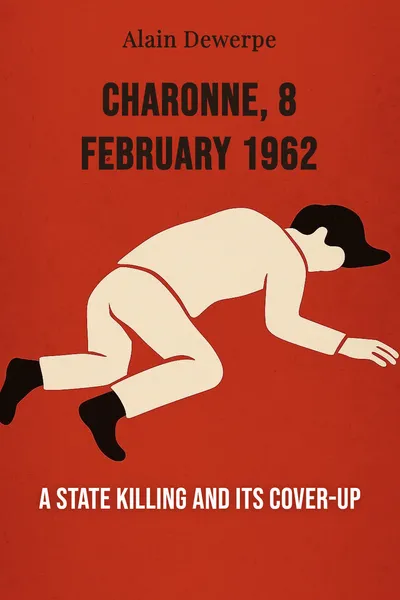
Charonne, 8 February 1962
A state killing and its cover-up
Description
On the evening of 8 February 1962, several thousand people gathered near the Bastille in Paris to march against the OAS, the clandestine far-right group that was setting off bombs across the city to keep Algeria French. The demonstration had been banned. The Algerian war was in its final months, and the French state, exhausted and jumpy, treated any street gathering as a threat to be contained. What happened over the next half hour, around the entrance of the Charonne metro station, would leave nine people dead — most of them crushed and beaten as the crowd tried to flee down a stairway into a station whose gates had been shut.
The dead were not rioters. They were trade unionists, communists, ordinary Parisians, one of them a teenager of fifteen. All nine belonged, one way or another, to the CGT and the Communist Party. The police charge that killed them was ordered, carried out, and then explained away. In the days that followed, official accounts spoke of confusion, of a panicked crowd, of an accident in the dark. Half a million people walked behind the coffins to Père-Lachaise a week later, in one of the largest funerals Paris had seen. And then the machinery of the state settled over the event and, slowly, closed.
Decades later, a historian named Alain Dewerpe — himself the son of Fanny Dewerpe, one of the nine killed that night — went back to the archives and reconstructed, page by page, both the killing and everything the institutions did afterward to make sure no one answered for it. His book is not a memoir. It is a forensic account of how a democracy kills and then absolves itself.
The question we’re asking : How does a state kill nine of its own citizens and then arrange for no one to be held responsible?What we’ll see : A minute-by-minute reconstruction of a police charge, followed by the long institutional labor of turning a killing into an accident.
Table of contents
01Chapter 1 — Nine bodies at a metro entrance
The physical facts of Charonne are narrow and terrible. When the police moved to clear the boulevard Voltaire that evening, part of the crowd was pushed toward the mouth of the metro station. People went down the stairs to escape the batons, but the station's folding gates had not been fully opened, and the stairway became a trap. Bodies piled up. Officers, some of them, kept striking and throwing objects — grilles from tree bases, heavy iron surrounds — down onto the mass of people wedged against the closed gate. The dead were not shot. They were crushed and struck, in a confined space, over a matter of minutes.
Dewerpe's method is to refuse the blur. He works out who was where, which police units were engaged, at what time each order was given. He assembles the count with care: eight died that night or within hours, a ninth some weeks later from injuries. He names them — Fanny Dewerpe among them, twenty-six years old, his mother. The precision is not decoration. It is the whole argument, because every official version of Charonne depended on the event staying vague, on the crowd being blamed for its own panic, on the darkness doing the work that the batons had actually done.

02Chapter 2 — A demonstration the state had already decided to break
To understand Charonne, Dewerpe reaches back before the evening itself, into the atmosphere of early 1962. The OAS was terrorizing Paris with plastic explosives, and the government of the Fifth Republic, under de Gaulle, was moving toward the Évian accords that would end the war and grant Algerian independence. Caught between the OAS on one side and a war it wanted to close on the other, the state had grown accustomed to hard policing. Only months earlier, on 17 October 1961, the Paris police had killed a large but long-suppressed number of Algerians during a demonstration — a massacre that would stay officially buried for decades.
Charonne belongs to that same policing culture, and to the same prefect, Maurice Papon, who ran the Paris police. The anti-OAS march of 8 February was banned in advance. The mobilization of officers, the deployment orders, the disposition of forces along the route — all of it, Dewerpe shows, reflected a decision made before anyone reached the boulevard: this crowd would not be allowed to hold the street. The violence was not an improvisation that got out of hand. It was the predictable output of a doctrine that framed a peaceful, if illegal, gathering as a public-order emergency.
03Chapter 3 — The dossier that went nowhere
The second half of the book follows the paper. A judicial investigation was opened; medical examinations were carried out; witnesses gave statements. On the face of it, the institutions were doing what institutions are supposed to do after violent deaths. Dewerpe reads the file the way an archivist reads a forgery — looking not only at what it says but at what it is shaped to avoid. And what it avoids, consistently, is the police as an actor.
The forensic framing is the first sleight. Autopsies and reports lean toward crushing and asphyxiation, toward a crowd movement, toward causes that have no identifiable human author. Responsibility diffuses into the general category of the throng. Then there is the problem of testimony against officers: statements are collected, but the identification of individual policemen who struck or ordered is left effectively impossible, protected by the anonymity of uniforms and helmets and by an inquiry that never seriously pressed to pierce it. A killing with many witnesses becomes a killing with no accused.
04Chapter 4 — When the state kills its own
Step back from the boulevard Voltaire and Charonne becomes something larger than one terrible evening. It is a case study in what happens when the institution accused of a killing is also the institution that holds the file, controls the witnesses, frames the medical questions, and staffs the inquiry. Dewerpe's deeper subject is what he calls, in effect, a state crime — not because a secret cabal plotted murder, but because the killing was produced by the ordinary functioning of state power and then absorbed by the ordinary functioning of state self-defense.
The two halves of the book mirror each other with grim symmetry. The charge was orderly, hierarchical, doctrinal; so was the exoneration. The same qualities that let the police kill efficiently — chain of command, procedural cover, institutional solidarity — let the state investigate itself into acquittal. Accountability fails not at the edges but at the center, precisely where a democracy claims its legitimacy: the idea that no power sits above the law it enforces on everyone else.
05Conclusion
A week after the charge, half a million Parisians followed the nine coffins to Père-Lachaise. It was a vast, silent verdict rendered in the street, at the very moment the institutions were preparing to render no verdict at all. The crowd knew what it had lost and, roughly, who had taken it. The courts, over the years that followed, would never quite manage to know either. Between the funeral and the closed file lies the whole distance Dewerpe set out to measure — the distance between what a society understands and what its state will admit.
Related books