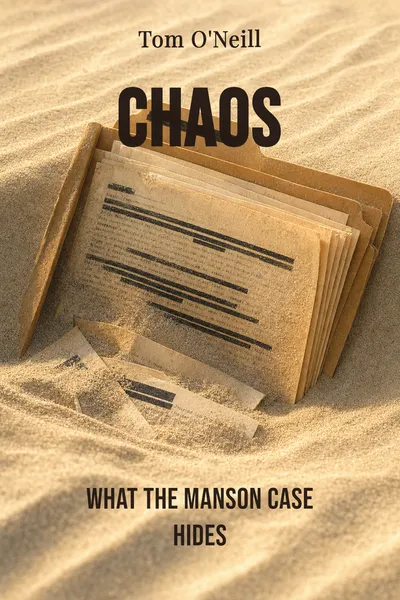
Chaos
What the Manson case hides
Description
In 1999, a freelance journalist named Tom O'Neill took a routine assignment from the magazine Premiere: a piece marking the thirtieth anniversary of the Manson murders. He was given three months. The story he eventually published, Chaos, arrived twenty years later, in 2019, after the magazine had dropped him, after lawsuits and near-bankruptcy, after he had accumulated thousands of documents and hundreds of interviews he could not stop chasing. The assignment had quietly consumed his life.
The received account is one most of us can recite without effort. Charles Manson, a failed musician and small-time criminal, gathered a commune of young followers in the California desert, convinced them that a race war called Helter Skelter was coming, and dispatched them to kill seven people over two August nights in 1969, including the actress Sharon Tate. A prosecutor named Vincent Bugliosi secured the convictions and wrote the bestselling book that sealed the story in the culture. Case closed, monster named.
O'Neill started out trying to write a colorful retrospective and ended up unable to make the official version hold together. Dates that didn't line up. Police reports that contradicted the famous book. A parole system that kept releasing a man it should have jailed. He never claimed to have solved anything — which is precisely what makes his book unusual, and unsettling, in a genre built on solutions.
The question we’re asking : What happens to the most familiar crime story in America when someone spends two decades checking whether it actually happened the way we were told?What we’ll see : How a three-month assignment turned into a twenty-year excavation of a case everyone thought was long finished.
Table of contents
01Chapter 1 — A magazine assignment that never ended
Premiere wanted a Hollywood angle: the murders had happened in a rented house on Cielo Drive, the victims moved in film and music circles, and 1969 made for an anniversary hook. O'Neill figured he would interview a few survivors, revisit the crime scenes, and file. Instead, he kept finding threads that didn't belong in a nostalgia piece. The more people he talked to — cops, lawyers, former Family members, Hollywood figures who had brushed against Manson — the less the standard timeline held.
The first crack was small and technical. O'Neill noticed that the movements of Manson and his associates in the months before the killings, as recorded in police files, didn't match the sequence laid out in the famous account. People placed in one location were documented somewhere else. A man supposedly under close police attention seemed to slip through arrests that should have stuck. None of it was dramatic on its own. All of it, stacked up, suggested the story had been smoothed over.

02Chapter 2 — The prosecutor who needed a motive
The center of the official story is Vincent Bugliosi, the deputy district attorney who prosecuted the case and later wrote Helter Skelter, one of the best-selling true-crime books ever published. Bugliosi's genius, in court and on the page, was the motive. He argued that Manson believed a coded message in a Beatles song foretold an apocalyptic race war, and that the murders were meant to trigger it by framing Black militants. It was a lurid, unforgettable explanation — and, crucially, it gave a jury something to convict on when the physical evidence tying Manson to the scenes was thin.
O'Neill's problem was that a motive built to win a trial is not the same thing as the truth of why seven people died. He spent years testing Helter Skelter against the record and found Bugliosi's account harder to defend than its cultural dominance suggested. The Beatles theory, he argued, may have been amplified and shaped in the courtroom rather than simply discovered in Manson's mind. A story that convinces twelve jurors is engineered for persuasion, not for completeness — and the more O'Neill compared the polished narrative to the raw case files, the wider the gap looked.
03Chapter 3 — What the CIA was doing in Haight-Ashbury
The strangest strand in Chaos is the one O'Neill approaches most cautiously. Manson, an ex-convict with a long record, was on federal parole in the years before the murders and repeatedly violated it — associating with felons, crossing state lines, facing new charges — without being sent back to prison. In a stricter system, he might have been locked up well before August 1969. Why he wasn't is a question O'Neill could never fully answer, but it led him toward the government programs operating in California at the time.
Two names recur. Roger Smith, a criminologist who supervised Manson's parole in San Francisco, ran a program studying amphetamine users out of the Haight-Ashbury Free Medical Clinic — a program with funding links O'Neill found difficult to trace cleanly. And Louis Jolyon West, a prominent psychiatrist who studied brainwashing and LSD, had a documented connection to MKULTRA, the CIA's Cold War program of experiments in mind control and behavioral manipulation, and kept an office near the same clinic. O'Neill was careful not to draw a straight line he couldn't prove, but the density of the overlap kept pulling him back.
04Chapter 4 — The comfort of a story that closes
The official Manson narrative has held for over fifty years, and it is worth asking why a version with this many loose ends became so durable. Part of the answer is that it works as a story. It has a monster with hypnotic eyes, a coded pop song, an apocalyptic motive, and a courtroom victory. It explains something genuinely frightening — that clean-cut young people could be turned into killers — by locating all the darkness in one charismatic man. Once Manson absorbs the evil, the rest of us are safe.
O'Neill's book is unsettling precisely because it withholds that comfort. A story that closes lets a culture move on; an open file keeps asking questions no one wants to keep answering. By refusing to name a new culprit, O'Neill declines the deal the genre usually offers. He does not hand back a tidier monster to replace Manson. He hands back uncertainty, which is far harder to live with and far easier to dismiss as the obsession of a man who spent too long alone with his boxes.
05Conclusion
Twenty years after the assignment that broke his career, O'Neill published a book that admits it cannot prove its own most explosive implications. That admission is the point. He spent two decades not to crown a new villain but to show that the file America closed in 1971 was never as sealed as we assumed — that dates, parole records, and a prosecutor's convenient motive don't quite fit the story we memorized.
Related books