
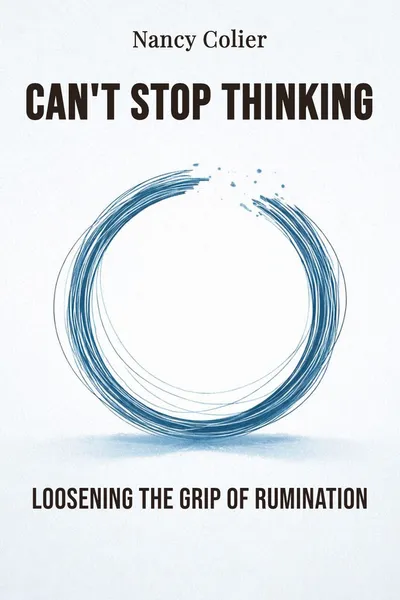
Can't Stop Thinking
Loosening the grip of rumination
Description
There's a particular kind of tiredness that has nothing to do with the body. You've done nothing all day but sit, and yet by evening you're wrung out, because the mind hasn't stopped once. It replayed a conversation from Tuesday. It rehearsed one that hasn't happened yet. It circled a decision, dropped it, picked it up again. Nancy Colier, a psychotherapist and interfaith minister who has spent decades sitting with people in exactly this state, calls it what it is: not deep thinking, not problem-solving, but compulsion. The mind running because running is what it does, whether or not there's anywhere to go.
Her book, Can't Stop Thinking, starts from an uncomfortable premise. Most of us believe our thoughts are us — that the voice narrating our day is our truest self, and that the answer to a restless mind is simply to think our way to peace. Colier's clinical experience points the other way. The more we try to out-think the noise, the louder it gets. The person exhausted by their own head is usually the person most convinced that one more round of analysis will finally settle things.
What Colier offers isn't a technique for silencing the mind, and she's blunt that no such switch exists. It's closer to a shift in position — a way of standing in relation to our own thinking that loosens its hold without demanding it disappear. The work is less about winning an argument with the mind and more about noticing we don't have to enter every argument it starts.
The question we’re asking : Why does a mind built to help us end up wearing us down, and can we loosen its grip without going to war with it?What we’ll see : How compulsive thinking works, why fighting it backfires, and what it means to step slightly outside the mental stream.
Table of contents
01Chapter 1 — The mind that never clocks out
Colier's starting observation is almost embarrassingly ordinary: for most people, thinking is not something they choose to do. It happens to them. The stream is on from the moment they wake, commenting, judging, planning, worrying, and it doesn't switch off when the day's actual problems are solved. This is the part she wants us to sit with. A mind that thought only when there was something to think about would be a tool. The mind she describes is more like an engine that idles at high speed even in the driveway, burning fuel for no destination.
She distinguishes this compulsive activity from genuine reflection. Real thinking has a shape — a question, some work, a conclusion, and then rest. Compulsive thinking has no off-ramp. It revisits the same worry it visited an hour ago and produces the same non-answer, then does it again. We mistake the repetition for diligence, as if worrying about a thing were a way of caring for it. Colier's point is that the loop rarely resolves anything; it just keeps us company, and the company is exhausting.

02Chapter 2 — The trap of thinking about thinking
The intuitive fix, when your head won't quiet down, is to try harder to quiet it. Colier sees this constantly, and she watches it fail with grim regularity. Telling yourself to stop thinking is itself a thought, one that requires the mind to stay switched on to monitor whether it's working. You end up with a second layer of activity supervising the first. Now you're not just anxious; you're anxious about being anxious, and mentally scoring how badly you're doing at not being anxious.
This is the trap at the center of the book. The tool we reach for to escape the noise is more noise. We think our way toward stillness, which is a bit like driving somewhere to find quiet and leaving the engine running the whole time. Colier notes that the people who suffer most are often the sharpest and most self-aware — precisely because they have more mental horsepower to throw at the problem, and the problem feeds on horsepower.
03Chapter 3 — Awareness is not the same as attention
The hinge of Colier's approach is a distinction that sounds subtle and turns out to change everything: the difference between the thoughts and the awareness in which they appear. We spend our lives identified with the content — I am this worry, I am this plan, I am this running commentary. What we overlook is the quieter fact that something is aware of all of it. There is a part of us noticing the thoughts, and that noticing part is not itself anxious. It's just watching.
She's careful not to make this mystical. It's an observable shift anyone can test in a few seconds. Notice a thought. Now notice that you noticed it. The second act is different in kind from the first — it's not another thought, it's the space the thought is happening in. Colier's wager is that we can learn to rest a little more in that space and a little less in the churn, without needing the churn to stop first. Awareness doesn't demand silence. It simply doesn't get pulled under.
04Chapter 4 — A relationship, not a war
Step back from the techniques and the deeper move in Colier's book comes into focus. Compulsive thinking, in her framing, is not a character flaw or a fixed trait. It's a pattern — something the mind does, not something we are. That reframing matters more than it first appears. If the restless mind is who you are, you're stuck with it, and the only options are endless management or defeat. If it's a pattern running through you, then you're the one it's running through, and that's a very different place to stand.
This is why she resists the language of battle. We talk about quieting the mind, silencing the inner critic, conquering our anxiety, as if peace were a victory won by force. But the fighter and the enemy are made of the same material — both are thought — so the war can only escalate. What Colier proposes instead is something like a relationship. You get to know the compulsive mind, its favorite worries, its tricks, its habit of dressing panic up as prudence. You stop being surprised by it, and you stop taking it personally. You can even develop a certain affection for it, the way you might for an anxious friend who means well and can't help themselves.
05Conclusion
Return to that evening exhaustion, the tiredness of a body that did nothing while the mind did everything. Colier's book doesn't promise to make the mind stop; it argues that we were never supposed to win that fight, because there was no fight to win. The restlessness was never the enemy. It was just a pattern doing what patterns do, mistaken for the whole of who we are. The relief comes not from a quieter mind but from a looser hold — the discovery that we can hear the running commentary without being conscripted by it.
Related books