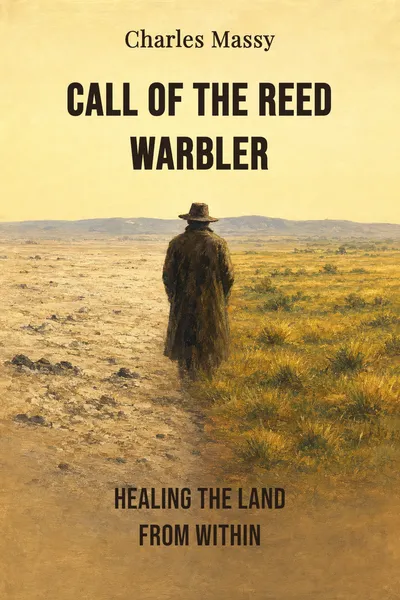
Call of the Reed Warbler
Healing the land from within
Description
There is a moment early in Charles Massy's account when he describes standing on his own family's farmland in the Monaro region of New South Wales, land he had worked and, by his own admission, degraded for decades. He had done everything conventional agriculture told him to do — cleared, ploughed, drenched, fertilized, stocked hard. And the country was dying under his boots. The creeks ran less. The soils blew and crusted. The reed warbler, a small brown bird whose call once meant healthy wetland reeds, had gone quiet. Massy, a fifth-generation grazier who also happened to hold a doctorate in human ecology, understood that the silence was a verdict on how he had been farming.
"Call of the Reed Warbler," published in 2017, is the book he wrote to make sense of that verdict — and of the way out he eventually found. It is part memoir, part field report, part argument. Massy travelled across Australia talking to farmers who had quietly abandoned the industrial playbook and rebuilt living, resilient landscapes without the chemicals, the debt, or the exhaustion. What he found convinced him that the damage running through soils, waterways, food and human bodies traces back to a single mistake: treating land as a machine to be forced rather than an organism to be understood.
The book sits at an odd angle to the usual environmental story. It is not written by an activist looking in from outside, but by someone who spent a working life inside the system he now indicts. That vantage gives the argument its particular weight. It is a confession as much as a manifesto, and it turns on the possibility that the same person who wrecked a landscape can be the one to heal it — if he learns to see it differently.
The question we’re asking : What does it actually mean to heal land from within, and what has to change in the farmer before the paddock changes?What we’ll see : How a degraded family farm, a quiet bird, and a network of unconventional Australian graziers reframe agriculture as a living system rather than a factory floor.
Table of contents
01 Chapter 1 — The day the land stopped speaking back
Massy grew up believing the story his generation of farmers inherited after the Second World War. Land was raw material. Yield was the measure of a good farmer. Nature was a set of problems — weeds, pests, poor soils — to be solved with technology bought from a merchant. He drenched sheep, sprayed pasture, bought superphosphate, and cleared trees, and for a while the numbers held. This was farming as most of the developed world came to practise it in the second half of the twentieth century, and it felt not like a choice but like common sense.
The trouble arrived slowly, the way ecological trouble usually does. Massy watched his soils lose their sponginess and their capacity to hold rain. A downpour that should have soaked in ran off instead, taking topsoil with it. Bare ground spread. Salinity crept up where the water table rose after the trees came out. The 1982 drought — one of the worst in the region's recorded history — hit his overgrazed, over-simplified country far harder than it hit land that had been left with more cover and more diversity. The machine, it turned out, had no reserves.

02 Chapter 2 — Five landscape functions, one broken machine
To explain what industrial agriculture had broken, Massy leans on a framework of natural functions that a healthy landscape performs — the ways it moves water, cycles minerals, captures sunlight through green plants, sustains the web of living organisms in and above the soil, and organises itself into a dynamic, self-correcting whole. These are not separate systems but facets of one integrated process. Conventional farming, he argues, degraded every one of them at once, because it never recognised them as functions in the first place.
The water cycle is where the damage shows most plainly. Bare, compacted, low-carbon soil sheds rain rather than absorbing it, so water arrives in destructive floods and leaves in droughts, and the land oscillates between the two. Healthy soil, rich in organic matter and covered by living plants, behaves like a sponge: it takes water in, holds it, and releases it slowly. Massy shows how the same rainfall can either rebuild a landscape or strip it, depending entirely on the condition of the ground it lands on.
03 Chapter 3 — The farmers who let the paddock lead
The heart of the book is not theory but people. Massy travelled the continent seeking out farmers and graziers who had turned their properties around, and the most striking thing about them is how ordinary and how various they are. There is no single technique, no product to buy. What they share is a posture: they stopped imposing a plan on the land and started reading what the land was telling them, then adjusted accordingly. Massy calls the change one of moving from a mechanical mind to an organic, ecological one.
Grazing management is the clearest example. Several of his subjects practise forms of planned, time-controlled grazing, moving animals in tight mobs and then resting paddocks for long stretches — mimicking the way wild herds once moved across grasslands under pressure from predators. Rested, densely grazed and then left alone, pastures recover root depth and ground cover, soils rebuild carbon, and the whole water cycle improves. The animals become tools of regeneration rather than agents of erosion. The counter-intuitive lesson is that rest, not constant use, is what makes land productive over time.
04 Chapter 4 — Farming as a way of seeing
The larger claim running under Massy's fieldwork is that regenerative agriculture is a change of mind before it is a change of practice. Drawing on his training in human ecology, he frames the industrial approach as the expression of a whole worldview — mechanistic, reductive, treating nature as inert stuff to be controlled — that reaches back through the Enlightenment and the Scientific Revolution. On this reading, the degraded paddock is not just a technical failure but the visible outcome of how modern culture has been taught to see the living world.
This is why he argues that the transformation begins inside the farmer. Every regenerative farmer he met had undergone something he describes almost as a conversion: a shift from seeing separate objects to seeing relationships, from asking how to force an outcome to asking what a system needs. The soil, the water, the plants, the animals, and the human community stop being a list of resources and become a single, interdependent whole in which the farmer is a participant, not a manager standing outside. Once seen that way, the land cannot be treated as it was before.
05 Conclusion
The book closes where it began, on Massy's own recovering country, with the reed warbler audible again along the reeds. That returning song is the whole argument in miniature: a landscape given back its own functions will announce its recovery in its own language, if we have learned to listen. Massy does not pretend the turnaround was quick or easy, or that one grazier's Monaro property settles anything on a planetary scale. He offers it, and the many farms like it, as proof of concept — evidence that degraded land is not a verdict but a condition, and a reversible one.
Related books