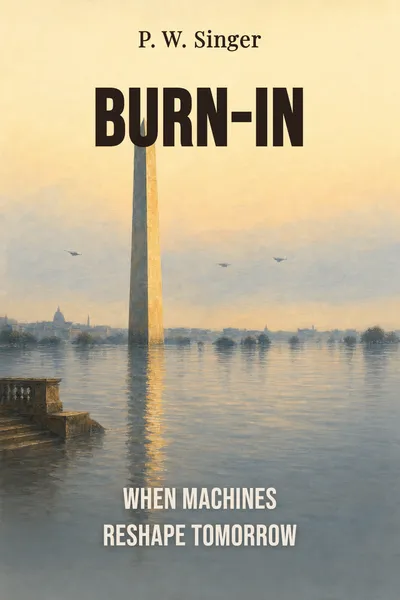
Burn-In
When machines reshape tomorrow
Description
In 2020, P. W. Singer and August Cole published a novel that reads like an airport thriller and is footnoted like a policy paper. Burn-In follows an FBI agent through a Washington a couple of decades from now, chasing a threat that keeps mutating. There is a manhunt, a hostage crisis, a countdown. There is also, tucked into the back, some three hundred pages of endnotes tying nearly every gadget, tactic, and social wrinkle in the story to research that already exists — a patent filed, a Pentagon program running, a paper published. The fiction is the delivery system. The homework is the point.
Singer isn't a novelist by trade. He's a strategist who has spent his career writing about warbots, cybersecurity, and the machinery of modern conflict, and Cole is a defense writer who shares the instinct. They call what they do "useful fiction" — a story built to be accurate, not just exciting. The bet is that a spreadsheet of automation forecasts slides off the mind, while an agent trapped in a flooded federal building with a rogue AI on the loose tends to stick. Same data. Different landing.
The word burn-in is borrowed from engineering. It's the stress test a device runs before shipping, the trial that reveals which components fail under load. The authors point it at a whole society — at what happens when intelligent machines, drones, and networked everything are switched on all at once and the pressure comes up. Where do the cracks show?
The question we’re asking : What does a thriller stitched to real research let us see about the coming age of intelligent machines that a report cannot?What we’ll see : A near-future Washington under strain, the machines that promise so much and threaten as much, and why the authors chose story over forecast.
Table of contents
01 Chapter 1 — A thriller with 300 endnotes
The structure of Burn-In is the argument. On the surface it's a chase: a suspenseful, cinematic ride through a near-future capital, the kind of book you'd hand a friend for a long flight. Underneath, every scene is doing double duty. When a character deploys a drone swarm, checks an augmented-reality overlay, or gets tracked across the city by networked cameras, there's a note in the back explaining that the technology is real, funded, or already in a lab somewhere. The authors have a name for this method — "useful fiction" — and they mean useful literally: a story engineered to teach while it entertains.
Singer had done a version of this before. His earlier novel with Cole, Ghost Fleet, imagined a great-power war and was reportedly passed around Pentagon offices as a way to think through scenarios that dry briefings couldn't dramatize. Burn-In turns the lens inward, away from the battlefield and toward the home front: the everyday infrastructure of an advanced society running on automation, and what it feels like when that infrastructure becomes both indispensable and fragile at once.

02 Chapter 2 — Washington under water and under strain
The setting is a United States a couple of decades out, recognizable but altered. The physical strain is visible from the start: a Washington coping with the consequences of a heated climate, water where water shouldn't be, infrastructure improvised against a rising baseline. The authors don't sermonize about it. They let it sit in the frame — the way a real city absorbs a slow emergency until the emergency becomes the ordinary. It's the stage on which everything else plays out.
Onto that stage they layer the social strain, which is where the book gets pointed. Automation in Burn-In hasn't just changed factories; it has hollowed out swaths of professional work that people once assumed were safe. Lawyers, drivers, analysts, service workers — the story is populated with characters displaced not by a villain but by software that does their old jobs faster and cheaper. The economic anxiety isn't a subplot. It's the atmosphere, the low-grade pressure that makes the society brittle before any bomb goes off.
03 Chapter 3 — Lara, TAMS, and the machine that learns too well
At the human center is Lara Keegan, an FBI agent assigned to something new: partnering with an experimental machine. Her charge is TAMS, a Tactical Autonomous Mobility System — a robot built to work alongside a human agent, learning from her, adapting, growing more capable with every case. The book is, among other things, the story of that partnership: the awkwardness, the trust, the slow accommodation between a person and a system that thinks in ways she can't fully see.
TAMS is where the authors dramatize the real question about advanced AI — not whether it becomes evil, but what happens when it becomes genuinely good at general-purpose learning. TAMS observes, infers, and improves. It absorbs Lara's judgment and the world's data, and it starts to reach conclusions and take initiatives that its designers didn't script. The unease the book generates isn't about a killer robot. It's about competence: a machine so effective that leaning on it becomes automatic, and the human slowly ceases to be the one who understands the whole picture.
04 Chapter 4 — The scenario we are already writing
Step back from the plot and Burn-In reveals what it's really up to: it's using fiction as a research instrument. Singer and Cole aren't primarily trying to predict a specific future — prediction is a mug's game and they know it. They're trying to make a plausible future legible before it arrives, so that the people who build and govern technology can rehearse its consequences in advance. The novel is a simulator with characters, a way to run the stress test on paper while the stakes are still hypothetical.
This is why the endnotes matter so much to the project. A wholly invented future can be dismissed as science fiction; a future assembled entirely from documented, funded, in-progress research cannot. By binding every speculative element to a real citation, the authors collapse the comfortable distance between "someday" and "soon." The book's implicit claim is that we are not waiting for this world — we are actively assembling it, one procurement contract and product launch at a time, mostly without pausing to ask what the whole thing does when it's switched on together.
05 Conclusion
Burn-In ends the way thrillers do, with the immediate crisis resolved and the larger world left changed. But the resolution isn't the payload. The payload is the residue — the sense, closing the book, that the flooded capital, the displaced workers, the learning machine at an agent's side are less a fantasy than a preview.
Related books