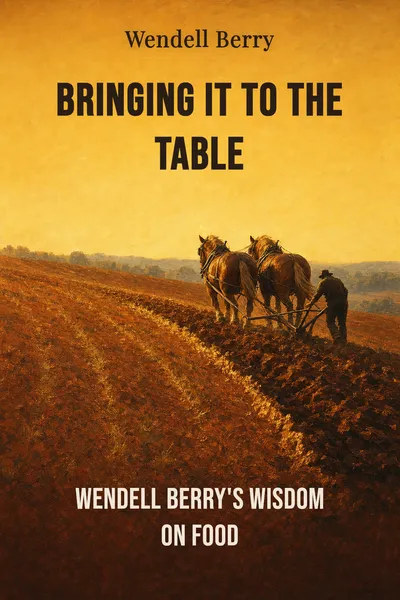
Bringing It to the Table
Wendell Berry's wisdom on food
Description
Somewhere in Henry County, Kentucky, a man has been plowing a hillside with horses and writing about it for more than fifty years. Wendell Berry was born there in 1934, left for the wider literary world, taught in New York, and then did the thing that made him strange to almost everyone he knew: he went home. In 1965 he bought a worn-out farm called Lanes Landing on the Kentucky River and started restoring soil that generations of tobacco had exhausted. He has stayed put ever since — farming, and writing essays, poems and novels that keep circling back to the same subject. What we eat, and what eating costs.
For a long time this looked like a private eccentricity. Then the world caught up. By the time organic vegetables reached the supermarket, by the time farmers' markets and "know your farmer" became a movement with bestsellers attached, Berry had already spent decades saying most of it. Bringing It to the Table, a 2009 collection of his essays and fiction, gathers pieces going back to the 1970s and 1980s. Michael Pollan, who wrote its introduction, put the discomfort plainly: to read them is to realize how little of what we now say about food Berry hadn't already said, and said better, thirty years before.
The collection is not a manifesto and not a diet. It's a farmer thinking out loud about where his food comes from, what industrial agriculture broke, and why the two ends of the table — the eating and the growing — were never meant to be strangers to each other. The pieces are old and they do not feel old, which is its own kind of verdict.
The question we’re asking : Why was a Kentucky farmer decades ahead of a whole culture on what it means to eat well?What we’ll see : A working farm, a broken food system, the pleasure we mislaid, and what a meal quietly says about the people who make it.
Table of contents
01 Chapter 1 — The farmer who wrote it down first
Berry's authority on food has an unusual source: he actually grows it. This matters more than it sounds. Most of what we read about eating comes from journalists, doctors, chefs or activists who buy their groceries like everyone else. Berry writes from inside the work — from the animal that has to be fed at dawn, the field that erodes if you plant it wrong, the harvest that comes whether you're ready or not. The essays in the collection carry the weight of someone who has paid for his opinions with his own labor, and it gives the prose a plainness that no amount of research can fake.
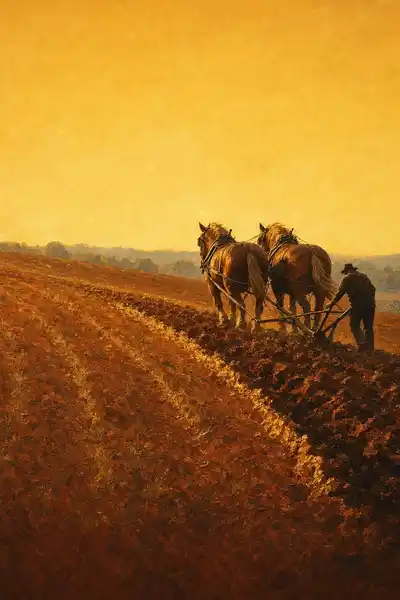
When he came back to Kentucky in the mid-1960s, the choice ran against every current of the age. American agriculture was consolidating, mechanizing, emptying the countryside into the cities. The government's own advice to farmers was blunt: get big or get out. Berry did the opposite. He took twelve acres, then more, and farmed them with methods that were already being called obsolete — horses instead of tractors on the steep ground, animals and crops kept together so the manure fed the soil that fed the animals. Not nostalgia, he insisted, but husbandry: the old discipline of returning to the land as much as you take.

02 Chapter 2 — Eating is an agricultural act
The line that made Berry famous in food circles is deceptively simple: eating is an agricultural act. He wrote it in an essay called "The Pleasures of Eating," and it lands like a small accusation. We tend to think of farming as something that happens far away, done by other people, ending when the food reaches the store. Berry's point is that the person eating is the last farmer in the chain. Every purchase is a vote for a way of growing. Buy the anonymous, industrially raised thing and you have, without meaning to, endorsed the system that produced it.
The trouble, as he saw it, was that industrial food is designed to hide this. The modern eater, in Berry's phrase, is passive — a consumer who receives food the way one receives any manufactured product, with no idea and no curiosity about its origins. The distance between the plate and the field had been stretched so far that most people could no longer imagine it. And that ignorance was not accidental; it was useful. A shopper who does not know how the chicken lived is easier to sell to than one who does.
03 Chapter 3 — The pleasure the industry forgot
What keeps Berry from sounding like a scold is that his case rests, finally, on pleasure. He argues that industrial food did not just harm the soil and the small farmer — it also made eating worse. Standardized, shipped, engineered for shelf life, the food itself lost flavor and lost meaning, and the eating of it became a joyless, distracted refueling done in the car or in front of a screen. The industry offered convenience and quietly took delight in exchange. Berry thinks that was a bad trade, and he makes the sensory case as forcefully as the ethical one.
There is a whole domestic vision in these pages that has nothing to do with hardship. A tomato eaten in season, still warm from the garden. Bread from grain you can trace. A meal cooked from things whose story you know, shared at a table with people rather than swallowed alone. For Berry, knowledge deepens the pleasure rather than spoiling it — the eater who understands what went into the food tastes more, not less. Ignorance, he suggests, is what makes eating dull, because it cuts the meal off from everything that could give it depth.
04 Chapter 4 — When a man feeds a nation, he feeds himself too
Step back from the tomatoes and the horses, and Berry's real subject comes into view: food is the place where a whole culture shows what it believes. How a society grows and eats is not a lifestyle question tucked away in the back pages. It's a confession. It reveals what that society is willing to use up — soil, water, animals, the people who do the labor — in exchange for cheapness and speed. Berry's essays keep pulling the plate back to the field, and the field back to the values that decided how it would be worked, because he refuses to let food be treated as a small thing.
His diagnosis is that industrial agriculture is not merely inefficient in some hidden way; it is a moral posture made physical. It treats land as a machine for extracting yield, treats the farmer as an interchangeable operator, and treats the eater as a mouth to be filled at the lowest cost. Each of those is a decision about worth. Berry insists that a culture which farms carelessly will, in the end, live carelessly, because the habits are the same habits. The way we handle the soil is the way we handle everything.
05 Conclusion
Wendell Berry is now in his nineties and still, as far as anyone can tell, in Henry County, on the farm he came back to when the whole country was leaving. The essays collected in Bringing It to the Table were written across four decades, and the strangest thing about reading them together is how little dates them. The soil erosion, the vanishing small farm, the eater who has no idea where dinner came from — the problems he named in the 1970s are the problems on the front pages now, only larger. He was not predicting. He was describing what was already there, and waiting for the rest of us to notice.
Related books