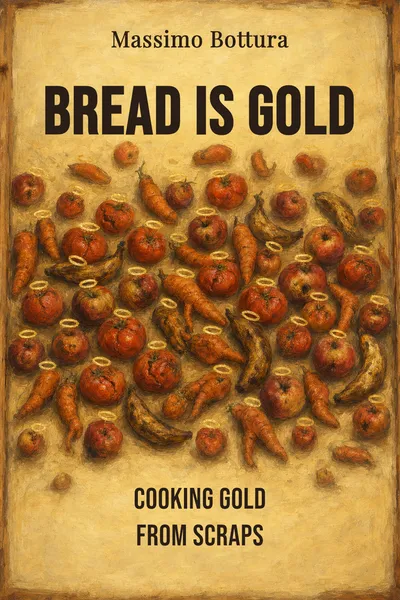
Bread Is Gold
Cooking gold from scraps
Description
In February 2015, in a former theater in Milan's Greco neighborhood, an Italian chef named Massimo Bottura opened a soup kitchen. This was not a modest gesture from a modest man — Bottura's restaurant, Osteria Francescana in Modena, would soon be named the best in the world. He assembled it for the World's Fair happening across town, where the theme, ironically, was feeding the planet. The dining room got tables, decent lighting, artwork on the walls. And the kitchen, run by rotating star chefs, cooked with what the fair's supermarkets and stalls were about to throw away: bruised produce, stale bread, trimmings, day-old everything.
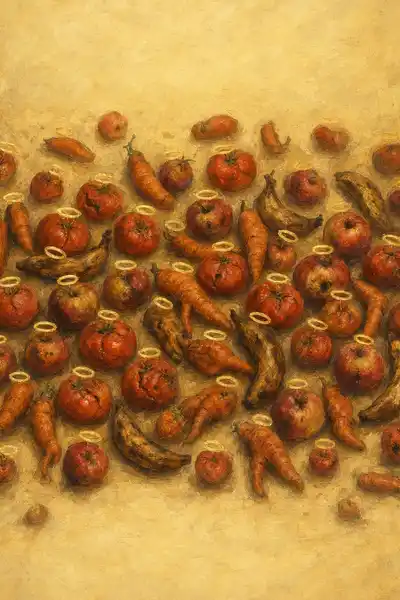
The premise sounds like charity, and it was, but the ambition ran deeper than a full plate for someone hungry. Bottura wanted to prove something to himself and to the industry that had crowned him. The scraps that a market discards every evening — the crooked carrot, the overripe fruit, the crust — are not lesser ingredients. They are ingredients that have simply been abandoned early. In the right hands, with the right attention, they become dinner worth sitting down for. He gathered the recipes from that kitchen, and from the ones that followed in Rio, Bologna and beyond, into a book.
The result reads less like a cookbook than an argument dressed as one. Its title comes from a phrase Bottura learned from his grandmother's generation, from people who lived through scarcity and knew that stale bread was never garbage. Most of us, cooking in kitchens far from any world's fair, throw away a startling share of what we buy. Bread Is Gold asks what would change if we stopped.
The question we’re asking : What separates a scrap we discard from an ingredient we cook — and is the line real or a habit we never questioned?What we’ll see : How a soup kitchen for a world's fair became a manifesto for the home stove, and what the world's best chefs do with what the rest of us bin.
Table of contents
01 Chapter 1 — A soup kitchen behind a Milan theater
The place was called Refettorio Ambrosiano, and the word matters. A refettorio is a monastery's refectory, the room where a community eats together, and Bottura chose it deliberately over any word that would signal a handout. He wanted the people who came in from the neighborhood — many of them homeless, many of them elderly — to feel they were guests, not cases. The theater had been abandoned; a foundation and the local parish restored it. Artists donated work. The point was that dignity is not a garnish you add at the end. It is built into the room, or it is not there at all.
The cooking rule was strict and freeing at once. The chefs worked with surplus: whatever Expo Milano's vendors could not sell, whatever bakeries had left over, produce a day past its prime. No shopping list, no guaranteed ingredients. A chef arriving for a shift did not know what would be on the counter, only that it would be uneven, imperfect and abundant. This is the opposite of how a great kitchen normally operates, where consistency is the whole religion. Here, improvisation was the job.

02 Chapter 2 — The recipes hiding in a bruised banana
The heart of the book is practical, and stubbornly so. It is organized around the ingredients most likely to end up in the trash — bread, bananas, potatoes, milk about to turn, the parts of vegetables we peel off by reflex. For each, Bottura and his collaborators offer not one clever save but a whole grammar of uses. A banana too soft to eat is not on its way out; it is on its way to being the sweetest thing in the kitchen, ready for bread, ice cream, or a caramel that needs no added sugar.
Stale bread is the book's founding character, the gold of the title. Bottura treats it with the seriousness a French chef gives a stock. Blitzed, it thickens a soup. Soaked, it binds a dumpling. Toasted and torn, it becomes the crunch on top of a gratin. Cubed and fried in good oil, it turns a plate of leftover greens into a meal that feels intentional. None of this is new — it is what cucina povera, the poor cooking of rural Italy, always did. Bottura's move is to strip the poverty of its shame and hand the techniques back with a chef's confidence behind them.
03 Chapter 3 — Forty-five chefs, one shared refusal
Bottura did not write Bread Is Gold alone, and that is part of its point. He pulled in some forty-five chefs from the top of the profession — Daniel Humm, René Redzepi, Alain Ducasse, Joan Roca, Enrique Olvera, Ferran and Albert Adrià, Virgilio Martínez, Mario Batali, among others — and asked each for recipes built from the humblest possible materials. These are people whose restaurants sit at the summit of fine dining, where a single dish can cost more than a week of groceries. To see them cooking with peels and crusts is the book's most persuasive gesture.
The recipes they contribute carry their signatures without their price tags. Redzepi, whose Copenhagen restaurant Noma rebuilt cooking around foraging and fermentation, thinks naturally in terms of using the whole ingredient. Olvera, working from Mexico City, draws on a tradition where corn and its every part are sacred and nothing is squandered. Ducasse, from the grandest lineage of French cuisine, turns out something economical without a hint of condescension. The range shows that thrift is not a regional quirk but a value these cooks already share, whatever their style.
04 Chapter 4 — Cooking as an act of attention
Step back from the recipes and Bread Is Gold turns out to be less about food waste than about attention. What separates a scrap from an ingredient, in Bottura's telling, is not the thing itself but whether anyone is still looking at it with curiosity. The bruised banana, the heel of bread, the carrot top — these become food again the moment someone stops to ask what they could be. The book's real subject is that pause, and the habit of mind it requires.
This reframes what respecting food actually means. It is not a diet, not a restriction, not a virtue you perform. It is closer to a form of paying attention that most modern cooking has trained out of us. Abundance made us careless; the supermarket's perfect produce taught us that anything less than perfect is disposable. Bottura's grandmother, and the generations who called bread gold, had no such luxury, and their thrift was inseparable from their skill. Scarcity made them look harder, and looking harder made them cook better.
05 Conclusion
The soup kitchen in the Milan theater outlasted the world's fair it was built for. Refettorio Ambrosiano stayed open after the crowds left, and the model spread — refectories opened in Rio during the Olympics, then in London, Paris, New York and elsewhere, each cooking dinner for people in need from ingredients a city was about to discard. What began as a temporary experiment for a six-month event became a standing proof that Bottura's premise held anywhere there was a kitchen and a willingness to look twice at surplus.
Related books