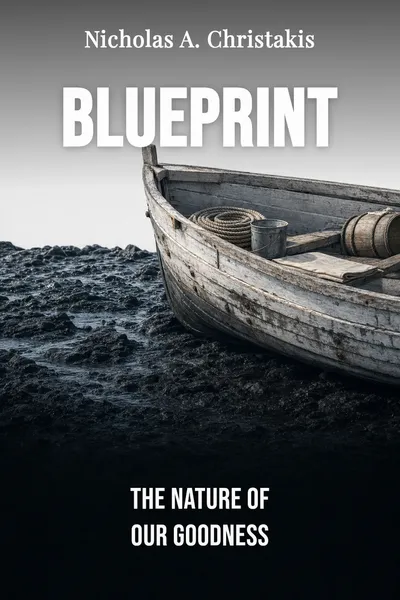
Blueprint
The nature of our goodness
Description
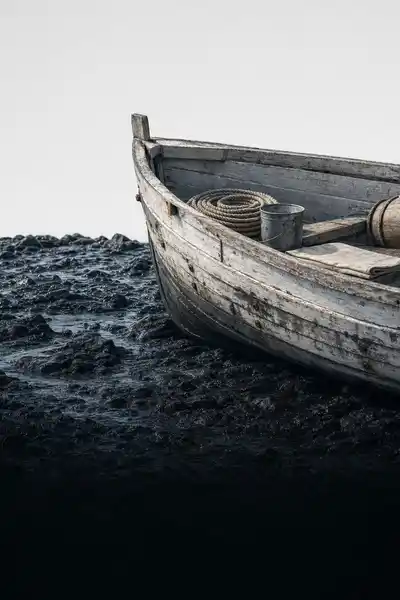
In the eighteenth and nineteenth centuries, hundreds of ships wrecked in the seas around Antarctica and the Pacific. A handful left behind something rarer than salvage: records of what the survivors did once they washed ashore. The sociologist Nicholas Christakis, in his 2019 book Blueprint, treats these accidental communities as natural experiments. Strangers, thrown together with no plan and no authority, had to invent a society from scratch. And when he lines the wrecks up side by side, something odd emerges. The groups that fell into hierarchy, hoarding, and violence tended to die. The ones that shared food, nursed the sick, buried the dead, and picked leaders by consent tended to survive.
That pattern is the hook of the whole book. Christakis is a physician and social scientist who spent years studying networks, kindness, and how people affect one another. His argument runs against a long habit in science. For decades, the fashionable story about human nature has been a dark one: we are wired for tribalism, aggression, deception, and self-interest, and everything decent is a thin coat of paint over the beast. Christakis does not deny the beast. He simply insists it is only half the inheritance.
The other half, he says, is written into us just as deeply — by the same blind process of natural selection that gave us opposable thumbs and colour vision. Love, friendship, cooperation, a taste for teaching and learning, a preference for people we recognise as individuals: these are not lucky accidents of civilisation. They are, in his word, a blueprint. And if that is true, it changes what we can expect of ourselves.
The question we’re asking : Is our capacity to build good societies a fragile cultural achievement, or something evolution baked into us long before the first city?What we’ll see : Shipwrecks, kibbutzim, elephants and robots, all pointing to a shared social grammar that runs deeper than any institution we've ever designed.
Table of contents
01Chapter 1 — A ship that keeps rebuilding the same room
Christakis opens with the wrecks because they strip the question down to its bones. When a ship goes down and the survivors reach an island, no government follows them ashore. There is no constitution, no police, no inherited law. Whatever social order appears has to be improvised by frightened, exhausted strangers. So the historical record of these disasters is, in effect, a rough archive of what people reach for when they have to start over.
He compares cases carefully. The Invercauld and the Grafton both wrecked on the same subantarctic island, Auckland Island, within months of each other in 1864. The Grafton's five men organised themselves democratically, taught one another skills, kept everyone fed, and eventually built a forge and a small boat. All five lived. The Invercauld's larger crew fractured into factions, abandoned the weak, and in at least one grim episode turned to cannibalism. Of nineteen men, three survived. Same island, same weather, opposite outcomes.

02Chapter 2 — The eight things every good society carries
The social suite, as Christakis lays it out, is a package of eight related things that show up wherever humans form durable groups. The capacity to have and recognise individual identity. Love for partners and offspring. Friendship. Social networks. Cooperation. A preference for one's own group, what he calls in-group bias. A soft, informal hierarchy rather than rigid domination. And social learning and teaching. Take any functioning human community, from a Silicon Valley office to a Hadza foraging band, and you find the same eight features doing the same load-bearing work.
He grounds the claim in comparison rather than assertion. When anthropologists survey small-scale societies with no contact with the modern world, the same features recur. When Christakis studied a set of isolated communities in Honduras, mapping who was friends with whom, the structure of those friendship networks looked statistically like the networks of American college students and Rwandan villagers alike. People everywhere have roughly the same number of friends, form roughly the same kinds of clusters, and are kind to friends of friends in roughly the same way.
03Chapter 3 — Why nature loved the friendly ones
The heart of the book is the claim that natural selection, the same process usually invoked to explain our violence, built our goodness too. This is not sentimental. Christakis walks through the mechanics of how a blind, amoral process could favour love, loyalty and friendship, and the answer is that these traits pay.
Take love. Pair-bonding — the tendency to form a lasting attachment to a mate — is rare among mammals but strong in humans, and Christakis ties it to the brutal arithmetic of raising a helpless, slow-growing child. A human infant is expensive and defenceless for years. Parents who bonded and cooperated raised more surviving children than those who did not, and the neural machinery of attachment, the oxytocin and the reward circuits, got passed along. What feels like the least biological thing about us — devotion — is among the most.
04Chapter 4 — The genes that build a civilization
Step back from the shipwrecks and the elephants and Christakis's larger quarrel comes into view. For most of the twentieth century, the loudest scientific stories about human nature were dark, and the loudest stories about human decency credited culture — as if institutions, religion and law had to civilise a creature that was, underneath, purely selfish. Blueprint refuses that division of labour. Culture and biology, in his telling, are not opponents. They are partners, and the partnership runs one particular way: our genes shape the kinds of societies we are able and inclined to build.
This is why he keeps returning to convergence. If good societies were purely cultural inventions, we would expect them to vary without limit. Instead, across wrecks, communes, kibbutzim and utopian experiments, the same social suite keeps reasserting itself, and the arrangements that fight it — that abolish the family, or crush individuality, or dissolve friendship into the collective — tend to fail or quietly restore what they banned. He reads the failed communes of the nineteenth century this way: the ones that survived longest were the ones that made peace with human nature rather than trying to reengineer it.
05Conclusion
Christakis ends more or less where he began, on the strangers washed ashore who kept rebuilding the same room. The Grafton's five men did not have a better island than the Invercauld's crew. They had a better grip on the parts of human nature that let a group survive — and those parts, Blueprint argues, were not invented on the beach. They were carried there, in the same bodies that also carried the capacity for cruelty and abandonment.
Related books