Blue Mind
Water's healing power revealed
Description
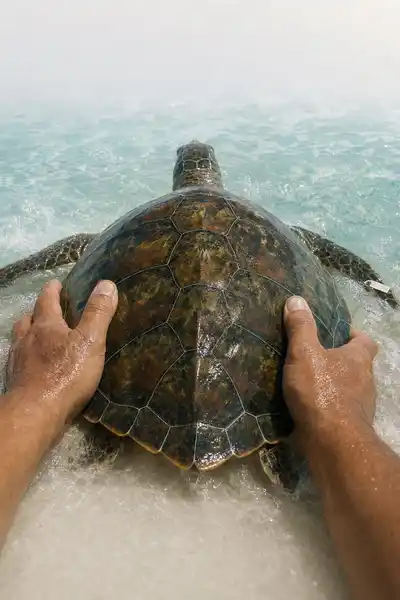
Somewhere on the coast of Baja California, in the early 2000s, a marine biologist named Wallace J. Nichols was tagging sea turtles and noticing something he couldn't put in a research paper. The volunteers who came to help him — scientists, students, retirees — kept saying the same thing about the ocean in front of them. Being near it made them feel better. Calmer, clearer, somehow more themselves. Nichols had spent his career studying what lived in the water. He started wondering, instead, what the water did to the people standing beside it.
That question became a book. Published in 2014, Blue Mind gathered the scattered evidence — from neuroscience, psychology, and medicine — that proximity to water changes how our brains behave. Nichols gave the phenomenon a name and made a claim that sounds soft until the studies pile up behind it: that lakes, rivers, pools, and coastlines aren't just pleasant backdrops. They act on the nervous system in ways we can now begin to measure, and that most of us have felt without ever naming.
What follows is Nichols's case, laid out the way he builds it — starting from a biologist's stubborn curiosity, moving through the wiring of the brain, and ending somewhere much larger than a beach vacation. The through-line is simple to state and harder to shake: our relationship with water is not decoration. It's biology, and it may be one of the more overlooked levers on how we feel.
The question we’re asking : Why does being near water make so many of us feel measurably better, and what is actually happening when it does?What we’ll see : How a marine biologist turned a hunch about the sea into a documented case for water as a force on the human mind.
Table of contents
01 Chapter 1 — A biologist who kept asking why we love the sea
Wallace J. Nichols didn't set out to write about feelings. He was a marine biologist with the credentials to prove it — years of fieldwork on sea turtles, tracking their migrations across the Pacific, publishing the kind of quantitative work that earns tenure and grants. Water, for him, was a habitat to study, full of animals with measurable behaviors. The people around it were incidental to the science.
But the people wouldn't stay incidental. Over years of expeditions, Nichols kept collecting the same offhand testimony from everyone who joined him near the ocean: something about the water settled them. He heard it from hardened researchers and first-time volunteers alike. As a scientist, he was trained to distrust anecdote — but he was also trained to notice a pattern that keeps repeating. This one repeated relentlessly, and nobody was studying it.

02 Chapter 2 — The brain on water, measured
The strongest thread in Blue Mind is the attempt to move the conversation from poetry to measurement. Nichols draws heavily on the tools that let researchers watch the brain in something close to real time — functional imaging, hormone assays, heart-rate and stress markers — and asks what changes when a person encounters water. The picture that emerges is not that water performs miracles, but that it nudges the nervous system in a consistent, favorable direction.
Part of the explanation runs through attention. Nichols leans on the work of researchers like Stephen and Rachel Kaplan, whose attention-restoration theory holds that natural environments give the brain's overworked, directed-attention system a rest. A screen or a crowded street demands constant focused effort. A body of water offers what they call soft fascination — enough to hold the eye, not so much that it drains you. The mind wanders productively, and the exhausted attention circuits recover.
03 Chapter 3 — Not all water is the same water
A fair objection to Blue Mind is that "water" is doing an enormous amount of work in one small word. A raging flood is water. So is a tsunami, a drowning, a leaking basement. Nichols knows this, and one of the book's quieter strengths is that it refuses to pretend the relationship is uniformly warm. Our response to water is shaped by context, safety, and memory as much as by the water itself.
The healing effect, as he describes it, depends on a sense of safety. Water that reads as calm, contained, and navigable invites the Blue Mind state. Water that signals danger does the opposite — it flips us straight into the alert, defensive Red Mind, exactly as it should. The same ocean that soothes a swimmer on a gentle morning terrifies a sailor in a storm. The benefit isn't in the molecule; it's in the encounter.
04 Chapter 4 — What the case for blue space asks of a landlocked life
Step back from the individual swim, and Nichols's argument turns into something with public stakes. If water measurably improves mood, attention, and stress, then access to it stops being a matter of taste and starts looking like a matter of health — the kind of thing a society might reasonably choose to distribute more fairly. That reframing is where Blue Mind quietly gets ambitious.
Nichols pushes the point toward how we build and value places. Waterfront property commands a premium precisely because people sense its worth, but that same market logic tends to fence off the most restorative shorelines behind wealth. If the benefit is biological, the question of who gets to live near water, walk beside it, or simply see it becomes a question about equity, not just real estate. The people who most need a nervous-system reset are often the ones with the least blue space around them.
05 Conclusion
The book ends more or less where it began — with a biologist standing near the water, only now able to say something about the feeling he kept hearing described. Nichols never claims water cures anything. What he assembles is a patient case that our brains respond to it in consistent, favorable ways, and that we've been treating a genuine influence on human well-being as if it were merely a nice view. Named and measured, the effect stops being sentimental and starts being useful.
Related books