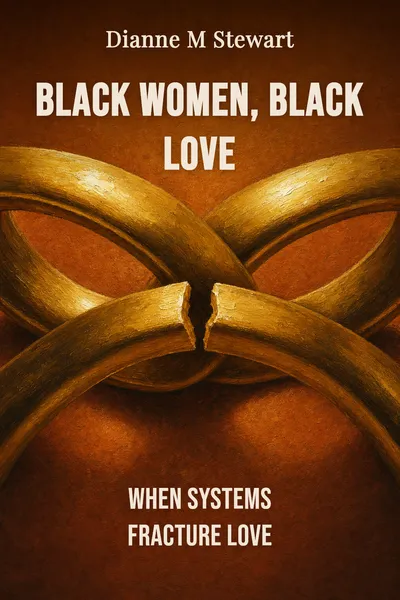
Black Women, Black Love
When systems fracture love
Description
In Black Women, Black Love, the scholar of religion Dianne M. Stewart opens with a number that has haunted American conversation for decades: by the second decade of the twenty-first century, roughly seven in ten Black women in the United States were unmarried, a far higher share than for white or Latina women. The figure gets recited on daytime television, in sermons, in group chats, usually with a shrug and a theory attached — women too demanding, men too absent, standards too high. Stewart takes the same figure and turns it a quarter turn, and suddenly it stops looking like a verdict on anyone's character.
Her book is neither a dating manual nor a lament. It is a work of history that treats the difficulty of Black love as evidence — the way a doctor treats a symptom as a clue rather than a flaw. Stewart, who teaches at Emory, weaves archival research, sociology, and passages from her own life into a single argument: that the loneliness so many Black women describe was engineered long before they were born, assembled brick by brick across four centuries of American policy toward Black families.
That reframing is the whole point. If the obstacle is personal, the fix is personal — try harder, want less, fix yourself. If the obstacle was built, the story is different, and so is who owes an explanation. Stewart wants us to read the intimate as the residue of the structural, and to sit with what that means for how a country narrates its own private wounds.
The question we’re asking : Why has partnership been so hard to hold onto for Black women in America, and where does that difficulty actually come from?What we’ll see : How Stewart traces a private ache back through slavery, law, and the modern state — and refuses to let it rest on individual shoulders.
Table of contents
01 Chapter 1 — The shortage that was manufactured
Stewart begins where most public conversation ends: with the sense that there simply aren't enough available Black men to go around. She doesn't deny the arithmetic. The imbalance is real, and it is stark. But she refuses to treat it as a fact of nature, the way a drought or a bad harvest might be. A gap in the marriage pool, she insists, is not weather. It is the sum of choices made by institutions over a very long time, and someone made them.
The book calls this the great unmentioned context. When commentators marvel that so many accomplished Black women are single, they tend to reach for explanations that live inside the women themselves — too educated, too independent, too particular. Stewart lets the reader feel how strange that move is. We would not, she notes, explain a bread line by scrutinizing the appetites of the people standing in it. Yet the marriage line gets read exactly that way, as if demand had malfunctioned rather than supply.

02 Chapter 2 — What slavery did to the marriage it forbade
The oldest layer, Stewart argues, is the one that touched the family most directly. American slavery did not recognize marriage between enslaved people as a legal bond. Couples could jump the broom, could love and raise children, could stay together for decades — but the law gave them no claim on each other that an owner had to honor. A husband could be sold south, a wife auctioned to settle a debt, children carried off before they could remember a parent's face. The bond existed; the protection did not.
Stewart draws on the testimony that survives — the advertisements placed by freed people after emancipation searching for spouses and children scattered across states, the interviews collected in the 1930s from those who had lived it. What comes through is not the absence of love but its deliberate fracture. Enslaved people built families with astonishing tenacity precisely because the system was designed to make those families provisional. The tenderness and the terror are recorded on the same page.
03 Chapter 3 — The state moves in where the plantation left off
The second half of Stewart's history is about what replaced the plantation. Freedom arrived without land, without capital, without the wages that let a man support a household on his own labor. Black men were funneled into the lowest-paid work and, through the convict-lease system, back into forced labor under a new name. A marriage needs a floor to stand on — steady income, a place to live, some protection from arbitrary removal. The Jim Crow economy withheld all three, and did so by design rather than accident.
The pattern Stewart traces is one of substitution. Where slavery had removed men through sale, the twentieth century removed them through other channels that arrived at the same result. Migration pulled workers toward northern cities and separated couples. Discriminatory lending and housing policy kept families from building the assets that stabilize a marriage. And then, in the closing decades of the century, came mass incarceration, which Stewart treats as the most consequential development of all.
04 Chapter 4 — A private ache with public fingerprints
Step back from the specific dates and what Stewart has really done is change the category the problem belongs to. For most of American life, the difficulty of Black love has been filed under private matters — a question of individual choices, personal chemistry, who was willing to compromise. Stewart moves the file. She argues that this intimate terrain carries the fingerprints of public decisions, and that reading it any other way is a kind of collective forgetting dressed up as common sense.
The stakes of that move are larger than they first appear. When a hardship is labeled personal, the burden of explanation falls on the person living it, and the country gets to keep its innocence. The single Black woman is told to examine her standards; the nation is not asked to examine its record. Stewart's history refuses that trade. She insists that a love life is also a document, and that this particular document records what happened when policy decided some families deserved less protection than others.
05 Conclusion
Stewart ends where she began, with the woman told her singleness is her own doing, and hands her a different account of herself. The seventy-percent figure that opened the book has, by the last page, been unfolded into two centuries of interference — the sold spouse, the leased convict, the redlined block, the emptied cell block's worth of missing men. Nothing about the number changes. What changes is the direction the explanation runs. It no longer points inward at a flaw; it points outward at a country.
Related books