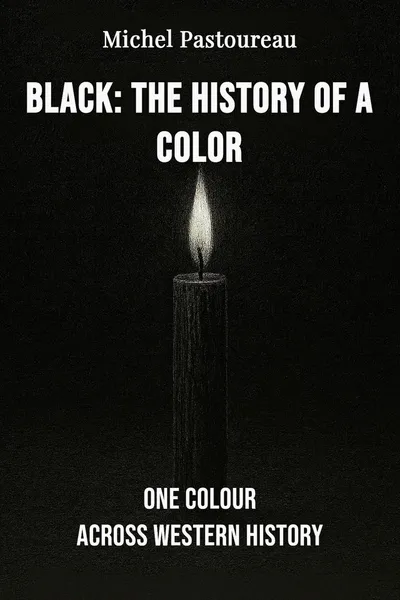
Black: The History of a Color
One colour across Western history
Description
In his study of black, the French historian Michel Pastoureau opens on a paradox that most of us never think to question: black is not really a color, and yet no color has carried more weight across Western history. We treat it as the absence of light, the neutral ground against which everything else stands out. We put it on judges, priests, mourners and the well-dressed, and we barely notice that we are doing so. Pastoureau spent decades tracking colors through medieval manuscripts, dye-workshop records, church councils and painters' contracts, and black is the one that kept changing meaning under his hands.
His method is unusual. He refuses to treat a color as a fact of physics or a matter of taste. Color, for him, is a social phenomenon — something a society decides, argues over, legislates and eventually forgets it ever decided. Black is the clearest case. In the ancient world it could mean fertility or death depending on which black one meant. In the Middle Ages it fell into disrepute, then climbed back to become the most respectable shade a person could wear. By the seventeenth century it was the color of kings and merchants alike, and by the nineteenth it was the uniform of the industrial age.
What makes the story worth following is that black never moves on its own. It moves because a dyer solves a technical problem, because a theologian wins an argument, because a sumptuary law tells the rich what they may not wear. The color is a mirror held up to a civilization's anxieties about wealth, virtue, death and status. Pastoureau's book is less about a shade than about the machinery that assigns shades their meaning.
The question we’re asking : How did one color travel from the color of the grave to the color of elegance, and what moved it each time?What we’ll see : A journey through dye vats, monastic quarrels and royal wardrobes, following the color that a whole civilization kept redefining.
Table of contents
01 Chapter 1 — The color of the beginning and the grave
Pastoureau begins where black itself begins, in the oldest layers of Western imagination. Prehistoric painters used two blacks — one from charcoal, one from burnt bone or manganese — and they used them abundantly, tracing the animals of Lascaux and Chauvet in confident dark lines. Black was among the first colors humans ever handled deliberately. It was not yet a symbol of anything grim; it was simply the color that let an image exist on stone.
In the ancient Mediterranean, black already carried a double life. The Egyptians linked it to the fertile silt of the Nile, to rebirth and the promise of the afterworld, which is why it could sit comfortably beside gold in the tomb. But black was also the color of the underworld, of night, of the shades of the dead. Two blacks, roughly, coexisted in the ancient mind: a good black tied to fertility and origin, and a bad black tied to death and the void. This distinction, Pastoureau argues, would echo for centuries.

02 Chapter 2 — When the Church argued about a color
The Middle Ages inherited this divided black and promptly made it the subject of a long theological quarrel. Early Christianity leaned toward suspicion. Black was the color of the demonic, of sin, of the raven and the crow, of everything that lurked in darkness away from divine light. The devil was routinely painted black; hell was rendered in soot and shadow. In a religion organized around light as the sign of God, the color furthest from light was easy to condemn.
And yet black also became the color of humility and renunciation. When Benedict of Nursia clothed his monks, he chose undyed dark wool — cheap, plain, a rejection of vanity. For centuries the Benedictines were simply the black monks. To wear black was to withdraw from the color, the display and the pride of the world. Here the shade meant discipline and holiness, the opposite of its demonic sense. Pastoureau shows how the same color could carry sanctity and sin depending only on who wore it and why.
03 Chapter 3 — The dyers who could not make it deep
For most of the Middle Ages, Pastoureau explains, black was a color you could hardly buy. The technical obstacle was blunt: dyers simply could not produce a rich, deep, lasting black on cloth. Their black tended to come out grayish, brownish or bluish, and it faded. A garment dyed black often looked tired within a season. This is why, for a long time, black clothing signaled poverty rather than prestige — it was the color of undyed or badly dyed wool, of those who could not afford the brilliant reds and blues that only skilled workshops could deliver.
The dye trades were also rigidly divided and jealous of their monopolies. Guilds specialized: some dyers worked in blue with woad, others in red with madder or kermes, and the right to dye in one color did not extend to another. Black fell awkwardly between them, hard to make and easy to botch. To get a passable black, dyers often had to layer dyes — a bath of blue under a bath of another color — an expensive, uncertain process that few mastered.
04 Chapter 4 — Black comes back as power and elegance
This is Pastoureau's larger point, and it reaches well beyond the dye vat: a color is a social code, not a fixed fact. Black meant poverty until technique made it costly; it meant the devil until doctrine made it grave; it meant one thing to a mourner and another to a magistrate. Nothing in the color itself changed. What changed were the arrangements — technical, legal, moral — through which a society decided what the color was allowed to say. Once we see black this way, the modern story falls into place.
By the fifteenth century the dukes of Burgundy, among the richest and most fashionable rulers in Europe, dressed in black by choice, turning a color of restraint into a display of supreme confidence. From there black spread across the courts. The Spanish monarchy adopted it as the color of Catholic gravity and imperial dignity; the Protestant Reformation embraced it as the color of sobriety, modesty and rejection of Catholic display. Two opposed religious camps landed on the same shade for opposite reasons — proof, for Pastoureau, that a color's meaning is assigned, not inherent.
05 Conclusion
From the charcoal of Lascaux to the frock coats of the nineteenth century, black keeps returning as a different color each time — the grave and the fertile field, the devil and the humble monk, the pauper's cloth and the merchant's pride. Pastoureau's achievement is to show that these are not contradictions to be resolved but the whole point. Black has no single meaning because no color does. It carries whatever a given society, at a given moment, needs a dark shade to carry, and it sheds that meaning the moment the arrangements behind it shift.
Related books