Black Snow
The firebombing campaign against Japan
Description
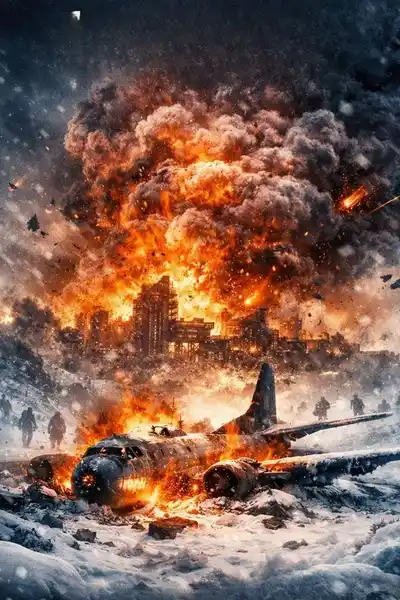
On the night of March 9, 1945, more than three hundred American B-29 bombers crossed the coast of Japan and turned toward Tokyo. They came in low, around five to seven thousand feet, stripped of most of their guns to carry more weight, and what they carried was fire. In roughly three hours they released some 1,600 tons of incendiaries over the densest working-class districts of the city. The bombs ignited a firestorm so intense that it generated its own wind, boiled the water in canals, and left survivors describing a black snow of ash falling from the sky. By dawn, sixteen square miles of Tokyo had ceased to exist, and somewhere around 100,000 people were dead — more than would die at Nagasaki five months later.
In his book Black Snow, the historian James M. Scott reconstructs how the United States came to wage this campaign, and how it became, for a time, the most destructive night of aerial warfare in history. The raid was not an accident or an excess. It was the deliberate product of a strategy, a technology, and a small group of officers who had concluded that the way to end the war was to burn Japan's cities down. What Scott traces is the path from precision bombing, the doctrine the US Army Air Forces had trained for and believed in, to something else entirely — the intentional incineration of civilian neighborhoods.
The firebombing of Japan is one of the largest things the United States did in the Second World War and one of the least discussed. Hiroshima and Nagasaki entered the moral imagination of the century; the sixty-odd cities burned before them mostly did not. Scott's book asks us to sit with that gap — to look at the decisions, the men who made them, and the people who lived and died under the fire, before the atomic flash rearranged what everyone chose to remember.
The question we’re asking : How did the United States move from precision bombing to deliberately burning Japan's cities, and why has the campaign that resulted faded from memory?What we’ll see : The strategy behind the incendiary raids, the night that made them infamous, and the long silence that followed.
Table of contents
01Chapter 1 — The man who wanted to burn cities
The American bombing of Japan began as something it did not stay. When the B-29 Superfortress finally reached Japan in late 1944, flying from newly captured bases in the Mariana Islands, it was meant to carry out the doctrine the Air Forces had built themselves around: high-altitude precision bombing of factories, aircraft plants, and other military targets. The idea was clean warfare — hit the machine that made the war, spare the people around it. The trouble was that it did not work. From 30,000 feet, over a country hidden under near-permanent cloud, and battered by a jet stream nobody had planned for, the bombs simply missed. Raid after raid dropped its load into fields and water.
Into that failure stepped Curtis LeMay, a thirty-eight-year-old general with a reputation for producing results and no patience for doctrine that didn't. Scott draws him carefully: a blunt, cigar-chewing officer who had already run bombing campaigns in Europe, who cared about outcomes more than method, and who arrived in the Marianas in January 1945 under pressure to justify the enormous cost of the B-29 program. The plane was the most expensive weapons project of the war, more costly even than the atomic bomb, and it was so far producing almost nothing.

02Chapter 2 — The city built to catch fire
To understand why the raid worked the way it did, Scott turns to the target itself. Tokyo in 1945 was one of the most flammable large cities on earth. Its residential neighborhoods were built almost entirely of wood, bamboo, and paper, homes pressed wall to wall along narrow lanes, with tile roofs over frames that dried like kindling. The districts LeMay chose — Asakusa, Honjo, Fukagawa, the low-lying eastern wards along the Sumida River — were among the most crowded places in the world, tens of thousands of people packed into each square mile.
The Americans had studied this with unsettling thoroughness. Scott describes the research effort behind the campaign, including a full-scale mock Japanese village built in the Utah desert, complete with authentic tatami mats and furnishings, so that engineers could test which incendiary mixtures spread fastest through Japanese homes. The weapon that emerged was the M-69, a small bomb clustered in bundles that scattered in the air, punched through roofs, and sprayed burning napalm gel that stuck to whatever it touched. Fire chemists had, in effect, been asked to design the most efficient way to burn a Japanese city, and they had delivered.
03Chapter 3 — The night of March 9, 1945
The lead planes arrived over Tokyo shortly after midnight. These were the pathfinders, and their job was to mark the target — to lay burning crosses of fire across the eastern districts that the main force would then fill in. Behind them came wave after wave of B-29s, flying lower than heavy bombers had ever attacked a defended city, each releasing its clusters of M-69s into the dark. The incendiaries fell in overlapping patterns, and within minutes thousands of separate fires had merged.
What followed was not a large fire but a firestorm — a self-sustaining inferno that pulls in air from all directions, feeding itself with hurricane-force winds. Scott reconstructs the night through survivor accounts of almost unbearable specificity. People fled through streets where the asphalt melted and clung to their feet. Families who took shelter in canals and rivers were boiled or suffocated as the fire consumed the oxygen above them. The heat was intense enough to ignite clothing at a distance and to reduce bodies to nothing. Superheated winds threw people off their feet and sucked children from their parents' arms.
04Chapter 4 — What the numbers left out
Tokyo was the beginning, not the end. Over the following months LeMay's bombers moved methodically across Japan, burning Nagoya, Osaka, Kobe, and dozens of smaller cities in a systematic campaign that torched more than sixty urban areas before August. By the war's end, the incendiary raids had killed hundreds of thousands of Japanese civilians and left millions homeless — a toll that, taken together, exceeded the deaths at Hiroshima and Nagasaki combined. And yet, as Scott observes, it is the two atomic bombs that fixed themselves in memory while the firebombing quietly receded.
Part of the reason is the strange arithmetic of how nations remember violence. The atomic bomb was singular, a new kind of weapon, a bright line that felt like the arrival of a different age; it demanded reckoning. The firebombing was cumulative — one city after another, no single flash, no new physics — and cumulative horror is easier to look past than a novel one. A weapon that ends the world in an instant makes a better story, and a heavier conscience, than fire delivered over months by ordinary bombs.
05Conclusion
Curtis LeMay lived a long public life after the war, commanding the Strategic Air Command, running for vice president in 1968, dying in 1990 as a decorated architect of American air power. He never much apologized for Tokyo, and never much needed to; the country that had burned Japan's cities largely chose not to ask. The black snow that fell on the survivors that March morning settled, over the decades, into a silence — present in Japanese memory, thinned almost to nothing in American.
Related books