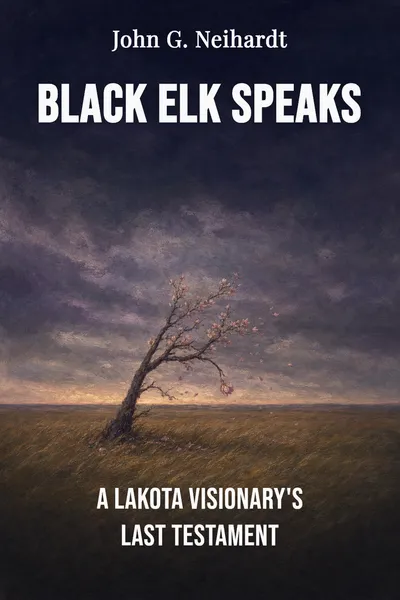
Black Elk Speaks
A Lakota visionary's last testament
Description
In May 1931, a middle-aged white poet named John G. Neihardt sat on the Pine Ridge Reservation in South Dakota, across from an aging Oglala Lakota man who had agreed to talk. Black Elk was then in his late sixties. He had been born around 1863, into a world of horses and open plains that no longer existed by the time the two men met. Neihardt had come looking for material on the Ghost Dance and the massacre at Wounded Knee. What he found instead was a man who had been waiting, he said, for someone to whom he could hand something before he died.
Black Elk was not a chief or a warrior chief of the kind history books remember. He was a wichasha wakan — a holy man, a healer — and as a boy he had received a vision so vast and so demanding that he had spent his whole life failing, by his own account, to make it come true. He was a second cousin of Crazy Horse. He had been at the Little Bighorn as a child, and at Wounded Knee as a young man in 1890. Through an interpreter, with his son Ben translating and Neihardt's daughter taking it down, he told his life across several days, and asked that it be given to the world.
The book that came out of those sessions, published in 1932, has outlived almost everything written about Native America in that era. It is at once one man's life, a nation's history, and a spiritual document that people who have never heard of the Lakota still read. And it ends not in triumph but in a kind of quiet grief — a holy man measuring his life against what he had been shown, and finding a gap he could not close.
The question we’re asking : What did an old Lakota healer choose to hand to a stranger at the end of his life, and why has it lasted?What we’ll see : A man's life told from the inside, the vision that organized it, the history that broke around it, and what survives a defeat.
Table of contents
01 Chapter 1 — A poet and an old man on Pine Ridge
John Neihardt was, by 1930, an established figure — poet laureate of Nebraska, a critic and writer working on a long epic cycle about the American West. He had spent years among Plains peoples, and he came to Pine Ridge that summer to interview survivors for the closing sections of his poem. Someone pointed him toward Black Elk, an old man living near Manderson, and the meeting seemed at first like one more research errand. It became the central encounter of Neihardt's life.
Black Elk received him with a recognition that unsettled Neihardt. The old man said he had known the poet was coming, and that here at last was the person he could give his story to before he passed. Whatever one makes of that — Neihardt reported it plainly, without smoothing it — the two men formed a bond that the book carries on every page. Black Elk adopted Neihardt into his family and gave him a Lakota name meaning, roughly, Flaming Rainbow.

02 Chapter 2 — The great vision of a nine-year-old
The center of Black Elk's life, and of the book, is a vision he received when he was about nine years old, during a serious illness that left him unconscious for days. It is one of the most detailed accounts of a visionary experience ever set down, and Black Elk described it as the fixed point against which he measured everything that followed. He said he was taken up by the Thunder-beings and brought before the six Grandfathers — the Powers of the four directions, of the sky, and of the earth.
In the vision the Grandfathers gave him gifts and showed him things: a cup of water with the power to make live, a bow with the power to destroy, a healing herb, a sacred pipe. He was shown the hoop of his nation and many hoops beyond it, all making one great circle, and at the center a flowering tree under which the people of every nation lived together. He saw himself standing on the highest mountain of the world, and understood that the sacred hoop of his people was one hoop of many, and that all living things were relatives.
03 Chapter 3 — A century of broken promises
Black Elk's life ran exactly along the years when the Lakota world was dismantled. He was a boy when the Bozeman Trail brought soldiers and settlers north through the buffalo country, and a young teenager in 1876 when the tribes gathered on the Little Bighorn and destroyed Custer's command. He describes that day from a child's vantage — the dust, the fear, the sudden turn of the fighting — without any of the triumph later mythology attached to it. He remembers it as a day of killing, and of the confusion afterward.
What followed the victory was defeat. The army pursued the free bands relentlessly. The buffalo, on which the whole way of life rested, were slaughtered nearly to extinction within a few years. Crazy Horse, Black Elk's relative, surrendered and was killed under a guard's bayonet in 1877. The people were pushed onto reservations, their movement controlled, their children pressured into distant schools, the old economy gone. Black Elk spent a stretch of these years touring Europe with Buffalo Bill's Wild West show, performing a version of the life that was being taken from him, and returned to find things worse.
04 Chapter 4 — When the tree failed to bloom
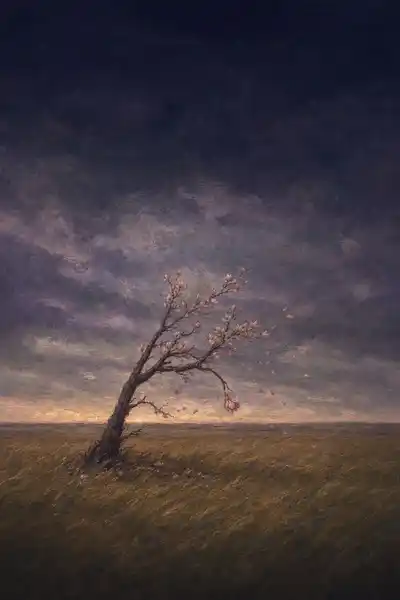
The book does not close on Wounded Knee as an event so much as on what it meant to the man telling it. Black Elk read his entire life against the vision of his childhood, and by that measure he judged himself to have failed. He had been shown a flowering tree at the center of the nation's hoop, and it was his task to make it bloom. Instead he had watched the hoop broken and the tree left dead. The most quoted lines in the book are his own verdict: that the nation's hoop is broken and scattered, that there is no center any longer, and that the sacred tree is dead.
What makes this more than one old man's sorrow is what the vision had actually contained. Black Elk had not been shown only the Lakota hoop. He had been shown many hoops making one circle, and all living things as relatives under a single tree. The dream that died at Wounded Knee was, in his telling, not merely tribal survival but a picture of humanity and the earth held together — the kind of unity that outlasts whichever people happens to be carrying it at a given moment. A testament like this survives because the thing it grieves is larger than the grief.
05 Conclusion
In 1931 Black Elk asked Neihardt to take him back to Harney Peak, the high place in the Black Hills he identified with the mountain of his vision. There, an old man in failing health, he prayed aloud to the Grandfathers, asking them to hear him one last time and, he said, half-expecting no answer. As he finished, a thin rain fell from a nearly clear sky and a little thunder sounded — enough that Neihardt recorded it, and enough that Black Elk took it as a reply. It is the image the book leaves us on: not a bloom, but a few drops of rain over a dead tree.
Related books