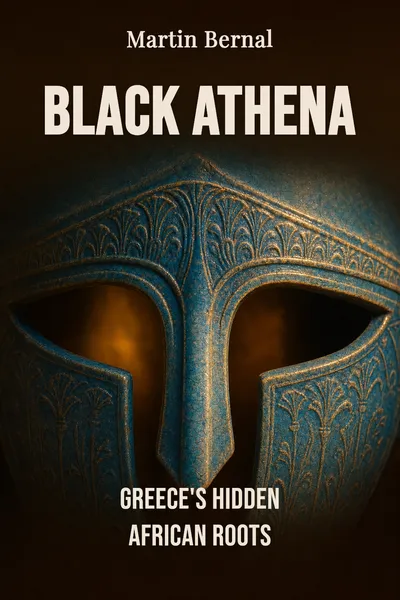
Black Athena
Greece's hidden African roots
Description
In 1987, a professor of Chinese political history at Cornell named Martin Bernal published the first volume of a book about ancient Greece — a field in which he had no formal training. Bernal had spent years teaching modern China; he came to the classical world sideways, through a mid-life fascination with the origins of his own Jewish and European heritage. The book was called Black Athena, and its subtitle promised something enormous: The Afroasiatic Roots of Classical Civilization. It argued that Greece, the culture Europe had spent two centuries claiming as its pure ancestor, had in fact been shaped, deeply and early, by Egypt and the Semitic Near East.
The reaction was not quiet. Classicists, historians, and linguists lined up to praise it, dismiss it, or take it apart line by line. Some called it the most important challenge to the field in a generation. Others called it a work of amateur overreach that got the philology wrong. The argument spilled out of the academy into newspapers and lecture halls, and it kept going: Bernal published a second volume in 1991, a third in 2006, and a whole book answering his critics in between. Few scholarly works of the late twentieth century generated so much heat for so long.
What made the book so combustible was not only what it said about the Bronze Age. It was what it said about the people who study the Bronze Age. Bernal claimed that the story of a self-generated, miraculously original Greece was not what the ancient sources reported — it was something modern Europe had constructed, and he thought he could name when, and why.
The question we’re asking : What did Bernal actually argue about where Greek civilization came from, and why did the claim provoke such a fight?What we’ll see : How a scholar reopened a question the ancient Greeks themselves had answered differently — and turned the origins of Europe into an argument about who gets to write the past.
Table of contents
01Chapter 1 — The two models of how Greece began
Bernal built his case around a contrast between two ways of telling the same story. The first he called the Ancient Model — the account the Greeks gave of themselves. In their own myths and histories, Greek culture had been seeded from outside. Egyptian colonists had founded cities; Phoenician settlers had brought the alphabet; gods and rituals had travelled north across the Mediterranean. Herodotus, writing in the fifth century BC, treated Egypt as the older, wiser civilization from which the Greeks had learned much of what they knew about the gods. This was not a fringe view. It was, more or less, the standard Greek understanding of their own beginnings.
Against this Bernal set what he called the Aryan Model, the version that took hold in European scholarship over the course of the nineteenth century. In this telling, Greece was born of an invasion from the north — Indo-European speakers, sometimes imagined as fair-skinned northerners, who arrived and produced a civilization essentially their own. The eastern and African contributions the Greeks had reported were downgraded to legend, or explained away, or simply dropped. Egypt became a static, exotic backdrop rather than a source. Greece became the first truly European thing.

02Chapter 2 — Egypt, Phoenicia, and the borrowings the Greeks admitted
The concrete heart of Bernal's argument lived in the details — in place names, divine names, and loanwords that he thought pointed east and south. He proposed that a large share of Greek vocabulary that scholars could not trace to Indo-European roots came instead from Egyptian and Semitic sources. The name Athena itself he linked, controversially, to an Egyptian phrase for the goddess Neith. Whole clusters of religious and technical terms, he suggested, carried the fingerprints of contact with older civilizations to the south and east.
Some of this ground was not really in dispute. That the Greek alphabet descended from a Phoenician one is standard: the Greeks said so, and the letters admit it. That Near Eastern art, mythology, and craft flowed into the Aegean during what specialists call the Orientalizing period is also widely accepted. Bernal's move was to push the contact earlier, into the second millennium BC, and to make it foundational rather than decorative — not a late influence on an already-formed Greece, but part of how Greece came to be in the first place.
03Chapter 3 — How the nineteenth century rewrote the family tree
The most disruptive part of Black Athena was not about antiquity at all. It was about the modern discipline of classics, and about the men who founded it. Bernal argued that the shift from the Ancient Model to the Aryan Model happened over a specific stretch of time — roughly the late eighteenth to the mid-nineteenth century — and that it tracked the rise of two things: scientific racism and Romantic nationalism. As Europe built theories of racial hierarchy and told itself stories about the northern peoples' special genius, a Greece indebted to Africa and Asia became intolerable.
He located much of the transformation in the German universities that professionalized classical scholarship. This was the era when 'the Greeks' were installed as the pure childhood of the European spirit, a people who had invented reason, art, and freedom out of themselves. A Greece that had gone to school in Egypt did not fit that portrait. So, Bernal argued, the Egyptian and Phoenician debts the ancients had freely reported were reclassified as myth, and Herodotus was gently patronized as a credulous tourist.
04Chapter 4 — The politics buried inside a footnote
Step back from the etymologies and the colonization legends, and what Black Athena really put on the table is an uncomfortable idea about how knowledge of the past gets made. Bernal's deepest claim was that a scholarly consensus can be simultaneously rigorous and biased — that a field can follow its own rules honestly while those rules quietly encode the values of the society that built them. The story of Greek origins was not falsified by villains. It was reshaped by a whole culture's sense of who it wanted its ancestors to be.
That is why the book mattered far beyond Aegean prehistory. If the founders of classics could not see the racial assumptions folded into their methods, then no discipline can assume its own neutrality. Every generation asks the questions its moment finds urgent, trusts the sources its moment finds credible, and finds obvious the answers its moment is prepared to hear. Bernal turned the tools of history back on the historians, and the result was a lasting unease about treating any inherited consensus as simply the way things were.
05Conclusion
Martin Bernal came to ancient Greece as an outsider, and he never stopped being treated as one. He kept building his case across three thick volumes and a book of replies, conceding some points, digging in on others, until his death in 2013. The specialists corrected many of his details, and some of his boldest etymologies did not hold. But the frame he imposed on the argument outlasted the corrections: you cannot now discuss where Greek civilization came from without also discussing who decided the answer, and when, and why.
Related books