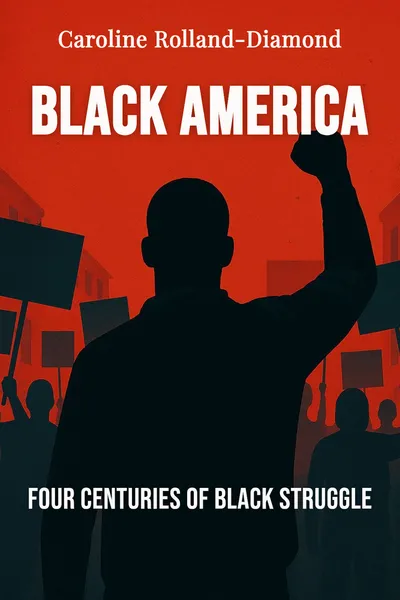
Black America
Four centuries of Black struggle
Description
In 1619, a ship carrying roughly twenty enslaved Africans reached the English colony of Virginia. It is one of the dates historians argue over — enslaved people had already passed through Spanish Florida decades earlier — but it has become the marker for the start of something that would run, in one form or another, for four hundred years. Caroline Rolland-Diamond opens her history of Black America there, not to fix a founding myth, but to set a clock running. From that moment, the presence of people of African descent on North American soil was organized around a single question that kept being answered and then un-answered: were they people, or property, or citizens, or something the law preferred to leave undefined?
The temptation, telling this story, is to reach straight for the famous images — a bus in Montgomery, a bridge in Selma, a speech at the Lincoln Memorial. Rolland-Diamond resists it. Her book stretches the frame back across centuries and insists that what we file under "the civil rights movement" was one chapter in a struggle that never actually paused. The people who marched in 1965 were the heirs of people who had petitioned, sued, escaped, revolted, organized and rebuilt for three hundred years before them. The victories were real. So were the reversals that followed almost every one of them.
What emerges is less a triumphal march toward freedom than a long argument the country kept having with itself, in which the same ground had to be won more than once. That pattern — gain, backlash, regroup — is the spine of the book, and it is what makes the history feel unfinished rather than settled.
The question we’re asking : How does four centuries of Black American history read when we treat it as one continuous struggle rather than a series of separate episodes?What we’ll see : A history that runs from a slave ship to the present, and keeps discovering that freedom won on paper has to be defended in practice.
Table of contents
01 Chapter 1 — The bondage that outlasted its own abolition
Slavery in North America did not arrive fully formed. In the early colonial decades, the line between an enslaved African and an indentured European servant was blurrier than it later became. Over the seventeenth century, colonial legislatures hardened that line deliberately, writing statutes that made slavery hereditary, tied it to African descent, and stripped enslaved people of the smallest legal footholds. By the time the thirteen colonies became a republic founded on the proposition that all men are created equal, roughly one in five people living in them was owned by someone else.
Rolland-Diamond is careful to show that the enslaved were never simply objects of this history. They shaped it constantly — through work slowdowns, through flight, through the preservation of family and faith under conditions designed to destroy both, and at times through open revolt. The rebellion led by Nat Turner in Virginia in 1831 left dozens dead and terrified the slaveholding South into tightening its controls even further. Resistance and repression fed each other. Every act of defiance was answered with new laws, new patrols, new cruelties meant to make the next act unthinkable.

02 Chapter 2 — Reconstruction, and the counter-revolution that followed
The years immediately after the war looked, briefly, like a genuine remaking of the republic. Three constitutional amendments abolished slavery, granted citizenship, and guaranteed Black men the vote. Across the South, freedpeople registered in enormous numbers, elected hundreds of Black officials, built schools and churches, and reached for the ordinary components of a free life — land, wages, the right to keep a family together. Rolland-Diamond treats Reconstruction as one of the most radical democratic experiments the country ever attempted.
It was also one of the most violently resisted. The Ku Klux Klan and allied groups waged a campaign of terror aimed at Black voters and their white allies, and the federal will to protect the new citizens steadily drained away. The disputed election of 1876 was resolved by a bargain that pulled federal troops out of the South. With the soldiers gone, the counter-revolution had a free hand.
03 Chapter 3 — A century of organizing before the marches
Because the mid-century movement is so vivid in memory, it is easy to imagine it arriving from nowhere. Rolland-Diamond spends much of her book dismantling that impression. The organizations, the strategies and the arguments that made the 1950s and 1960s possible were built over the preceding half-century, mostly out of public view.
The Great Migration was the largest fact of that period. Between roughly 1910 and 1970, some six million Black Americans left the rural South for the cities of the North and West, fleeing terror and poverty and looking for work and dignity. They found new forms of both discrimination and possibility, and the concentration of people in cities created something the scattered rural South had made difficult: dense networks, newspapers, churches, unions and political weight. Harlem in the 1920s produced an extraordinary cultural flowering, and it also produced organizers.
04 Chapter 4 — The unfinished arc
Reading four centuries in sequence changes what the famous victories mean. Rolland-Diamond's larger argument is that freedom, in the American story she tells, has repeatedly been granted on paper and then contested in practice — and that the contest is the actual history. Emancipation was followed by Black Codes. The Reconstruction amendments were followed by disenfranchisement. And the legislative triumphs of the 1960s, for all their genuine force, were followed by their own long backlash.
That backlash took forms that were harder to see than a lynch mob or a poll tax, which is part of why the struggle did not end when the cameras left Selma. Mass incarceration grew into a system that removed voting rights and life chances from Black communities at scale. Residential segregation, built by decades of housing policy, kept wealth and opportunity unevenly distributed long after the explicit laws were gone. Voting access, supposedly settled in 1965, became contested terrain again in the twenty-first century after the Supreme Court weakened the Voting Rights Act in 2013.
05 Conclusion
The book returns, in the end, to the length of the thing. Four hundred years is long enough that the temptation is to see progress as steady and cumulative — each generation a little freer than the last. Rolland-Diamond's chronology refuses that comfort. Progress in this history is real but reversible, and the reversals have been engineered as deliberately as the advances. The people who won each round knew they would have to defend what they had won, and often watched it eroded within their own lifetimes.
Related books