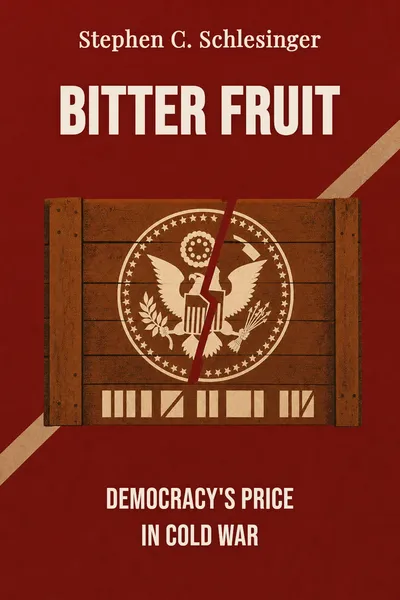
Bitter Fruit
Democracy's price in Cold War
Description
On June 27, 1954, Jacobo Arbenz, the democratically elected president of Guatemala, went on the radio to resign. He was the second president his country had chosen in free elections after decades of dictatorship. He had spent his brief term redistributing unused land to peasants who had none, and he believed, until nearly the end, that the United States would let a small neighbor run its own affairs. It would not. Within days he was walking through the airport terminal in Guatemala City, stripped to his underwear by soldiers as photographers recorded the humiliation, on his way into an exile from which he would never recover.
Stephen C. Schlesinger and Stephen Kinzer wrote the reconstruction of how that happened. Working through declassified documents, State Department cables, and interviews with the men who ran the operation, they laid out a covert action with a code name, a budget, a CIA case officer, and a script. The government that fell had won an election. The force that toppled it was a few hundred men, a couple of aging aircraft, and a radio station broadcasting a war that was mostly invented. Behind all of it sat a fruit company, a pair of Washington brothers, and a fear of communism sweeping the hemisphere.
The story matters because of what it turned out to be a rehearsal for. Guatemala in 1954 was one of the first times the United States quietly removed an elected government it disliked, and decided the method had worked well enough to keep. What made a land-reform law in a country of three million people look, from Washington, like a threat worth a coup — that is the knot this book patiently unties.
The question we’re asking : Why did the United States overthrow a freely elected government in a country most Americans could not find on a map?What we’ll see : How a democratic experiment, a single American corporation, and a Cold War reflex collided in a covert operation whose bill Guatemala is still paying.
Table of contents
01Chapter 1 — The country that decided to grow up
For most of its modern history, Guatemala had been run for the benefit of whoever owned the land. Coffee planters and foreign companies held the good soil; the Maya majority worked it under debt and vagrancy laws that were slavery in everything but name. The dictator Jorge Ubico, who governed through the 1930s, kept order with informers and made the trains run for the exporters. In 1944, a revolt of students, teachers, and junior officers pushed him out. For the first time, Guatemala held an open election.
The winner was Juan José Arévalo, a schoolteacher who had spent years in Argentina and came home talking about what he called spiritual socialism — a vague, generous idea that a country existed for its people rather than its landlords. He built schools, wrote a labor code, and survived more than twenty coup attempts. When his defense minister Jacobo Arbenz won the next election in 1950 with a large majority, the reforms turned concrete. Arbenz was an army officer, the son of a Swiss pharmacist, married to a wealthy Salvadoran woman with radical ideas. He was not a communist, though a handful of communists sat in his coalition.

02Chapter 2 — One company, one telegram line, one railroad
The United Fruit Company was not simply a business in Guatemala; for large stretches of the country it was the state. It owned the main port on the Atlantic, the railroad that reached it, the telegraph lines, and vast plantations of banana land, much of it deliberately kept fallow as a reserve. Guatemalans called it el pulpo, the octopus. When Decree 900 came for the unused acreage, the government offered compensation based on the low value United Fruit had itself declared for tax purposes — around six hundred thousand dollars. The company demanded roughly sixteen million.
What made United Fruit dangerous to Arbenz was not its plantations but its address book. Its public-relations operation was run by Edward Bernays, the man often called the father of modern spin, who worked the American press until Guatemala read, in respectable magazines, as a Soviet beachhead. Its legal and political ties ran straight into the new Eisenhower administration. Secretary of State John Foster Dulles had represented the company at his old law firm. His brother Allen Dulles, director of the CIA, had sat on related boards. Other officials held stock or had worked for the firm. The overlap did not need to be a conspiracy to function as one.
03Chapter 3 — The coup that ran on radio and bluff
The operation was named PBSUCCESS, approved by Eisenhower in 1953 and run by the CIA with a budget in the millions. Its instrument on the ground was Carlos Castillo Armas, an exiled Guatemalan colonel, given a few hundred men, some money, and a base in neighboring Honduras. On paper it was an invasion. In practice it was theater, and everyone who designed it knew the real weapon was not the tiny army but the impression of one.
The centerpiece was a clandestine radio station, the Voice of Liberation, which broadcast into Guatemala claiming that a great rebel force was advancing on the capital, that towns were falling, that the army was defecting. Almost none of it was true. Castillo Armas's column crossed the border in June 1954 and barely fought; it stalled a few miles in. But the broadcasts, combined with a handful of American-supplied planes bombing and strafing the capital to spread panic, created a fog in which no one could tell what was real. Arbenz, cut off from clear information, began to believe he was surrounded.
04Chapter 4 — What a small country revealed about a superpower
Step back from the banana fields and the radio scripts, and Guatemala becomes something larger than its own tragedy: a template. The year before, in 1953, the CIA had helped remove Mohammad Mosaddegh in Iran. Guatemala confirmed, in Washington's eyes, that covert action was a cheap, deniable, and effective tool of statecraft — cheaper than a war, quieter than a marine landing, and easy to dress in the language of freedom. The men who ran PBSUCCESS walked away convinced the method was sound. Some of them carried that conviction directly into the Bay of Pigs seven years later, where the same playbook failed spectacularly against a Cuba that had learned Guatemala's lesson.
What Schlesinger and Kinzer expose is the distance between the vocabulary and the deed. The United States spoke, sincerely, of defending democracy against totalitarian expansion. In Guatemala it overthrew the most democratic government the country had ever had, and installed a soldier who abolished elections for most of the population. The contradiction was not hypocrisy in any simple sense; it was the working belief that in the contest with communism, a friendly dictatorship was safer than an independent democracy. Sovereignty, in the hemisphere Washington called its backyard, was conditional on obedience.
05Conclusion
Jacobo Arbenz never found his footing again. He drifted through exile in Mexico, Switzerland, and the Eastern bloc, drank heavily, and died in Mexico City in 1971, found in his bathtub. Castillo Armas, the man Washington installed in his place, was assassinated by one of his own guards in 1957, and Guatemala fell into the cycle of coups and military rule that the intervention had been meant to prevent. The land went back to United Fruit, though the company itself would not long outlive its victory, undone by antitrust suits and its own decline.
Related books