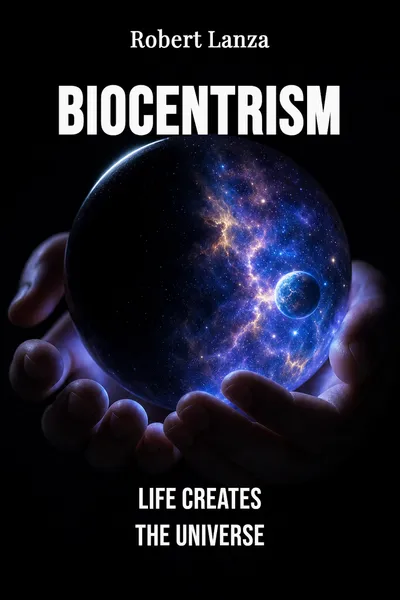
Biocentrism
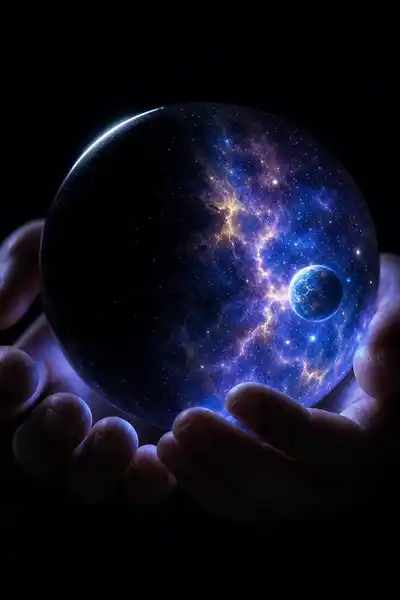
Life creates the universe
Description
For most of the fifteenth century, telling someone the Earth was a ball hanging in nothing would have earned a blank stare. The ground was flat, the sun crossed the sky, and common sense agreed. Then it didn't — and once the picture flipped, people couldn't unsee it. Robert Lanza, a biologist known for his work in stem-cell research and regenerative medicine, opens his 2009 book Biocentrism, written with the astronomer Bob Berman, by betting that we're standing on the edge of a comparable flip. Not about the shape of the planet this time, but about something stranger: whether the universe came first, or whether life did.
The claim sounds like a provocation, and Lanza knows it. Physics has spent a century assembling a spectacular account of how matter and energy behave, from the Big Bang to the standard model of particles. Yet the same century of experiments in quantum theory kept turning up results that refuse to sit still — outcomes that seem to depend on whether anyone is looking. Physicists mostly file these under "weird but useful" and keep calculating. Lanza's move is to stop walking around the weirdness and ask what it would mean to take it literally.
His answer runs backward from everything we're taught. The universe doesn't produce life as a late, lucky accident of chemistry on a small blue rock. Instead, the observer — the living, perceiving thing — is what turns a field of possibility into an actual world with space, time, color, and warmth. It's an argument that reaches into biology, physics, and the oldest questions about death, and it asks to be judged not by whether it's comfortable but by whether it fits the evidence better than the story we already have.
The question we’re asking : Does the universe create life, or does life create the universe — and what would it take to answer that seriously?What we’ll see : A biologist's case for flipping the usual order, built from quantum experiments, the puzzle of the perceiving mind, and a very different reading of time, space, and death.
Table of contents
01 Chapter 1 — The problem physics keeps walking around
Lanza starts with a confession the sciences rarely make out loud: for all its power, the standard picture of the universe has a hole in it exactly where we sit. Physics can trace the cosmos from the first fraction of a second after the Big Bang, model the fusion inside stars, and predict the behavior of particles to astonishing precision. What it cannot do, he argues, is explain the one thing every one of us has direct access to — the fact that there is experience at all, that a warm afternoon feels like something rather than nothing. Consciousness gets treated as a detail to be sorted out later, a byproduct of neurons that will fall into place once the physics is finished.
But the physics, he points out, never quite finishes. The book leans hard on a set of coincidences that physicists themselves find uncomfortable, sometimes grouped under the label of fine-tuning. A short list of fundamental constants — the strength of gravity, the charge of the electron, the force binding atomic nuclei — sit at values so precise that nudging almost any of them would produce a universe with no stars, no chemistry, and no possibility of life. The usual escape hatch is to imagine countless other universes with different settings, of which we happen to inhabit the rare hospitable one. Lanza finds that solution extravagant: an infinity of unobservable worlds invented to avoid a simpler question.

02 Chapter 2 — Seven principles, one reversal
To keep the argument from floating off into pure speculation, Lanza lays it out as seven principles of biocentrism — a spine for what is otherwise a sweeping claim. The first and most disorienting is that what we call reality is a process that requires our consciousness. A tree in a forest, on this view, is not a finished object sitting there in full color and sound waiting to be found. Color, sound, and even solidity, he argues, are constructions assembled in the perceiving mind. Photons carry no color; air carries no sound. Both are events that happen only when a nervous system turns them into experience. Strip away every observer and you're left not with a silent, colorless world but with something far harder to picture: possibility that hasn't yet resolved into anything.
03 Chapter 3 — Time and space were never out there
The strangest turns in the book come when Lanza applies his reversal to the two things that feel most solidly external: time and space. We treat both as a fixed stage on which events play out — a container that would keep ticking and stretching whether or not anyone were around. Lanza, drawing a line back through Immanuel Kant and forward through relativity, argues the opposite. Time and space are not features of the world independent of us. They are the tools the mind uses to organize experience, the software that arranges sensations into a coherent scene. Outside the act of perceiving, there is no ticking clock and no yardstick waiting in the dark.
He reaches for the quantum evidence again, and for its most vertiginous version. In the delayed-choice experiments proposed by the physicist John Wheeler and later carried out in the lab, a decision made now appears to determine how a particle behaved in the past — as if the present were reaching back to settle what already happened. Read through ordinary physics, this is a headache. Read through biocentrism, Lanza suggests, it stops being paradoxical: if time is not an external river flowing past us but a way experience is assembled, there is no fixed past sitting there to be violated. The famous double-slit experiment, where a single particle behaves like a wave until it is measured, becomes for him the plainest demonstration that observation is not passive. Looking does something.
04 Chapter 4 — What a theory of everything keeps leaving out
Step back from the individual claims and the shape of Lanza's project comes into focus. For decades physicists have chased a theory of everything — a single framework that would knit gravity to quantum mechanics and, in principle, describe the whole of nature from one set of equations. Lanza's quarrel is not that the search is too ambitious but that it is quietly incomplete by design. A theory that accounts for every particle and force while saying nothing about the consciousness doing the accounting is not, on his terms, a theory of everything. It is a theory of everything except the observer, and the observer is not a minor omission. It is the thing without which there would be no theory, no equations, and no one to be puzzled by the universe in the first place.
05 Conclusion
Biocentrism ends where it began, on the edge of a flip. Lanza and Berman have not handed the reader a new equation or a testable prediction so much as a change of stance — an invitation to read a century of unsettling quantum results not as noise around the edges of physics but as its central message. Life, in their telling, is not the improbable output of a mindless machine that ran for fourteen billion years before anyone showed up. It is the condition under which there is a machine, a universe, a fourteen billion years to count at all.
Related books