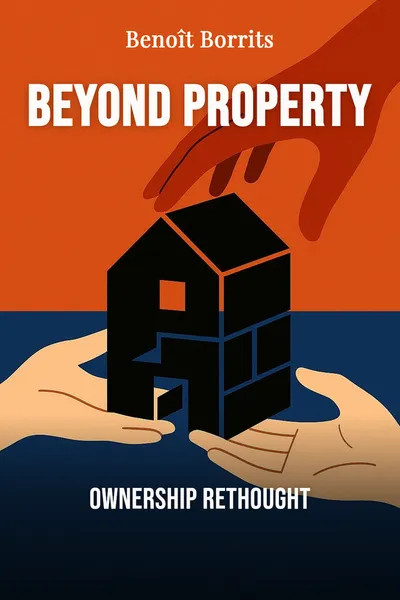
Beyond Property
Ownership rethought
Description
When we hand over a deed, a key, or a share certificate, we feel we have touched something solid. Property looks like one of the few words that means exactly what it says: this is mine, that is yours, the line between us is clean. We build mortgages, inheritance law, and whole political arguments on the assumption that ownership is a single, stable thing you either have or you don't. In Beyond Property, the French economist Benoît Borrits starts from a quieter observation. The word we treat as bedrock is, on closer inspection, a bundle of very different rights that history has tied into one knot — and that knot can be untied.
Borrits is not writing a legal textbook. He has spent years following worker-recovered factories in Argentina, cooperatives in Europe, and the long argument about who should control a firm and keep what it earns. His book pulls those threads into a single question: if property is really a package of separable powers — to use a thing, to decide what happens to it, to pocket what it produces — why do we keep defending the package as though it were indivisible? Once you see the seams, the familiar debate between private and state ownership starts to look like two versions of the same assumption.
What makes the book worth sitting with is that it refuses the usual binary. It does not argue that property is theft, nor that it is sacred. It takes apart the idea calmly, down to its components, and then asks what else we could build from the same parts. The answer involves arrangements most of us already brush against — a shared staircase, an open-source tool, a firm run by those who work in it — without noticing that they bend rules we thought were fixed.
The question we’re asking : If property is really a bundle of separable rights rather than one solid thing, what happens when we start pulling it apart?What we’ll see : A patient dismantling of ownership into its moving parts, and a tour of the arrangements that put those parts back together differently.
Table of contents
01Chapter 1 — The thing we think we own
Ask someone what it means to own a car and the answer sounds obvious: it's theirs. They can drive it, lend it, sell it, let it rust in a field. Borrits begins here, with the everyday intuition that ownership is a single relationship between a person and a thing. His first move is to show that this intuition, though comfortable, is not how property has ever actually worked. What we call owning a car is really holding a cluster of distinct permissions at once, and most of the time we never notice they are distinct because they happen to sit in the same hands.
The clearest way to see the seams is to watch them come apart. A tenant uses an apartment without owning it. A landlord owns it without living in it. A bank holds a claim on it without touching it. A local authority can limit what any of them do to it. Four different relationships to one object, each a genuine form of control, none of them the whole of property. Borrits draws on a long tradition in law and economics that treats ownership as exactly this: a bundle of rights, separable in principle, bundled only by convention.

02Chapter 2 — When property splits into pieces
If ownership is a bundle, the obvious next step is to see what each strand does on its own. Borrits sorts the package into three main powers, and the sorting is not academic housekeeping — it is where the alternatives begin. There is the right to use something, the usus; the right to collect the income it generates, the fructus; and the right to decide its ultimate fate, the abusus. In classic private property, one person holds all three. The whole argument of the book is that they can be prised apart and handed to different people on different terms.
History has done this many times, often without anyone calling it radical. Feudal land arrangements split use from ownership across layers of obligation. A modern shareholder holds the right to income and a vote on the firm's fate, but cannot walk into the warehouse and use the machines. A worker uses the machines daily and has no claim on the profit or the decisions. Borrits points out that we already live among these splits; we simply inherit them as natural rather than reading them as designs that could have gone otherwise.
03Chapter 3 — Who decides, and who gets the surplus
Borrits spends his most concrete pages on firms that have actually recombined the bundle: cooperatives, and the recovered factories he has followed on the ground. His touchstone is Argentina after the 2001 crisis, when workers in abandoned plants kept the machines running themselves rather than watch them sold for scrap. These empresas recuperadas were not a theory. They were people deciding, in real time, that the right to use an asset might carry the right to run it — collapsing the separation laid out in the previous chapter as use, decision, and income gathered back into the same hands.
The cooperative formalizes that move. In a worker cooperative, the people who labor in the firm hold the power to decide and the claim on what is left after costs. Instead of capital hiring labor and keeping the surplus, labor organizes production and treats capital as something to be remunerated and repaid, not obeyed. Borrits is careful not to romanticize this. Cooperatives struggle to raise money precisely because they refuse to hand decision power to whoever brings the cash, and that refusal is both their principle and their constraint.
04Chapter 4 — The commons as a verb
Step back from the catalog and a single thread runs through it. For Borrits, the lesson of taking property apart is that ownership was never mainly about things. It is about relationships — who decides, who benefits, who is bound by the decisions of others. The solidity we attach to the word is really the solidity of a particular way of arranging those relationships, one that happens to have won out. Change the arrangement and you have not abolished property; you have rewritten what it does and for whom.
This is where the commons enters, and Borrits is deliberate about not treating it as a nostalgic return to shared pastures. A commons is less a type of thing than a practice: a resource held under rules the users set and enforce together, where use, decision, and benefit are governed collectively rather than parceled out to a single owner. The shared staircase, the open-source codebase, the community-managed water source — these work not because nobody owns them but because the bundle has been reassembled around participation instead of exclusion.
05Conclusion
The book ends more or less where it began, with the deed and the key and the share certificate — but they no longer look solid. Having followed Borrits through the bundle, its strands, and the firms and resources that retie them, we are left seeing ownership as a composition rather than a fact. The question is never simply who owns a thing. It is who may use it, who decides its fate, and who keeps what it yields — and nothing forces those three answers to name the same person.
Related books