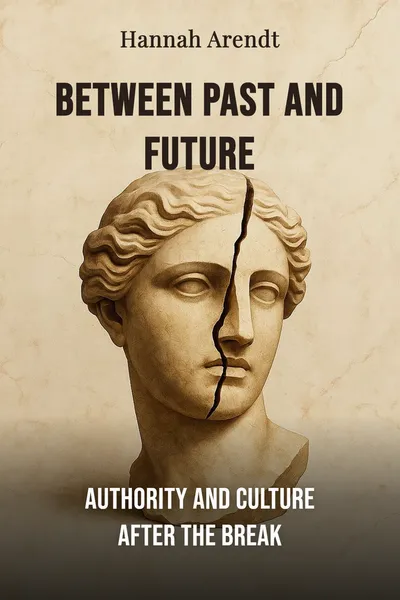
Between Past and Future
Authority and culture after the break
Description
Hannah Arendt liked to quote a line from the French poet René Char, written during the Resistance, after the fighters had gone back to ordinary life: "Our inheritance was left to us by no testament." For a few years, in the underground, Char and his comrades had lived inside something that felt like public freedom — they had acted, together, on things that mattered. Then the war ended, and that experience simply evaporated. Nobody had told them what it was worth, or how to keep it. There was no will, no executor, no instructions for the heirs. The treasure had appeared, and then it was gone, and worse: there were no words to say what had been lost.
That small phrase became, for Arendt, the diagnosis of a whole century. Something had broken in the transmission between generations — the quiet machinery by which one age hands the next a sense of what to value, what to preserve, what an inheritance even is. She published the essays gathered as "Between Past and Future" in 1961, and gave them a subtitle that reads almost as a confession: "Eight Exercises in Political Thought." Not a system, not a doctrine. Exercises. Attempts to think when the old certainties no longer hold you up.
Her wager was strange and bracing. The thread of tradition had not just frayed; it had snapped, and no amount of restoration would splice it back. But she refused to read that as pure catastrophe. The break, she thought, might also clear the ground — might force us to look at the past directly, without the reassuring filter that told us in advance what everything meant.
The question we’re asking : What happens to authority, tradition and culture once the thread connecting us to the past is cut for good?What we’ll see : How a broken inheritance turns the ordinary act of judging into the last thing we can still be asked to do.
Table of contents
01 Chapter 1 — The thread that snapped
Arendt begins where most of us would rather not: with an admission that the loss is real and that it cannot be undone. For most of Western history, she argues, there ran a continuous thread linking the living to the dead — a tradition that carried forward not just facts but the weight of things, the sense that certain ideas and works deserved reverence because they had lasted. This thread did the reader's work in advance. It told you what a great book was before you opened it, what an authority was before you obeyed it. You inherited a world already furnished with meaning.
What the twentieth century did, in her reading, was cut that thread rather than merely stretch it. The totalitarian regimes were the sharpest proof: they showed that everything once thought unthinkable — the factory-scale murder of innocents, the wholesale rewriting of what had happened — was in fact perfectly possible. And once the unthinkable happens, the categories we used to make sense of the world stop fitting. The old concepts of politics, of guilt, of law, went on being spoken, but they no longer gripped anything real.

02 Chapter 2 — When authority stopped answering
The word Arendt keeps circling is authority, and she insists we have almost forgotten what it once meant. We tend to lump it together with power and with violence, as if authority were just a softer name for making people do things. She pulls them apart. Real authority, she says, is precisely what needs neither persuasion nor force. Where you have to argue someone into obeying, authority has already failed. Where you have to coerce them, it never existed. Authority is obedience freely given, because the source is genuinely recognized as legitimate.
Her essay "What Is Authority?" opens with a jolt: it might be better, she writes, to ask what authority was, since it has all but vanished from the modern world. This is not a lament about disrespectful children or unruly citizens. It is a structural claim. The vertical relation that once held a society together from top to bottom — parent over child, teacher over pupil, tradition over the present — has quietly dissolved, and we have not built anything to replace it.
03 Chapter 3 — What the Romans knew about holding the past
To understand what we have lost, Arendt turns to the Romans, because they are the ones who built a whole civilization on the idea of the past. For them, she notes, the decisive event was the founding of the city, and everything afterward drew its authority from that beginning. To be authoritative was to be tied to that origin — the Latin auctoritas comes from augere, to augment, and the elders' role was to augment the foundation, not to command. Authority looked backward, toward a beginning that had to be preserved and enlarged, never abandoned.
This is a genuinely foreign idea to us, and Arendt lingers on it deliberately. The Romans did not revere the past because they were conservative in temperament. They revered it because they had grasped something the moderns forgot: that a public world needs an anchor outside the present moment to keep it from being blown apart by every new opinion and every new appetite. The past was load-bearing. It carried the weight that let people build and trust and hand things on.
04 Chapter 4 — Judging without the handrail
If tradition can no longer tell us what things are worth, and authority no longer answers, something has to take the strain. For Arendt, that something is judgement — the human capacity to look at a particular thing, an act, a work, a situation, and say: this is what it is, this is what it deserves. She came to see this faculty as the quiet hero of her whole enterprise, precisely because it does not depend on rules handed down from above. Judgement works case by case, in the open, without a manual.
She borrows the framework from an unlikely place — Kant's account of aesthetic taste, of how we judge that something is beautiful. Such judgements, Kant saw, cannot be proved the way a theorem is proved, yet they are not merely private whims either. When we judge, we implicitly appeal to others, imagining how the thing looks from many standpoints, courting agreement we cannot compel. Arendt lifts this out of art and sets it at the center of politics. Judging, for her, is the faculty of people who share a common world and must decide together what to make of it, without a rulebook to settle the matter in advance.
05 Conclusion
Char's line sits at the front of the book like a warning and a permission at once. The inheritance came with no testament: no one told the heirs what they had, and so it slipped away. Arendt's whole effort is to take that loss seriously without softening it and without surrendering to it. The thread is cut. Authority has fallen silent. The Roman architecture that held past and present together for two thousand years has finally come down, and no restoration will raise it again.
Related books