Becoming Wise
Questions that shape us
Description
For years, Krista Tippett has sat across from people at the far edges of human experience — physicists and monks, poets and neuroscientists, survivors of atrocity and people who forgave the unforgivable — and asked them a version of the same thing. Not what they believe, exactly, but how they live. What sustains them. What they've learned about being human that they didn't expect to learn. She built a public radio conversation, first called Speaking of Faith and later On Being, around that patient practice, and over more than a decade she noticed something. The most interesting people were rarely the most certain. They carried questions the way others carry answers.
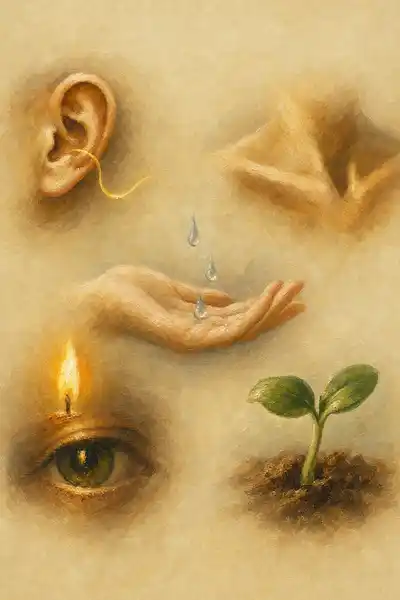
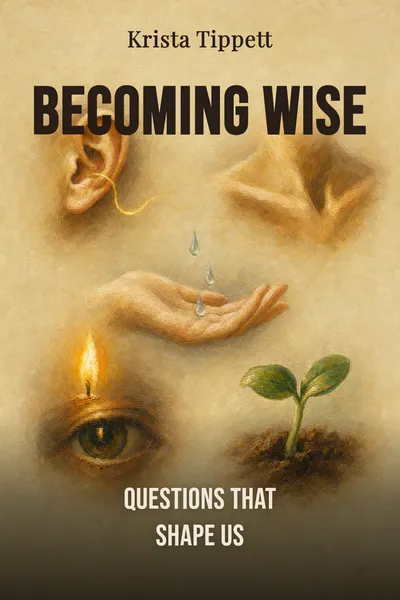
In 2016 she gathered what those conversations had taught her into a book, Becoming Wise. It's not a memoir, though her life runs through it, and it's not a self-help manual, though it hopes to be useful. It reads more like the field notes of someone who has spent her working life listening closely, arranged around five raw materials she thinks wisdom is made of: words, the body, love, faith, and hope. She treats each not as an abstraction but as something we handle daily, usually without noticing what we're doing with it.
Her wager is that wisdom isn't reserved for sages or the old. It's an aptitude anyone can cultivate, in the middle of an ordinary and complicated life, mostly by paying attention to the quality of our questions. That premise sounds gentle. In practice it's demanding — it asks us to hold curiosity alongside conviction, and to keep some questions open on purpose, even when closing them would feel like relief.
The question we’re asking : What does it actually mean to become wise, and can it be learned in an ordinary life rather than inherited from the wise?What we’ll see : How a lifetime of listening turned into a working theory of the raw materials wisdom is made from.
Table of contents
01 Chapter 1 — A radio host who kept asking
Tippett didn't set out to become an interviewer of the soul. She grew up in Oklahoma, the granddaughter of a Southern Baptist preacher, then left for Brown, then for divided Berlin as a journalist and diplomatic aide in the years before the Wall came down. She watched politics up close and found it strangely thin — good at describing what people did, useless at explaining what moved them. The interior life, the part of a person where meaning is actually made, had no place in the public conversation she was part of.
She eventually studied theology at Yale, not to become a minister but because it was the only discipline she could find that took the big questions seriously without flinching. Out of that came a radio program, launched in 2003, that treated religion, science, and the search for meaning as one continuous conversation rather than separate hostile camps. The format was simple and, for public radio, a little radical: long, unhurried talk with people who had thought hard about how to live.

02 Chapter 2 — Words as the vessels of what we mean
The first raw material Tippett examines is language, and she treats it with the seriousness of someone who has spent her career discovering how much a single word can carry. Words, she argues, are not neutral labels we stick onto a reality that exists independently of them. They shape what we're able to notice and feel. The vocabulary we inherit — for love, for God, for suffering, for the stranger — quietly determines the range of lives we can imagine living.
She's especially interested in how public words have coarsened. The language of politics and media has narrowed to accusation and defense, a vocabulary built for winning arguments rather than understanding anyone. Meanwhile the words that might help us live well — grace, mercy, forgiveness, even virtue — have grown embarrassing, too churchy or too soft to say in a serious room. Tippett wants to reclaim them, not as religious property but as tools for describing experiences we all still have and lack the language to name.
03 Chapter 3 — The body knows before the mind agrees
The second material is the body, and here Tippett pushes against a habit of Western thought she thinks has cost us dearly: treating wisdom as a matter of ideas, argued in the head and settled in words. Much of what we understand, she argues, we understand physically first. We feel injustice as a tightening in the chest before we can articulate it. We know we've been loved by the quality of a touch, a tone of voice, a room's warmth, long before anyone explains it.
She draws on conversations with contemplatives, doctors, and musicians who all, in different vocabularies, described the same thing — that presence is a bodily discipline. Sitting with a dying person, playing music with others, praying, breathing on purpose: these are not ideas but practices, and they train the whole organism, not just the mind. She's persuaded that this is why ritual endures across every human culture. Ritual works on the body, teaching it slowly what the mind can only be told.
04 Chapter 4 — Hope is a muscle, not a mood
Step back from the five materials and a single conviction holds the book together: wisdom is something we practice, not something we possess. Tippett resists every version that would make it a summit — reached by the old, the credentialed, the serene. She has met too many people who were none of those things and clearly wise, and too many who were all of them and clearly not. What she has come to trust instead is a disposition anyone can cultivate at any age, in the mess of an unfinished life.
The last material, hope, is where she stakes this most plainly. Hope, in her usage, is not optimism — optimism is a temperament, a bet that things will probably turn out fine. Hope is a choice made against the evidence, an orientation you can adopt on a bad day precisely because it isn't a feeling. She's careful about this distinction because she's talked to people who kept working for change across decades that gave them almost no reason to. They weren't cheerful. They were faithful to a possibility they refused to abandon, and that faithfulness was itself a discipline.
05 Conclusion
The book ends more or less where Tippett's working life began: at the microphone, across from someone, asking. What changed over the years wasn't her curiosity but her understanding of what the curiosity was for. She had thought she was gathering answers about how to live. She came to see she was learning how to ask — that the quality of a life tracks, more than we'd like, with the quality of the questions we're willing to sit inside without rushing to resolve them.
Related books