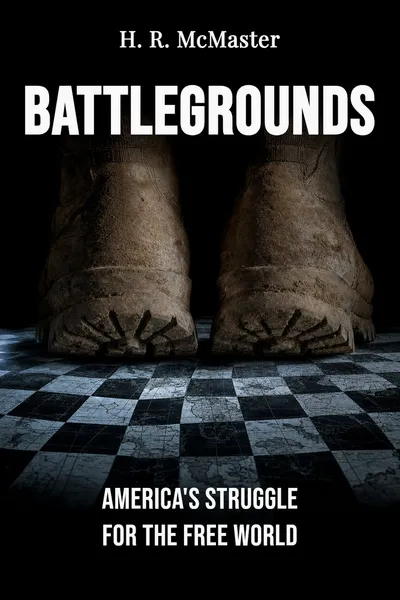
Battlegrounds
America's struggle for the free world
Description
In February 2017, a retired Army lieutenant general named H. R. McMaster walked into the White House to serve as national security adviser, a job that gave him a desk close to the most consequential decisions in American foreign policy and, as it turned out, a front-row seat to how those decisions actually get made. He had spent a career studying this. His doctoral thesis, published as Dereliction of Duty, had dissected how senior officers failed to tell the truth about Vietnam. Now he was inside the room, watching the machinery of American strategy run in real time — and finding it, in his telling, badly misaligned with the world it was supposed to navigate.
Out of that experience came Battlegrounds, published in 2020, a book that is part memoir, part history lesson, and part argument. McMaster's core claim is uncomfortable: that the United States keeps getting foreign policy wrong not because its rivals are cunning but because Americans tend to see the world as a reflection of their own hopes. We assume other powers want what we want. We assume history bends our way. And when it doesn't, we swing between overconfidence and the urge to just walk away.
The book takes that diagnosis and applies it, country by country, conflict by conflict — Russia, China, Iran, North Korea, Afghanistan, the fight against jihadist terror. It is written by someone who has read the archives and also stood in the fight, and it refuses the easy comfort of either retreat or crusade. What it asks of the reader is harder than a slogan.
The question we’re asking : Why does the world's most powerful country keep misreading the very rivals and conflicts that most threaten it?What we’ll see : A soldier-scholar's tour of the arenas where the free world's fate is being contested, and the mental habit he thinks keeps sabotaging us.
Table of contents
01 Chapter 1 — The trap of strategic narcissism
McMaster opens with a phrase he borrows and sharpens: strategic narcissism. It's the tendency to define the world only in relation to ourselves — to assume that what happens abroad is mostly a response to what America does, and that other actors are essentially passive, waiting to be nudged toward the outcomes we prefer. It sounds like a psychological quirk. He treats it as a structural flaw in how a superpower thinks.
The pattern, he argues, produces two opposite errors that share the same root. One is overconfidence: the belief, common after the Cold War, that liberal democracy and open markets had simply won, that history was over, and that other nations would converge on the American model given enough time and trade. The other is resignation: the belief that the problems are too tangled, the region too foreign, the effort not worth it, so we should pull back and let events take their course. Both, McMaster says, flatter us. Both put America at the center and treat everyone else as scenery.

02 Chapter 2 — Russia, China, and the revisionists' playbook
The first arena is Russia. McMaster does not describe a resurgent superpower so much as a declining one playing a weak hand aggressively. Putin, in his reading, is driven by a sense of grievance and lost status, and by a conviction that the West humiliated Russia after the Cold War. From that emotional core flows a strategy of subversion: cyber operations, disinformation, election interference, energy leverage, and the seizure of Crimea in 2014. The aim is less to build than to weaken — to fracture NATO, discredit democracy, and make the free world look as cynical and divided as the Kremlin believes it to be.
The mistake the West made, he argues, was strategic narcissism in its purest form. For years after 1991, American leaders assumed Russia was on a path toward partnership and integration, and read Putin's early cooperation as agreement rather than tactics. The reset buttons and summits reflected our hopes about Russia, not Russia's account of itself. By the time the pattern was undeniable, the tools of subversion were already deep inside Western institutions.
03 Chapter 3 — The long wars nobody wants to name
If the rival-power chapters warn against wishful thinking, the war chapters warn against its twin: the impatience that mistakes exhaustion for strategy. McMaster turns to Afghanistan, the conflict he knew most intimately, and to the wider struggle against jihadist terrorism, and he refuses the two framings that dominate American debate — either declare victory and leave, or declare it unwinnable and leave. Both, he argues, are strategic narcissism dressed as realism.
On Afghanistan, his case is that the war was never given a coherent, sustained strategy. Instead it lurched through short-term deadlines, arbitrary troop numbers, and announced withdrawal dates that told the Taliban exactly how long they needed to wait. Publicly signaling that you are leaving, he observes, hands your adversary the one thing they most want: time. A war fought on the enemy's clock rather than toward a defined political outcome cannot succeed, no matter how capable the soldiers.
04 Chapter 4 — Confidence without arrogance
Step back from the individual arenas and Battlegrounds resolves into a single wager about where the real danger lies. McMaster's argument is that the free world's gravest vulnerability is not the strength of Russia, China, Iran, or jihadist networks. It is the West's own habit of misreading them — the recurring choice between an arrogance that assumes we've already won and a defeatism that assumes we can't. The enemy exploits the gap between those moods; the discipline of strategic empathy is what closes it.
This is why the book resists being read as either hawkish or dovish. McMaster is not calling for endless intervention, and he is not calling for retreat. He is calling for something harder to sustain politically: a steady, informed engagement grounded in confidence about democratic principles without arrogance about their inevitability. The distinction matters to him. Confidence says liberal societies are worth defending and capable of prevailing. Arrogance says they'll prevail automatically, so no defense is required. The second is how you lose the first.
05 Conclusion
McMaster ends where he began, back inside the rooms where American strategy is made and unmade. The argument he carries out of them is not a prediction but a discipline. The rival powers he surveys are real, patient, and playing for advantage, but none of them, in his reading, can defeat the free world outright. What can defeat it is the West's own oscillation — the swing between believing history is settled in its favor and believing the whole effort is hopeless. Both moods let the adversary set the terms.
Related books