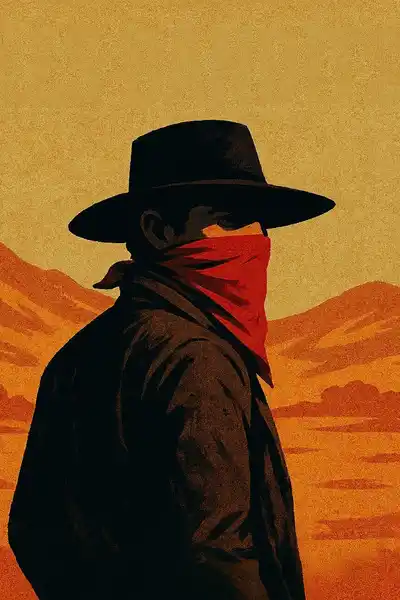
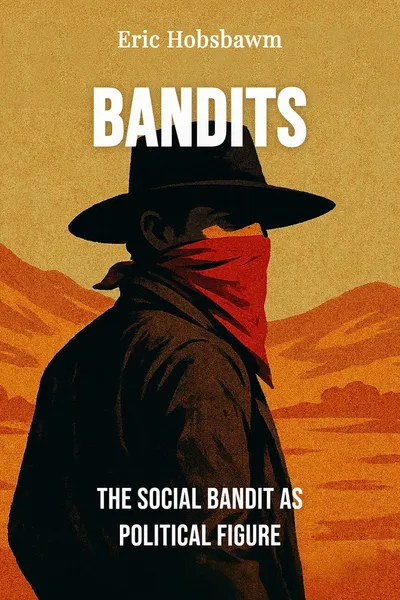
Bandits
The social bandit as political figure
Description
Somewhere in the hills of southern Italy, around 1860, a peasant is asked about a man the authorities have branded a murderer and a thief. He does not lower his voice or look away. The man on the poster, he says, only takes from those who have too much, and he has never harmed a poor family. The gendarmes want him dead; the village will not give him up. Feed him tonight, warn him tomorrow, and swear to any officer who asks that nobody here has ever seen his face. The same scene, with different mountains and different names, repeats across Sicily, Andalusia, the Balkans, Brazil, China — anywhere land is worked by people who own almost none of it.
Eric Hobsbawm, the British historian, spent a good part of his career noticing that this figure was not a local curiosity but a pattern. In a slim, much-argued book first published in 1969, he gave the pattern a name: the social bandit. Not every outlaw qualifies. The social bandit is the peasant robber whom the state calls a criminal but the peasantry calls a hero, a champion, an avenger — someone whose crimes the community reads as a rough kind of justice rather than as theft.
What makes the type worth taking seriously is that it keeps appearing in societies that have almost nothing else in common, and it keeps meaning roughly the same thing to the people who shelter it. The bandit is admired, protected, mythologized while alive and long after death. And yet the men behind the legend rarely changed anything. They robbed, they hid, they were usually betrayed and killed young. The gap between what they did and what they came to represent is where the whole story sits.
The question we’re asking : Why do peasant societies across the world keep turning ordinary robbers into heroes — and what does that admiration reveal about the people doing the admiring?What we’ll see : How the social bandit becomes a figure of justice, what the legend is built from, why it almost always ends the same way, and what it says about rebellion before politics.
Table of contents
01Chapter 1 — The outlaw the poor kept feeding
The first thing to understand about the social bandit is that he is defined by his relationship to a community, not by his crimes. Plenty of robbers prey on the poor as readily as on the rich; those are simply criminals, and the peasantry fears them the way it fears anyone with a weapon. The social bandit is something else. He is a man who has fallen foul of the law — often for something the village considers no crime at all, a quarrel over honor, a killing the authorities call murder — and who then takes to the hills with the tacit approval of the people he came from.
Hobsbawm draws the portrait carefully. The bandit typically starts as a victim of injustice, or at least is seen as one. He is often a young man, unmarried, with a reputation for courage and a certain style. He does not, as a rule, attack the poor. When he robs, he robs the landlord, the merchant, the tax collector, the outsider — the same people the peasantry resents but cannot touch. And he stays, physically and morally, inside the world of the village. He is fed there, warned there, hidden there, married into families there.

02Chapter 2 — What Robin Hood is really made of
The Robin Hood story is the purest version of the myth, and Hobsbawm treats it as a template rather than a single English legend. The essential claims are always the same, whatever the country. The bandit rights wrongs. He takes from the rich and gives to the poor. He never kills except in fair fight or just revenge. He is not the enemy of the king or the emperor, only of the local oppressors — the sheriff, the landlord, the abbot. And in the end he is destroyed not by superior force but by treachery, betrayed by someone he trusted.
Almost none of this survives contact with the historical record. Real bandits kept most of what they stole; the redistribution to the poor was usually modest, closer to well-placed generosity than to a program. They killed more freely than the legend allows. What matters, though, is that the myth is not a description of what bandits did but a statement of what the peasantry wished were true. It is an image of justice projected onto a man who was, at best, a rough approximation of it.
03Chapter 3 — Why the bandit almost never wins
For all the devotion he inspires, the social bandit is a strikingly ineffective rebel, and Hobsbawm is unsentimental about why. The bandit does not want to abolish the world that produced him. He wants justice within it — the greedy landlord punished, the honest peasant left in peace, the old rough fairness restored. His quarrel is with particular oppressors, not with the system that keeps producing them. He is, in the deepest sense, a conservative: he dreams of setting things right, not of building something new.
This is also the source of his powerlessness. A handful of armed men in the hills can rob, terrorize a district, embarrass a government. They cannot govern, cannot organize, cannot hold territory against a serious army. When the modern state arrives in force — with railways, telegraphs, standing police, maps of the countryside — the space the bandit lived in simply closes. The mountains that hid him become passable; the villages that fed him are policed; the networks of silence are broken by a few well-paid informers.
04Chapter 4 — The rebellion before politics had a name
Hobsbawm's larger claim is that banditry is not really about bandits. It is about the moment before a society has learned how to fight back in any organized way — what he calls the pre-political stage. In a countryside without unions, without parties, without newspapers or the vote, the peasant has no instrument for changing his conditions. He cannot strike, cannot campaign, cannot appeal to a system that does not recognize him. What he can do is admire a man who refuses, who takes to the hills and lives outside the law that grinds everyone else down.
The social bandit, in this reading, is a placeholder for a rebellion that has no other form yet. He expresses a refusal the community feels but cannot act on collectively. That is why the figure flourishes in places caught between an old rural world and the arrival of the modern state and market, and why he tends to vanish once real political tools appear. Where peasants gain leagues, cooperatives, parties, the energy that once went into sheltering an outlaw flows into organizations that can actually shift the balance of power.
05Conclusion
The peasant who refused to give up the outlaw's name was not confused about the facts. He knew the man robbed and sometimes killed, knew he would probably hang or be shot in the back by a neighbor within a few years. What the villager saw was not a saint but a standing proof that the powerful could be defied, and in a world that offered no other proof, that was worth feeding and hiding and lying for. The bandit almost never won. The point was that he tried, alone, when trying seemed impossible for everyone else.
Related books