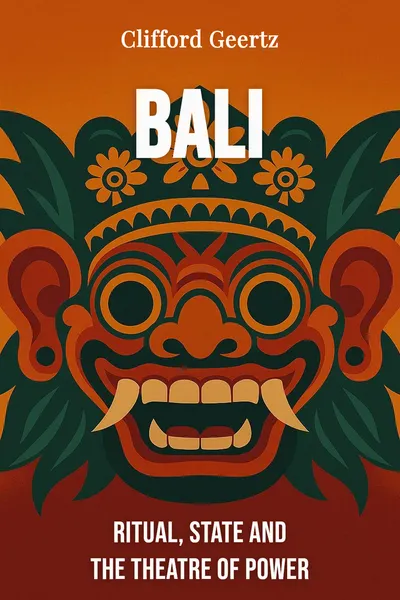
Bali
Ritual, state and the theatre of power
Description
In the middle of the nineteenth century, on the island of Bali, there were something like a dozen kingdoms, each with a king, a court, a hierarchy of lords, and a dense calendar of ceremonies that absorbed enormous quantities of labor, rice and attention. A cremation could take years to prepare and empty a treasury in a day. Temple festivals ran on a schedule nobody could override. And yet these kingdoms, for all their grandeur, barely governed. They collected taxes erratically, fought wars that rarely settled anything, and left the actual business of irrigation, land and village life to other institutions entirely. The courts were spectacular. Their administrative grip was close to nothing.
This is the puzzle Clifford Geertz set out to make sense of. An American anthropologist who worked in Indonesia from the 1950s onward, Geertz went looking for the classical Balinese state as it existed before the Dutch finished their conquest in 1908 — and found something that refused to fit the categories political science had on hand. It was not a machine for taxing and coercing a population. The energy of the whole system ran in a different direction, toward display, rank and ritual precision, and the king sat less at the center of a government than at the center of a ceremony.
Geertz gave this arrangement a name that has stuck: the theatre state. The phrase is deliberately provocative, because it asks us to take seriously the idea that the pomp was not decoration on top of power but the point of the whole enterprise. To follow the argument, we have to loosen a very deep assumption — that status and spectacle serve the state, rather than the other way around. Bali, read closely, suggests the arrow can run the other way.
The question we’re asking : What was a Balinese kingdom actually for, if it was not built to govern?What we’ll see : How a reading of cremations, calendars and cockfights turns ritual into the real substance of politics on the island.
Table of contents
01 Chapter 1 — The kingdom that governed almost nothing
The first thing to let go of is the picture of a king as an administrator. In nineteenth-century Bali, the lords who mattered most were not the ones who controlled the most territory in any neat, mapped sense. Sovereignty was not a block of land with a border around it. It was a web of personal ties, loyalties and ceremonial obligations that thinned out as it spread, with no sharp edge where one kingdom ended and another began. A village might owe ritual allegiance to one lord, send its irrigation water through a system answering to another, and pay a market toll to a third. Power was not pooled. It was scattered across overlapping claims that rarely lined up.
Geertz draws on Dutch records, Balinese texts and informants to reconstruct how little the court actually did. The real work of Balinese society — growing rice, managing water, settling disputes — was handled by institutions outside the king's reach. The subak, the irrigation associations governing the terraced fields, ran on their own rules and ritual calendar. Village councils managed their own affairs. The state did not supply these things; it hovered above them, drawing prestige from a landscape it did not organize and taxing it only when it could.

02 Chapter 2 — Time without a line
If the court's purpose was display, the display rode on something deeper: a Balinese sense of time that had very little to do with the forward march we take for granted. Geertz describes a calendar built not from a single counting stream but from several cycles of different lengths running at once. The permutational calendar interlocks ten different week-cycles, from a one-day week to a ten-day week, and what matters is not how far along the year has traveled but which named conjunctions of these cycles fall on a given day. Time is not a distance covered. It is a pattern that recurs.
The effect is a world organized around repetition rather than progress. Days are not steps toward a destination; they are instances of recurring types, each with its own ritual character and auspicious or inauspicious combinations. A festival happens not because a certain number of days have elapsed but because a particular configuration of cycles has come around again. Geertz connects this to the whole texture of Balinese life, where people are experienced less as unfolding biographies than as occupants of fixed social types — bearers of titles, roles and positions that outlast any individual who fills them.
03 Chapter 3 — The cockfight as a story Bali tells itself
To see how ritual carries meaning rather than merely decorating it, Geertz turns to a smaller and more notorious scene: the Balinese cockfight. He describes arriving in a village as an outsider nobody would acknowledge, then being swept up — along with everyone else — in a police raid on an illegal cockfight, fleeing across a courtyard, and finding afterward that the shared panic had made him, suddenly, a person the village could see. The fight was banned, marginal, a little disreputable. It was also, he argues, one of the places where Balinese men put their deepest concerns on display.
The surface of the cockfight is gambling and spilled blood. Underneath, Geertz reads it as a commentary a society makes about itself. The serious bets are not really about money; center-bets are often close to even odds, and the men who place them stand to gain little materially while risking a great deal in standing. What is wagered is status. A man bets with and for his kin group, his village, his allies, and the match becomes a brief, intense dramatization of the rivalries and loyalties that structure ordinary life — rivalries that daily etiquette keeps carefully muffled.
04 Chapter 4 — The theatre state
The phrase Geertz settles on — negara, the theatre state — gathers all of this into a single claim about what politics can be. The classical Balinese polity was organized expressively rather than instrumentally. Its purpose was not to get things done but to enact a vision of how the world should be. The court was a model of the cosmos; the king, at its still center, was divine order made visible; the ceremonies were not advertisements for power but the substance of it. Power did not serve the pageant. The pageant was the power.
This cuts against a very old habit of thought. We tend to treat the ceremonial side of any state — coronations, parades, architecture, flags — as lubricant, something that greases the real machinery of taxation, law and force. Geertz's Bali refuses that split. It presents a case where the expressive and the political are not two layers but one, where governing and staging are the same act. The question it forces is uncomfortable: what if the symbolism is not a means to power but the end that everything else is a means to?
05 Conclusion
We began with a puzzle: a cluster of kingdoms that spent lavishly and ruled hardly at all, where cremations bankrupted courts and administration barely existed. The theatre state dissolves the puzzle by refusing its premise. These kingdoms were not failing to govern; governing in the sense we mean was never the business they were in. They existed to stage an order — to make a cosmos visible in rank, ritual and spectacle — and by that measure they were not weak at all. They were doing, at enormous cost and with great precision, exactly what they were for.
Related books