Ayrton Senna's Principles of Race Driving
What it takes to win
Description
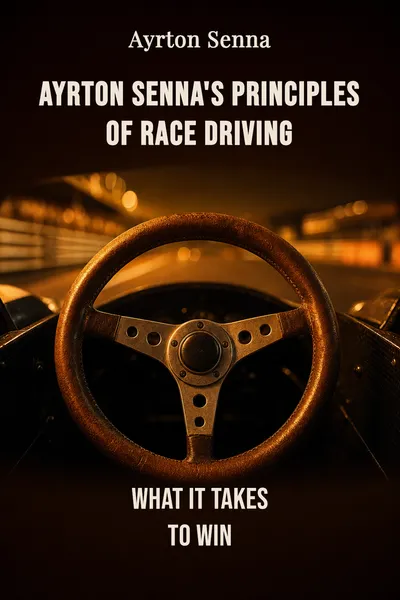
In 1991, an Italian publisher put out a book with an unusual author. Ayrton Senna, then the reigning Formula 1 world champion and the most talked-about driver on the grid, had agreed to sit down and explain, in plain terms, how a racing car is actually driven. The result was Guidare in Pista, translated into English as Ayrton Senna's Principles of Race Driving. It landed in Italy first, which makes sense: few countries take Formula 1 as personally, and few audiences were more likely to want the champion's own words on the craft rather than a journalist's paraphrase.
What came out was not a memoir and not a highlight reel. It was closer to a manual. Senna walks through braking, cornering, gear changes, overtaking, driving in the rain, the way a master carpenter might walk an apprentice through joints and grain. He is precise, unsentimental, occasionally surprising, and never mystical about a talent that the wider public had already begun to treat as something otherworldly. He treats driving fast as a set of things that can be learned, done wrong, and corrected.
That posture is the interesting part. Here is a man whose qualifying laps were routinely described as inexplicable, calmly insisting that most of what he does can be broken into components and taught. And yet the book keeps arriving at a threshold where the components run out and something else takes over. Following his own explanation, we watch a champion try to hand over a method while quietly circling the part of it that never quite transfers.
The question we’re asking : How does one of the fastest drivers who ever lived describe, in his own words, what winning actually requires?What we’ll see : Senna's own account of the craft — the mechanics he insists can be taught, and the edge that resists being written down.
Table of contents
01 Chapter 1 — The book a champion agreed to write
By 1991 Senna had little to prove and no obvious reason to explain himself. He had won the title in 1988 and again in 1990, driving for McLaren, in the middle of a rivalry with Alain Prost that had already turned Formula 1 into front-page material well beyond the motorsport press. Drivers of that stature usually guard their methods the way a chef guards a recipe. Senna did the opposite. He agreed to lay the craft out in order, from the basics upward, for readers who might never sit in a single-seater.
The book's premise is almost pedagogical. It assumes a reader who is curious about how a car is driven at the limit but who does not already know, and it refuses both extremes: it never talks down, and it never disappears into jargon a specialist would need decoding. Senna defines his terms as he goes. When he uses a word like understeer or trail-braking, he explains what the car is doing and why it matters, the way a good teacher pauses to make sure the room is still following.

02 Chapter 2 — Lines, brakes, and the geometry of speed
The heart of Senna's method is the racing line, and he treats it as a problem of geometry before it is a problem of nerve. A corner is not taken as a single sweep; it is a sequence with a beginning, a turning point, and an exit, and the whole art lies in choosing where each of those falls. The classic line enters wide, clips an apex late rather than early, and unwinds toward the outside on the way out, so the car can begin accelerating as soon as possible. The corner exists to be left, and the exit governs the straight that follows.
Braking is where he is most exacting. Senna describes the brake not as an on-off switch but as a graded input, applied hard at first and then eased off progressively as the car slows and turns. The technique of carrying a little braking into the entry of a corner — trail-braking — keeps weight over the front tyres and lets them bite when the car needs to change direction. He is clear that this is delicate work: too much and the car slides, too little and time is lost. The pedal is an instrument, not a lever.
03 Chapter 3 — The wet, the mind, and the limit
Rain is where the manual turns from mechanics toward something harder to pin down. Senna, whose wet-weather drives became part of his legend, treats a wet track as a different surface that has to be relearned lap by lap, because it is never uniform and never stable. Grip appears in unexpected places and vanishes in others; the usual racing line, polished dry by rubber, can be the most slippery part of the circuit. The wet driver, he explains, often has to invent a new line, hunting for traction off the conventional path.
His advice for the rain is mostly about sensitivity. Inputs have to become gentler and earlier, the driver reading the car through a much thinner margin, feeling for the moment grip returns rather than assuming it. He is frank that this is where confidence and fear do their real work, and where a driver either finds a way to stay calm inside a very small window or does not. He does not romanticize it. He describes it as concentration stretched to its limit for the length of a race.
04 Chapter 4 — Where the method stops and the driver begins
What makes Senna's manual quietly remarkable is the shape of its honesty. For most of its length it behaves like any good technical book: it breaks a hard craft into parts, names them, and shows how they fit. Braking is a technique. The line is a geometry. Car balance is physics you can learn. If that were all there was to winning, the book would be a complete instrument, and any diligent reader could follow it to the front of the grid. Senna clearly does not believe that, and he does not pretend otherwise.
Because the manual keeps arriving at the same threshold. He explains everything up to the limit of grip, and then describes living at that limit as something felt rather than calculated. He explains the wet line, and then admits it has to be found fresh each time by feel. He explains concentration, and then gestures at a state beyond it that he can report but not prescribe. The method is real and it is generous, but it stops at a border, and on the far side of that border sits whatever it was that made him him.
05 Conclusion
Guidare in Pista arrived in 1991 as the work of a driver at the height of his powers, still racing, still winning, still in the middle of the story that would define his era. It reads less like a champion's victory lap and more like a craftsman's careful account of his tools. Braking, lines, balance, the rain, the focus that has to hold for a full race — Senna sets each out in order, defines it, and shows how it connects to the next, until the reader has a genuine map of how a car is driven at the limit.
Related books