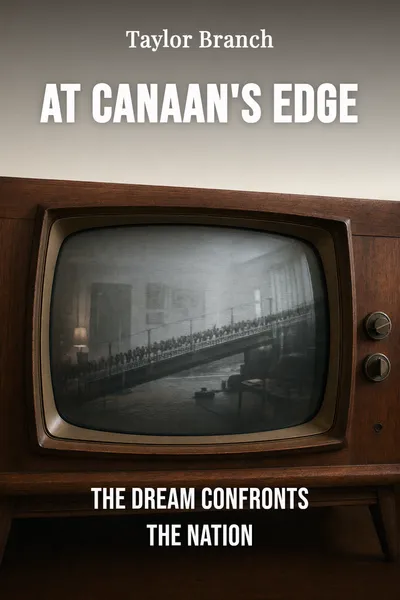
At Canaan's Edge
The dream confronts the nation
Description
On the morning of March 7, 1965, roughly six hundred people set out to walk from Selma, Alabama, to the state capital in Montgomery, fifty-four miles east. They got about six blocks. At the far side of the Edmund Pettus Bridge, state troopers and mounted deputies waited in a line across Highway 80. When the marchers refused to turn back, the troopers advanced with clubs and tear gas, and the cameras were there for all of it. That evening ABC interrupted its broadcast of a film about Nazi war crimes to show Americans what had happened on their own soil that afternoon.
Taylor Branch opens the final volume of his enormous history of the King years with that bridge, and it is the right place to start. By 1965 Martin Luther King Jr. was a decade into the work. He had a Nobel Prize, a national reputation, and an FBI file that the bureau was actively using to try to destroy him. What he did not yet have was the thing Selma would help win: a federal law guaranteeing Black Southerners the right to cast a ballot. The bridge is where the movement's moral argument met the machinery of the state, and neither would leave the encounter unchanged.
Branch's subject across three volumes is not really one man. It is the long collision between the promises written into American democracy and the country that kept declining to keep them. This last book, covering the years from Selma to Memphis, is the stretch where the movement won its greatest legislative victories and then discovered how much lay beyond the reach of any law.
The question we’re asking : What happened to King and his movement in the three years between the triumph at Selma and the killing in Memphis?What we’ll see : A movement that could win laws by exposing violence, and a country that would change its statutes far more readily than its streets.
Table of contents
01Chapter 1 — The bridge at Selma
Selma was chosen because it was hard. In Dallas County, Black residents made up a majority of the population and a tiny sliver of the registered voters, kept off the rolls by literacy tests, poll taxes, and a registrar's office open two days a month. King and the Southern Christian Leadership Conference came in early 1965 to force the question, aware that the local sheriff, Jim Clark, had a temper and a habit of using it in front of reporters. The strategy was cold-eyed and it worked. Confrontation photographed well, and photographs moved Washington.
What Branch shows is how contested every step of it was. The younger organizers of the Student Nonviolent Coordinating Committee had been working in Selma for two years before King arrived, and they resented the way his fame swept in and rearranged their patient local work. The first bridge crossing, the one that became Bloody Sunday, went ahead without King present. When he led a second, symbolic march two days later, he turned the column around at the police line rather than defy a federal court order, and some of his own people never forgave the retreat.

02Chapter 2 — What the vote bought, and what it cost
The Voting Rights Act did what a decade of appeals to conscience had not. Federal examiners went into the Deep South, the literacy tests fell, and Black Southerners registered in numbers that redrew the region's politics within a few years. Branch stays close to the ground on this, following organizers into rural Mississippi and Alabama where sharecroppers who had never been permitted near a ballot box learned to read the forms, walked to the courthouse under threat of eviction, and in some counties built their own political party from nothing. The abstraction of a federal law becomes, in these pages, a specific person risking a home and a livelihood.
But the victory did not settle the movement; it split it. The cost of nonviolence was patience, and patience was wearing thin among the young field workers who had absorbed the beatings year after year while the country applauded King. In June 1966, on a march through Mississippi, a SNCC organizer named Stokely Carmichael, freshly out of jail again, began calling out two words to a crowd: Black Power. The phrase electrified some and alarmed others, and Branch traces the way it fractured a coalition that had held, however uneasily, since the sit-ins.
03Chapter 3 — The North that would not bend
In 1966 King took his campaign to Chicago, and the ground shifted under him. In the South the enemy had a face and a sheriff's badge; the injustice was written into statute, and a camera could capture it. In the Northern city the machinery was quieter. There were no whites-only signs on the tenements of the West Side, only the fact that Black families paid more for worse housing and could not move into white neighborhoods without meeting a mob. Branch follows King into a movement whose target was harder to photograph and harder to name.
When King led marches into white neighborhoods on Chicago's Southwest Side, the reaction stunned him. Crowds hurled bricks and bottles; a rock struck King in the head and dropped him to one knee. He said afterward that he had never seen mobs as hostile and as hate-filled as those in Chicago, not even in Mississippi. The remark is one of the book's quiet hinges. The comfortable Northern conviction that bigotry was a Southern disease did not survive the summer of 1966.
04Chapter 4 — Memphis, and the last campaign
On April 4, 1967, exactly a year before he died, King stood at Riverside Church in New York and denounced the Vietnam War in the plainest terms, calling his own government the greatest purveyor of violence in the world. The speech cost him. Newspapers that had praised him turned scornful, allies in the administration felt betrayed, and even some within his own organization thought he had strayed dangerously from his lane. Branch presents the decision as of a piece with everything else: King could not keep preaching nonviolence at home while staying silent about the violence his country was exporting abroad.
The dissent and the turn toward poverty were the same movement of mind. King had concluded that the deepest injustices were now economic, and he began planning a Poor People's Campaign to bring the destitute of every color to Washington and refuse to leave until the government acted. It was his most ambitious and least popular idea, and it was still half-built when a strike by sanitation workers pulled him to Memphis in the spring of 1968.
05Conclusion
Branch's three thousand pages amount to an argument about how a democracy changes. The movement's great weapon was the capacity to make the country look at itself: Selma worked because the violence was visible and the cause was plainly just, and a nation confronted with its own reflection reached for its lawbooks. The Voting Rights Act was the fruit of that method at full strength. What the last years showed was the method's edge. Poverty had no sheriff to photograph, and Northern prejudice wore no uniform, and a country that would rewrite a statute under moral pressure was far slower to rearrange the ordinary arithmetic of who lived where and earned what.
Related books