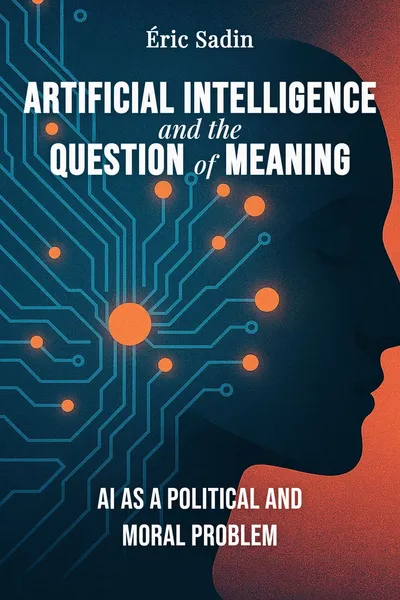
Artificial Intelligence and the Question of Meaning
AI as a political and moral problem
Description
Sometime in the past few years, a small shift happened in how we talk to our devices. We stopped asking them to find things and started asking them what to do. Not just the route to the restaurant, but which restaurant. Not just the available dates, but the right one. The French philosopher Eric Sadin, who has spent more than a decade tracking how digital technology reshapes everyday life, treats this shift as the hinge of his work. In his book Artificial Intelligence and the Question of Meaning, he argues that the machines around us have crossed a line — from telling us what is, to telling us what ought to be done.
That line matters more than it sounds. A search engine presents options; we choose. A recommendation engine, a predictive assistant, a system that flags, scores, suggests and decides — these do something else. They issue what Sadin calls injunctions. They speak in the voice of a truth that admits no reply, because it arrives dressed as data, optimization, efficiency. And efficiency, once it becomes the measure of everything, quietly stops being a tool and starts being a verdict.
Sadin's argument is not the familiar one about robots taking jobs or machines becoming conscious. He is almost indifferent to the engineering. What worries him is the social contract we are signing without reading it: a world in which the capacity to judge — to weigh, to hesitate, to decide what counts — is handed over to systems that have no idea what anything means. The stakes, he insists, are political and moral long before they are technical.
The question we’re asking : What exactly do we surrender when a machine stops informing us and starts telling us what to do?What we’ll see : How a philosopher reframes AI away from its technique and toward the handover of human judgement it quietly organizes.
Table of contents
01 Chapter 1 — The machine that answers before we ask
Sadin starts from an ordinary scene. We open an app and it already knows. The playlist is assembled, the route is chosen, the purchase is suggested, the reply is drafted. We did not ask for a list of possibilities to sift through. We asked, in effect, to be relieved of the asking. And the system obliged, not with information but with a decision wearing the costume of a recommendation.
This is the move he wants us to notice. For most of the digital era, machines handled the world of facts — they stored, retrieved, calculated, displayed. The human kept the privilege of deciding what to make of it all. What changed, roughly over the 2010s, is that the systems began to speak in the register of the ought. They no longer say 'here is what exists.' They say 'here is what you should do,' and increasingly, 'here is what will now be done.'

02 Chapter 2 — When efficiency becomes an argument
If the machine can now tell us what to do, the next question is why we let it. Sadin's answer is that we have made efficiency into something it was never meant to be: a justification. Faster, cheaper, more accurate, better optimized — these used to be practical advantages, weighed against other things we value. In the world he describes, they have hardened into a standard that overrides the weighing itself. If the system is more efficient, the argument is considered closed.
He traces this to a long tendency he calls technoliberalism — the marriage of market logic and technological solutionism. The promise is seductive and almost impossible to argue against in its own terms: why would anyone prefer the slower, costlier, more error-prone human way of doing a thing? Put like that, resisting sounds like nostalgia. And that is precisely the trap. The efficiency argument smuggles in a whole hierarchy of values while pretending to be value-neutral.
03 Chapter 3 — The quiet handover of judgement
The heart of Sadin's worry is a word he uses without softening it: judgement. To judge is to bring a situation under consideration and decide what it calls for — knowing the facts are never quite enough, that something must be risked, that we could be wrong and answer for it anyway. It is the faculty that makes us responsible beings. And it is exactly the faculty we are handing over.
The handover is rarely a dramatic abdication. It happens in small, reasonable steps. A manager leans on the scoring tool because overruling it now requires an explanation. A doctor follows the system because departing from it carries liability. A judge consults the risk-assessment software because why wouldn't one use the best available information? Each step is defensible. The sum is a world where the human increasingly ratifies rather than decides, and where saying no to the machine becomes the deviant, effortful act.
04 Chapter 4 — A political question wearing technical clothes
Step back and the shape of Sadin's argument becomes clear. Nearly every debate about artificial intelligence is conducted as if it were a technical matter — accuracy, safety, bias, capability, alignment. His intervention is to insist that these are secondary. The primary question is political and moral: who, in the end, gets to decide the things that matter, and on what authority. Dressing that question in technical clothes is not an accident. It is how the question gets removed from public life.
Because once a decision is reframed as optimization, it leaves the realm where ordinary people have standing to object. You cannot vote on an optimum. You cannot deliberate with a confidence score. The move from 'what should we do' to 'what does the system recommend' quietly transfers authority from citizens to those who build and own the systems — and, further down, to a logic of efficiency that no one in particular chose and everyone is expected to accept. The depoliticization is the point, even when no one intends it.
05 Conclusion
Return to that small scene at the start: the app that answers before we ask. Sadin's achievement is to make it impossible to see as neutral convenience. In the gap between being informed and being instructed, something is quietly reorganized — not our tasks, but our relation to our own decisions. The efficiency is real. The time saved is real. What is harder to notice, because it leaves no trace, is the deliberation that never happened, the judgement that was ratified instead of made.
Related books