Art Worlds
Art as collective production
Description
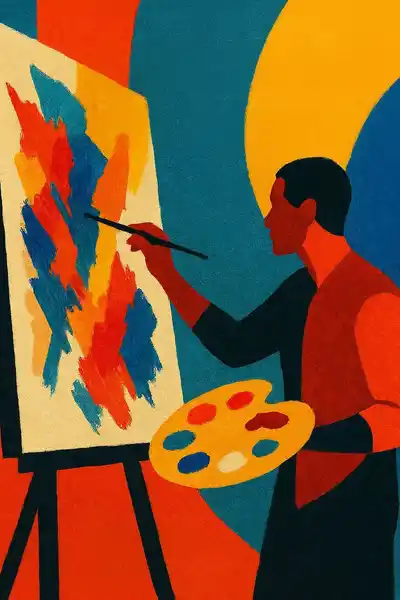
Consider the last painting that stopped you in a museum. The wall label named one person. But that canvas came stretched on a frame someone milled, primed with paint a chemist formulated and a factory mixed, hung under lights an electrician wired, insured by an underwriter, described by a curator, and framed within a room built by people whose names appear nowhere. The signature in the corner is real. It is also a spectacular act of editing. In 1982, the American sociologist Howard S. Becker published a book, "Art Worlds", that took this editing apart and asked a plain, almost rude question: who actually makes art?
Becker's answer was that nobody makes it alone. An art world, in his terms, is the whole network of people whose joint activity produces the things we agree to call art — not just the artist, but the suppliers, performers, technicians, dealers, critics, audiences, and the state. He came at this partly as a working jazz pianist, someone who knew from the inside that a night of music depends on the drummer showing up, the club owner keeping the lights on, and a crowd that knows when to stay quiet. The romantic figure of the lone creator, he argued, is less a fact than a story a society tells itself.
It sounds like it might deflate art, reduce genius to logistics. It does the opposite. Once we see how many hands a work passes through, the interesting questions shift. Why do these networks hold together at all? What lets a violinist and a composer who have never met still play the same piece? And why do we keep crediting one name when the labor was shared by dozens?
The question we’re asking : If art is made by whole networks of people, why do we still credit one name — and what does that habit hide?What we’ll see : How a jazz-playing sociologist reframed the masterpiece as the visible tip of an invisible, cooperating crowd.
Table of contents
01 Chapter 1 — The people the credits leave out
Becker starts by counting. A symphony reaches an audience because instrument makers built the violins, publishers printed the scores, a hall was constructed and heated, an orchestra rehearsed, ushers seated people, and reviewers told them it was worth attending. Subtract any one of these and the evening changes or collapses. He calls everyone involved in this joint effort the personnel of an art world, and his point is that the division of labor is not a footnote to the art. It is the condition of the art existing at all.
The trick our culture plays is to sort these contributors into two piles: artists and everybody else. The painter is an artist; the person who manufactures the tubes of paint is a supplier. But Becker refuses to treat that line as natural. It is a decision, made and remade, about whose contribution counts as creative and whose counts as mere support. Move the line and the same act flips categories. The photographer who develops a print is an artist; the lab technician who develops it for hire is not — though the darkroom work can be identical.

02 Chapter 2 — The rules everyone already knows
The glue holding an art world together, Becker argues, is convention — the shared, mostly unspoken agreements that let people who have never met still work in sync. Western music divides the octave into twelve tones; a standard novel runs a few hundred pages, not three or thirty thousand; a play has an interval so the audience can stretch and buy a drink. These are not laws of nature. They are settled habits, and once settled, they let a violinist walk into a session with a sheet of dots and produce something coherent alongside strangers.
Conventions are efficient. They spare everyone from renegotiating the basics each time. A jazz musician can call a standard and count off, and the rhythm section falls in, because they all carry the same repertoire of forms in their heads. But efficiency has a cost, and Becker is precise about it. Every convention that makes cooperation easy also makes departure expensive. Break with the tuning, the length, the format, and you do not just surprise people — you strand them. The instrument makers, the players, the venues, the audiences are all tooled for the old way.
03 Chapter 3 — Who counts, and who decides
If art is joint activity governed by convention, then the label "art" is itself something the network confers, not a quality glowing inside the object. Becker treats this as an empirical matter: watch how a thing gets admitted. Photography spent decades arguing its way in, needing galleries willing to hang it, critics willing to write about it, collectors willing to pay, and museums willing to accession it before it could sit beside painting. Jazz made a similar journey from disreputable dance music to concert-hall repertoire. Nothing in the sound changed. The verdict did.
This is where Becker's account gets its edge. Being recognized as art is not a private achievement but an institutional one. It requires distributors — dealers, galleries, publishers, festivals — because they are the channels through which work reaches anyone at all. Work that cannot find a channel does not reach an audience, and work with no audience struggles to be treated as art, however accomplished it is. The gatekeepers are not villains in his telling; they are simply part of the personnel, doing the sorting that any art world has to do somehow.
04 Chapter 4 — Reputation is a group project
Step back and the deepest thing "Art Worlds" unsettles is our belief in the solitary great. We tend to think reputation is a report on the work — that we discover greatness the way we discover a mineral, already there. Becker's networks suggest something less comfortable: reputation is manufactured, continuously, by the same cooperating crowd that made the work possible. It is a collective verdict, and like any verdict it can be revised, appealed, and overturned as the people casting it change their minds.
This does not mean greatness is arbitrary or that any work would do. It means the value we attach to a piece and a name is a joint product, held in place by critics who keep writing, curators who keep hanging, teachers who keep assigning, and audiences who keep showing up. When those activities stop, reputations fade, not because the paintings got worse but because the network maintaining them dispersed. Countless competent artists vanish from view within a generation for exactly this reason, while a handful stay canonical because a steady chain of people keeps doing the work of remembering them.
05 Conclusion
Back at the museum wall, the label still names one person, and Becker never asks us to erase it. He asks us to read it differently — as the visible end of a long chain of joint activity, most of it edited out. The painting is the trace of a supplier who mixed the pigment, a convention that told the painter what a painting could be, a dealer who found it a wall, a critic who argued for it, and an audience that agreed to look. Take any of them away and the object on the wall is not quite the same object, or is not there at all.
Related books