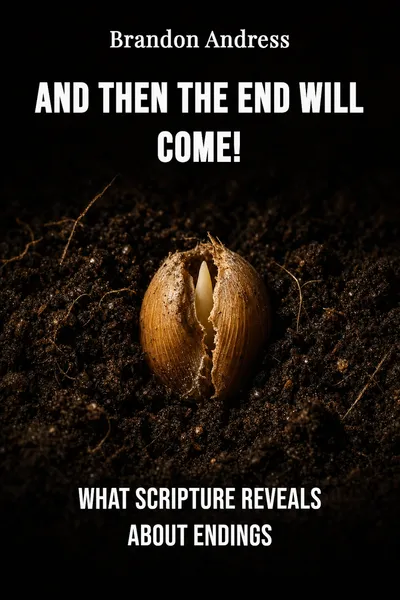
And Then the End Will Come!
What scripture reveals about endings
Description
Somewhere in a sermon, a Bible study, or a headline about wars and rumors of wars, most of us have run into the phrase: "and then the end will come." It sits in the Gospel of Matthew, chapter 24, at the tail of a sentence about the good news being preached to all nations. For a lot of readers raised in the Christian tradition, that half-verse comes loaded — with charts of the last days, with countdowns, with a certain dread about the final act of history. Brandon Andress, a writer working from inside the faith rather than at a distance from it, takes that same phrase and turns it over in his hands to see whether we have been reading it the way it was meant.
His book, sharing its title with that line, is less a prediction than a re-reading. Andress is interested in what the ancient texts actually say about endings — not the pop-culture version stitched together from Revelation, Daniel, and a few dramatic verses in the Gospels, but the shape the biblical writers themselves seem to have in mind. And that shape, he argues, keeps surprising the people who assume they already know it. What looks like a doctrine of destruction turns out, on closer reading, to lean somewhere else.
That is the real provocation here. Not "when will it happen," the question that has sold so many paperbacks and filled so many prophecy conferences, but "what kind of ending are we even talking about." Because the answer to that second question, Andress suggests, changes what a person does on an ordinary Tuesday — long before any trumpet sounds.
The question we’re asking : When scripture says "the end," does it mean the world's destruction — or something closer to its renewal?What we’ll see : How Andress re-reads the familiar prophecies, what the earliest listeners heard in them, and why the shape of the ending presses on how faith gets lived right now.
Table of contents
01Chapter 1 — The verse everyone quotes, read backwards
Andress starts with the sentence itself, because he thinks most of us hear only its second half. In Matthew 24:14, Jesus says the gospel of the kingdom will be proclaimed throughout the whole world as a testimony to all nations, "and then the end will come." The popular imagination locks onto those last five words and reads them as a threat — a deadline after which the lights go out. Andress asks us to notice what comes first. The clause is about something spreading, something being announced, something arriving in every corner of the world. The "end" is what follows that arrival, not what interrupts it.
This matters, because a great deal of end-times writing treats the culmination of history as a rupture — a sudden break where God finally gives up on the world and pulls the plug. Andress reads the grammar the other way. The end is the point where a long process reaches its intended destination. It is less like a demolition and more like a harvest, a moment that the whole season has been building toward. That reframing does not soften the seriousness of the language, but it changes its direction of travel.

02Chapter 2 — What the disciples were actually asking
The twenty-fourth chapter of Matthew, along with its parallels in Mark and Luke, is often treated as a standalone forecast of the future. Andress puts it back in its setting. The disciples have just walked out of the temple in Jerusalem, and Jesus has said something startling: not one stone of that enormous building will be left on another. The disciples, alarmed, ask him when this will happen and what the sign of his coming and of the end of the age will be. Everything that follows is an answer to that specific, rattled question.
Andress leans on this context hard, because it reframes the whole speech. The disciples were not asking about a distant apocalypse thousands of years away; they were asking about the temple in front of them, the center of their world. And within a generation — in the year 70 — Roman armies did destroy it, exactly as predicted. A significant strand of the chapter, Andress argues, was addressed to that first-century catastrophe, not to a calendar hanging over the twenty-first.
03Chapter 3 — The end that is also a beginning
If the popular picture of the end is a world burned to ash, Andress argues the biblical picture is closer to a world made new. He points to the last chapters of Revelation, where the vision is not of the faithful escaping earth for a distant heaven but of a new heaven and a new earth, of a holy city descending, of God coming to dwell with people rather than extracting them from their home. The movement is downward and toward, not upward and away.
This is the heart of the book's re-reading. Andress notices how much end-times theology assumes the goal is evacuation — that the point of salvation is to get out before the whole thing burns. The texts he keeps returning to describe something else: restoration. Creation is not disposable scenery to be abandoned once the souls have been rescued. It is the thing being healed. The end, in this reading, is the moment the long work of renewal is completed, not the moment it is called off.
04Chapter 4 — Living now as if the end were already decided
Step back from the individual passages and a pattern emerges that Andress cares about more than any single interpretation: what a person believes about the ending quietly rewrites how they live before it arrives. This is where his argument stops being about grammar and history and becomes about the texture of ordinary faith. A picture of the future is never inert. It leaks into the present, shaping what feels worth doing and what feels like a waste of time.
Consider the difference in practice. A believer who expects imminent destruction and escape tends to treat the world as a sinking ship — worth warning people off, not worth repairing. Effort spent on the environment, on institutions, on the slow work of justice can look almost beside the point when the whole set is about to be struck. Andress is gentle but pointed about this: an eschatology of evacuation produces a certain kind of disengagement, and it does so almost without the believer noticing.
05Conclusion
The book comes back to where it started, to that half-verse that so many people quote with a shiver. "And then the end will come." Andress has spent his pages arguing that the shiver is a reflex, not a reading — that the phrase points less to a wall than to a doorway, less to cancellation than to arrival. The end, in the texts he keeps returning to, is the place where a long-promised renewal finally lands, where a world is set right rather than swept away. That is a very different sentence to live inside.
Related books