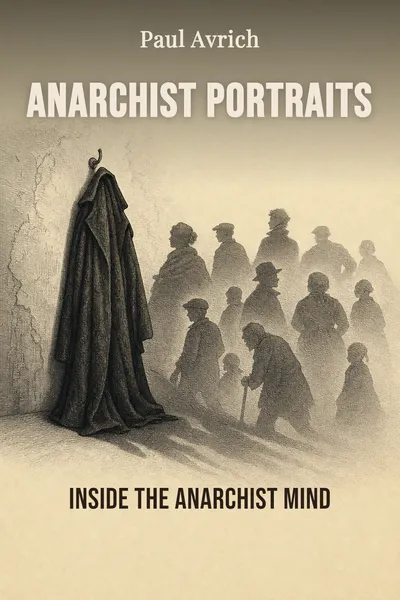
Anarchist Portraits
Inside the anarchist mind
Description
For most of the twentieth century, the word anarchist did a lot of heavy lifting in the popular imagination, and almost none of it flattering. Bomb-thrower, assassin, wild-eyed man in a black cloak. The stereotype hardened early and stuck. Paul Avrich, who taught history at Queens College in New York for decades and died in 2006, spent a career doing something quieter and more patient with that caricature: he took the people behind it seriously, one at a time. His book Anarchist Portraits, published in 1988, is the result of that patience — a gallery of individual lives assembled from archives, letters, and the voices of people who had actually been there.
What makes the collection distinctive is its refusal to argue for or against anarchism as a doctrine. Avrich is not selling the idea and not burying it. He is interested in the human beings who held it — Russian exiles, Italian printers, American schoolteachers, a Japanese poet, a handful of thinkers whose names still circulate and many more whose names had all but vanished. He tracked down elderly militants before they died, sat with them, recorded what they remembered. The essays that came out of that work read less like political theory than like a series of close, respectful encounters.
The tradition Avrich reconstructs is far stranger and more varied than the cartoon allows. It contains pacifists and men who defended violence, dreamers of rural communes and organizers of urban strikes, people who agreed on almost nothing except a deep suspicion of coercive power. To meet them individually, as Avrich insists we should, is to watch a caricature dissolve into a crowd of distinct, often contradictory faces.
The question we’re asking : Who were the people behind a label that has spent a century being misunderstood?What we’ll see : A historian's method, the famous figures reconsidered, the obscure ones rescued from silence, and what a movement looks like when you count it in faces rather than slogans.
Table of contents
01 Chapter 1 — The historian who took anarchists at their word
Avrich's approach was unusual for its time. When he began working on anarchist history in the 1960s, the field was thin and the sources were scattered, partly because the movement had been persecuted, driven underground, and deported out of the United States after the First World War. Much of what survived was in private hands — in the attics and memories of aging participants who had never been asked, or had never been asked kindly. Avrich decided the way in was through them.
So he did the legwork. He learned Russian to read the émigré press and the correspondence of exiles. He hunted through archives in several countries. Above all, he interviewed hundreds of surviving anarchists and their descendants, often traveling to sit in living rooms with people in their eighties and nineties, listening to accounts that would otherwise have died with them. That oral record, gathered over years, became one of the great documentary achievements in the history of the movement, and it runs beneath every portrait in the book.

02 Chapter 2 — The famous names, seen up close
Some of Avrich's subjects are figures a reader might already half-know. Mikhail Bakunin, the towering Russian who feuded with Karl Marx and split the First International, appears not as a symbol but as a man of enormous energy and equally enormous inconsistency — charismatic, disorganized, capable of both genuine insight and reckless conspiracy. Avrich is candid about the contradictions, including the strain of anti-Semitism and the manipulative streak, without letting them cancel out the seriousness of the ideas.
Peter Kropotkin gets a warmer but no less honest treatment. The Russian prince who became a geographer and the movement's gentlest theorist, author of Mutual Aid, comes through as a figure of real moral gravity — and also as someone whose support for the Allied cause in the First World War alienated many of his own comrades. Avrich lets the disappointment sit there. He is interested in what happens when a thinker's principles collide with a war, and he does not tidy the collision away.
03 Chapter 3 — The forgotten hands that carried it
The book's real originality lies with the figures almost no one remembers. A movement is not only its theorists; it is the printers, the organizers, the correspondents, the ones who kept the papers running and the meetings going. Avrich devotes as much care to them as to the celebrities, and in some ways more, because they are the ones history had genuinely lost.
There is the Japanese anarchist and poet whose story most Western readers would never encounter otherwise, executed for a conspiracy against the emperor in a case built on flimsy evidence. There are the Italian immigrants in American mill towns, radicalized by exploitation and by the execution of Sacco and Vanzetti, whose commitment ran through decades of poverty and surveillance. There are activists whose names survive only because Avrich sat down with someone who remembered them and wrote it down.
04 Chapter 4 — A movement made of people, not doctrine
Read as a whole, Anarchist Portraits makes an argument by accumulation rather than assertion. There is no single anarchist mind, and that is rather the point. Set Kropotkin's tender faith in cooperation beside Bakunin's appetite for insurrection, place Goldman's individualism next to the collectivism of an immigrant mill town, and the notion of a unified ideology falls apart. What remains is a family resemblance — a shared distrust of imposed authority — expressed through temperaments so different that they often could not stand one another.
This is why Avrich's biographical method is not incidental to his subject; it is the argument itself. To write about anarchism through doctrine would be to impose exactly the kind of unifying system its adherents resisted. To write about it through lives honors the thing being described. The form matches the content: a decentralized movement gets a decentralized history, a gallery rather than a system, individuals rather than a program.
05 Conclusion
Avrich came back, again and again, to the same conviction that opens the book: that ideas are inseparable from the people who hold them, and that a political tradition is best understood as a collection of biographies. He never pretended the anarchists had been right or that their projects had succeeded. Most of them ended in prison, exile, or obscurity, and the world they imagined never arrived. What he offered instead was accuracy — a refusal to let their defeat also erase their humanity.
Related books