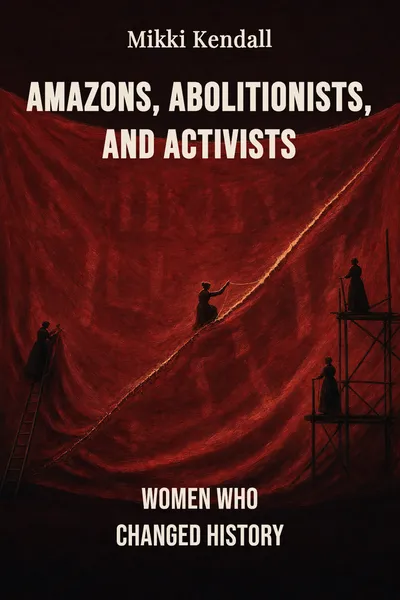
Amazons, Abolitionists, and Activists
Women who changed history
Description
There is a version of history most of us were handed in school, and in it women appear as guests. A queen here, a nurse there, a saint, a suffragette in a sash. They arrive, do one memorable thing, and step back out of the frame so the generals and presidents can resume. Mikki Kendall, the writer behind the essay collection Hood Feminism, set out to redraw that frame in her 2019 book Amazons, Abolitionists, and Activists, illustrated by A. D'Amico. She built it as a graphic history — panels, speech bubbles, a guide character walking the reader through — and used the form to do something the textbook rarely bothers with: treat women as the drivers of events, not the decoration around them.
The scope is deliberately huge. Kendall runs from the warrior women of antiquity through the abolitionists, the suffrage marches, the labor strikes, the civil rights organizers, the fights for reproductive freedom and queer liberation, right up to the present. It could have been a parade of names. Instead she keeps pulling the camera back to show the thing the individual portraits usually hide — the movements, the arguments between allies, the wins that got rolled back, the people written out because they were poor, or Black, or trans, or simply inconvenient to the tidy story.
What holds it together is a stubborn refusal to treat any of this as settled. Kendall is not building a monument. She is showing a fight that never fully stops, one that each generation inherits half-finished and hands on the same way. The book's warmth comes from that honesty — it admires its subjects without pretending they were saints or that their victories were permanent.
The question we’re asking : When women's history stops being a list of remarkable individuals, what does it actually become?What we’ll see : How a graphic primer reframes centuries of struggle — the buried figures, the movements they built, the fault lines between them, and why the story stays unfinished.
Table of contents
01Chapter 1 — The women history filed under footnote
Kendall opens where the myths are loudest. The Amazons of the title were long treated as pure invention — a Greek fantasy about women who fought like men. Then archaeologists digging Scythian burial mounds on the Eurasian steppe found women buried with weapons and battle wounds, and the fantasy turned out to have real riders behind it. It is a useful place to start, because it sets the book's method: the woman written off as legend often had a life the record simply declined to keep.
From there she moves through figures the textbooks either shrink or skip. Rulers like Hatshepsut, who governed Egypt as pharaoh and whose successors tried to chisel her out of the monuments. The Trung sisters, who raised a rebellion against Han occupation in Vietnam. The women who led armies, ran spy networks, negotiated treaties — and then got recast, in the retelling, as somebody's wife or somebody's mother, if they were mentioned at all.

02Chapter 2 — Movements built in the margins
The book's center of gravity is the moment individual courage becomes organized force. Kendall is far more interested in movements than in heroines, and she spends her strongest pages on how ordinary women turned private grievance into public pressure. Abolition is her hinge. Women who could not vote, could not own property in their own name, and were told to stay silent in mixed company nonetheless built the networks that moved enslaved people to freedom and moved the argument against slavery into every parlor and pulpit that would listen.
That work bled directly into the fight for their own rights. Kendall traces how many suffrage organizers came out of abolitionist circles, having learned to petition, to organize, to speak in public and absorb the abuse that came with it. The 1848 Seneca Falls convention gets its due, but so does the longer, grubbier reality: decades of marching, arrests, hunger strikes, and force-feeding before the vote arrived, and it arrived unevenly, leaving many women — especially Black women in the American South — still shut out for generations by other means.
03Chapter 3 — Solidarity that never came easy
The book's most bracing move is refusing to pretend these movements were united. Kendall, who spent Hood Feminism arguing that mainstream feminism kept forgetting poor women and women of color, brings that clear eye here too. The struggle for women's rights was never one struggle. It was a set of overlapping fights whose participants frequently disagreed, excluded one another, and sold each other out when it seemed strategically useful.
Suffrage is her sharpest example. The nineteenth-century American movement fractured hard over race — some prominent white suffragists made explicitly racist arguments for the vote, contending that educated white women deserved it more than newly enfranchised Black men. Black suffragists like Ida B. Wells organized anyway, often marched separately because white organizers asked them to, and won rights that the movement's leadership had been willing to trade away. Kendall does not smooth this over. She lets the ugliness sit on the page.
04Chapter 4 — History as a fight still in progress
Step back from the individual chapters and the book's larger argument comes into focus. Amazons, Abolitionists, and Activists is not really a collection of biographies. It is a case that women's history is a single, unbroken, and unfinished process — and that the habit of telling it as a highlight reel of exceptional individuals is itself a way of containing it. Isolate a Hatshepsut or a suffragette and you can admire her while implying the problem she faced is safely in the past. Show the continuous line and that comfort disappears.
Kendall's choice of form carries the argument as much as her content. A graphic history is not a lesser textbook; it is a deliberate claim about who history belongs to. The comic panel is accessible, unintimidating, designed to be picked up by a teenager or handed across a kitchen table. By putting centuries of struggle into a form that does not require a university library to enter, Kendall is doing in medium what her subjects did in the streets — insisting that this knowledge is not the property of specialists but the inheritance of everyone the story is about.
05Conclusion
Kendall closes the way she opened — with the Amazons no longer a myth but women who really rode, really fought, and were nearly written out entirely. The bookend is not decoration. It is the whole point compressed into one image: what looks like legend often turns out to be a life the record chose to lose, and recovering it is neither nostalgia nor tribute. It is the ongoing work of refusing an edited past.
Related books