

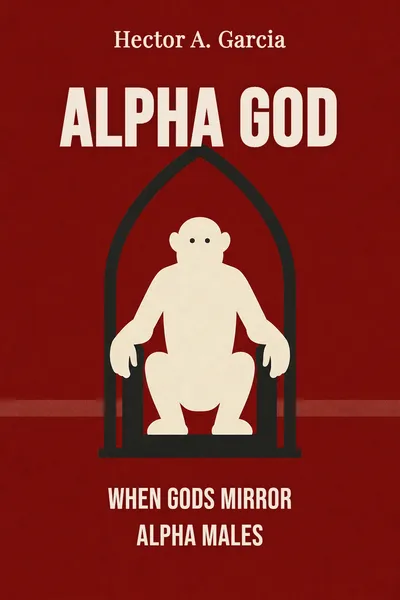
Alpha God
When gods mirror alpha males
Description
Watch a troop of chimpanzees and you will eventually see the alpha male make his rounds. He struts, his hair bristles, he charges through the group in a noisy display that sends smaller males scrambling and females into postures of appeasement. He controls access to food, to mating, to the best sleeping spots. He punishes challengers and rewards allies. It is a familiar shape of power, and Hector A. Garcia, a clinical psychologist who spent years treating trauma, thinks we have seen it somewhere else — carved into the ceilings of cathedrals, thundering from scripture, seated on a throne above the clouds.
In his 2015 book Alpha God, Garcia takes the tools of evolutionary psychology and turns them on the divine. His claim is blunt and unsettling: across a striking range of traditions, humans have imagined their gods in the image of a dominant primate male. The jealous god who demands loyalty, who rewards submission and punishes defiance, who guards sexual access and rains violence on rivals — that god, Garcia argues, behaves less like a cosmic abstraction than like the biggest male in the group, scaled up to infinity.
It is a provocative move, and Garcia knows it. He is not writing a polemic against belief so much as an inquiry into why belief so often takes this particular shape. Why does so much religious language run on hierarchy, dominance, and fear? Why do holy wars, sexual control, and the policing of women recur across faiths that otherwise share little? Garcia's answer reaches back millions of years, into the same instincts that governed our primate ancestors long before anyone built an altar.
The question we’re asking : Why do so many gods, across unrelated traditions, behave like dominant primate males?What we’ll see : How an evolutionary reading of the divine ties worship, violence, and the control of bodies back to instincts far older than religion itself.
Table of contents
01Chapter 1 — The primate in the pew
Garcia begins where evolutionary psychology begins: with the body and brain we inherited, not the one we would design. Humans are primates, and our nearest living relatives — chimpanzees and gorillas — live in steep hierarchies organized around dominant males. Rank is everything. It decides who eats, who mates, who is safe. Subordinates monitor the dominant one constantly, reading his moods, offering submission before he demands it. Garcia's argument is that this machinery for detecting and deferring to power did not vanish when our ancestors stood upright. It is still running, and religion is one of the places it runs loudest.
Consider the physical grammar of worship. Believers kneel, bow, prostrate themselves, lower their eyes, keep silent in the presence of the sacred. To a primatologist, Garcia notes, these are not neutral gestures. They are almost exactly the appeasement displays a low-ranking chimp performs before an alpha: crouching, making oneself small, avoiding a direct challenge. We use the same body to submit to a god that our ancestors used to submit to a stronger male. The behaviors line up too precisely, he suggests, to be coincidence.

02Chapter 2 — A god shaped like the strongest male
If gods are modeled on alpha males, Garcia argues, they should share the alpha's defining traits — and he sets out to show that they do. The first is territoriality. Dominant males defend turf and drive off rivals, and the gods of history have been ferociously territorial, laying claim to lands, peoples, and holy sites, sanctioning the slaughter of those who worship elsewhere. Scripture across traditions is full of divinely ordered conquest, the smiting of enemy tribes, the promise of land to a chosen people. This is not, in Garcia's reading, an accident of ancient politics dressed in religious language. It is the alpha's instinct to expand and hold territory, projected onto the cosmos.
The second trait is the demand for exclusive loyalty. An alpha male will not tolerate a rival's presence in his group; challenge means violence. The jealous god who forbids other gods, who treats worship of rivals as the ultimate betrayal, maps onto this precisely. Garcia lingers on the vocabulary itself — the divine described as jealous, as a consuming fire, as one who will not share his glory. These are the emotions of a dominant male guarding his standing, and human worshippers respond as subordinates do: with vigilant, anxious fidelity.
03Chapter 3 — Bodies, submission, and the fight over reproduction
For dominant primate males, Garcia stresses, power is never abstract — it is ultimately about reproduction. The alpha's rank translates into control over mating, and much of primate aggression is, at root, competition to father the next generation. This is where Garcia's argument turns toward one of religion's most persistent features: the intense preoccupation with sex, and above all with the control of women. If our gods inherited the alpha's traits, we should expect them to be deeply concerned with who mates with whom. And they are.
Garcia surveys the machinery of sexual control that religious systems have generated: rules governing marriage and virginity, veiling and seclusion, punishments for adultery that fall hardest on women, doctrines that treat female sexuality as a danger to be managed. He reads these not as arbitrary moral codes but as expressions of an ancient male reproductive strategy — the drive to guard paternity and monopolize mating — now enforced with divine authority. The god who legislates women's bodies is, in this frame, the alpha protecting his reproductive interests, generalized across an entire society.
04Chapter 4 — The old brain in the modern sanctuary
Step back from the specific traditions and Garcia's book is really an argument about the human mind. His deeper claim is that our theology is a kind of self-portrait, painted by a brain that was assembled for primate social life and never fully redesigned for temples and scripture. When we reach for the highest thing we can conceive, we do not escape our evolutionary inheritance; we monumentalize it. The god on the throne is, on this view, the shape our oldest instincts take when we project them onto the sky. That is why the same cluster of traits keeps recurring — because the same mind keeps producing them.
This reframing changes how Garcia reads religious violence, which is his real target. If holy war, persecution, and the policing of bodies were simply doctrinal errors, they could be corrected by better doctrine. But if they flow from dominance instincts far older than any creed, then they are harder to argue away, because the enemy is partly internal. Garcia treats religion less as the cause of these impulses than as a powerful amplifier — a system that takes the primate drive to dominate, defend territory, and control reproduction, and hands it the authority of the absolute. What might otherwise be ordinary aggression becomes a sacred duty.
05Conclusion
The chimpanzee alpha on his rounds and the god on his throne turn out, in Garcia's telling, to be close relatives. Both command territory, demand loyalty, guard reproduction, reward submission, and punish defiance — and both are read, moment to moment, by anxious subordinates scanning for signs of favor or wrath. Alpha God does not set out to disprove any faith. It sets out to explain a pattern: why unrelated traditions keep converging on the same domineering figure, and why so much of religious history has run on conquest, control, and the policing of women. The answer Garcia offers is that the template was inside us all along, inherited from ancestors who never built an altar.