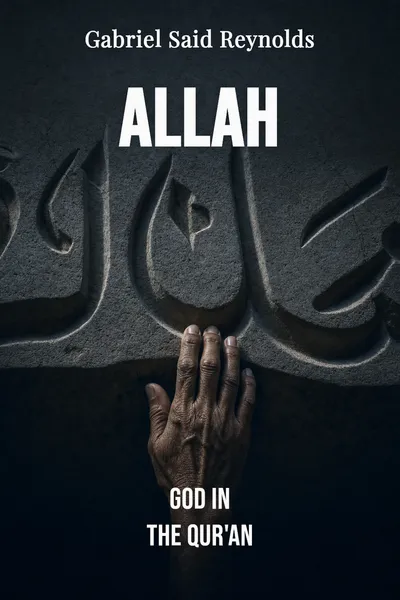
Allah
God in the Qur'an
Description
Open almost any chapter of the Qur'an and the first thing you meet is a formula, repeated over a hundred times across the text: in the name of God, the Merciful, the Compassionate. Muslims say it before eating, before writing, before beginning almost anything. It is the sentence a child learns first. And yet the God it names is not only merciful — the same book that opens on compassion also describes a God who punishes, who tests, who is utterly beyond comparison, who holds the fate of every soul. Gabriel Said Reynolds, a scholar of Islam and its scriptures at Notre Dame, spent a career reading the Qur'an closely, and he noticed that the God on its pages is richer and stranger than the slogans on either side tend to allow.
His book, simply titled Allah, sets out to do something that sounds obvious but rarely gets done carefully: describe the God the Qur'an actually portrays, from the text itself. Not the God of later theological schools, not the God of polemic, not the caricature. The Qur'an, Reynolds points out, did not appear in a vacuum. It emerged in a seventh-century Arabian world already soaked in Jewish and Christian stories — Adam and Abraham, Moses and Mary, angels and prophets. The Qur'an knows these figures, argues with them, retells them. To read its God well, we have to read that whole conversation.
That is where the book becomes something more than an introduction. Reynolds treats the Qur'an not as a sealed monument but as a voice in a long argument that Jews and Christians were already having — an argument about who God is, what he wants, and how he deals with the people he made. The word Allah, after all, is simply the Arabic word for God, the one Arabic-speaking Christians still use today. Which raises a quieter question underneath the whole book.
The question we’re asking : Who is the God the Qur'an describes, and how much of him do Jews, Christians, and Muslims actually share?What we’ll see : How one scholar reads Islam's scripture alongside the traditions it grew from, and what its portrait of God looks like up close.
Table of contents
01Chapter 1 — The God who names himself mercy
The single most repeated thing the Qur'an says about God is that he is merciful. The two divine names in that opening formula — al-Rahman, al-Rahim — both come from a root meaning compassion, and one of them, al-Rahman, is close to a proper name. Reynolds notes that the Qur'an sometimes uses it almost as a synonym for Allah himself, as if mercy were not one attribute among many but something near the center of who God is. This is not a soft, sentimental mercy. It is the mercy of a creator toward creatures who owe him everything and constantly forget it.
Reynolds is careful to show how the Qur'an anchors this in the world we can see. God's mercy is written into rain that revives dead land, into the alternation of night and day, into the milk animals give and the ships that stay afloat. These are called signs — ayat, the same word used for the verses of the book. The natural world and the scripture are both readable as messages from a God who wants to be found. To notice the world rightly, in this telling, is already to be on the way to God.

02Chapter 2 — A conversation with earlier scripture
The Qur'an assumes you already know the stories. It does not introduce Adam, Noah, Abraham, Joseph, Moses, or Mary so much as refer to them, retell fragments, and draw lessons. Reynolds's central scholarly move is to take this seriously: the Qur'an is talking to an audience steeped in biblical and para-biblical tradition, and its portrait of God comes into focus only when we hear that background. It is less a book that ignores the Bible than one that responds to it.
Take Abraham, who matters enormously to the Qur'an's idea of God. He is presented as the first true monotheist, a man who reasons his way from the stars and the moon and the sun to the one who made them, rejecting each because it sets and fades. This is not quite the Abraham of Genesis; it draws on Jewish legends that had grown up around him over centuries. Reynolds shows how the Qur'an takes an existing figure and sharpens him into an argument about God's oneness — the conviction the text calls tawhid, and treats as the deepest truth about reality.
03Chapter 3 — Mercy and wrath, held together
If mercy is the Qur'an's first word about God, judgment is never far behind. The book is saturated with the Day of Reckoning — scales that weigh deeds, a garden for the faithful, a fire for those who denied. Reynolds does not soften this. The God of the Qur'an is a sovereign judge, and the vividness of paradise and hell is one of the text's most distinctive features, meant to be felt as much as understood. The two destinations are described in sensory detail precisely so that the choice between them feels urgent.
The theological tension this creates — a God at once endlessly merciful and severely just — is one the Qur'an lives inside rather than resolves. Reynolds shows that Muslim thinkers later argued for centuries over how to hold the two together. Does God's justice bind him, so that he must reward and punish fairly? Or does his sovereignty mean he is free to forgive whom he wills, owing nothing to anyone? The Qur'an gives ammunition to both readings, and Reynolds treats that ambiguity as a feature of the text, not a flaw to be explained away.
04Chapter 4 — Reading God across three faiths
Step back from the individual attributes and Reynolds's larger argument comes into view. By reading the Qur'an alongside Jewish and Christian scripture rather than in isolation, he is making a claim about how these three religions actually relate. They are not three sealed worlds that happen to sit near each other. They are participants in one long, unfinished conversation about the same God — the God of Abraham — each convinced the others have gotten something crucial wrong, and each drawing on a shared stock of stories to say so.
This reframes a question people usually treat as a slogan: do Muslims, Christians, and Jews worship the same God? Reynolds's careful work suggests the honest answer is neither a flat yes nor a flat no. The Qur'an clearly means to speak of the God of Abraham and Moses; it uses the same word Arabic-speaking Christians use for God. Yet it describes him in ways that deliberately diverge — no son, no incarnation, an oneness so absolute it rules out the very moves Christian theology depends on. Same subject, different portrait, and the difference is the point.
05Conclusion
The book ends more or less where its title begins — with a word. Allah is not the name of a foreign deity but the Arabic word for God, spoken by Muslims and Arab Christians alike, carrying inside it a portrait built over centuries and in constant dialogue with the Bible. Reynolds's achievement is to have described that portrait patiently, letting the Qur'an speak in its own idiom of mercy first, sovereignty always, judgment in full color, and oneness above all. The God who writes mercy upon himself and the God who weighs every deed turn out to be the same God, held in a tension the text does not want dissolved.
Related books