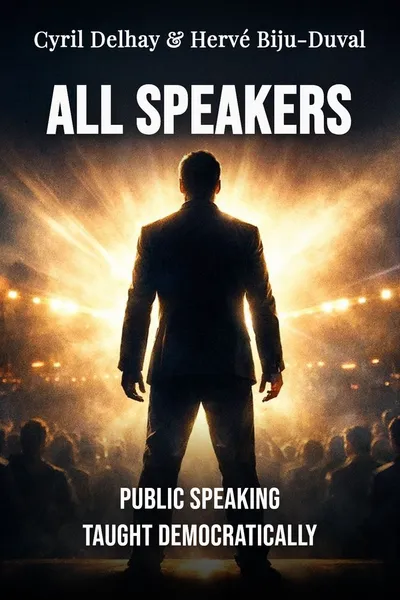
All Speakers
Public speaking taught democratically
Description
For most of the history of French schooling, there was one skill the system quietly refused to teach: speaking in front of others. We graded essays, parsed grammar, corrected spelling to the comma. We taught children to read and to write, and then we asked them, with no training at all, to stand and defend a thesis, pitch an idea, answer a question in a job interview. The spoken word was treated as a gift you either had or didn't — a matter of temperament, of confidence, of family background. Cyril Delhay, who taught at Sciences Po and later advised the French education ministry, spent years watching bright students freeze the moment they had to open their mouths.
In "All Speakers," written with Hervé Biju-Duval, Delhay makes an argument that sounds obvious once stated and was revolutionary in practice: speaking well is not a talent, it's a competence. And a competence can be taught — to everyone, not just to the kids who already feel at ease in front of a room. The book grew out of real reform. Delhay helped shape the "grand oral," the spoken final exam introduced to the French baccalauréat in 2021, which forced the system to confront a question it had dodged for a century.
The stakes are not cosmetic. When only some people learn to hold a room, the others stay silent — in meetings, in courtrooms, in assemblies, in their own lives. A society that leaves oral fluency to chance quietly sorts its citizens into those who get heard and those who don't. Delhay and Biju-Duval set out to show that the sorting is avoidable.
The question we’re asking : Can the art of speaking in public actually be taught to anyone — and what happens when a school decides it must be?What we’ll see : How two educators turned a supposed gift into a learnable craft, and why they treat the spoken word as a matter of fairness rather than flair.
Table of contents
01Chapter 1 — The skill nobody thought could be taught
Delhay starts from an uncomfortable observation about French schooling. For generations it prized the written word above all — the dissertation, the explication de texte, the carefully composed sentence. Speaking was everywhere in daily school life, yet almost nowhere as something taught. Students recited, answered, presented, but no one showed them how. The implicit belief was that eloquence belonged to the naturally gifted, or to those raised in homes where dinner-table debate was a sport. The rest were left to improvise, and most improvised badly.
That belief, the book argues, is both false and quietly unjust. False, because every skill we admire in a confident speaker — pacing, breathing, making eye contact, structuring an idea on the fly — is a learnable behavior, not a personality trait. Unjust, because treating speech as innate conveniently excuses the school from teaching it, and leaves the gap to be filled by social origin. The children who arrive already able to speak tend to be the ones whose families modeled it. School, by doing nothing, ratifies the head start.

02Chapter 2 — Breathing, body, and the end of the gifted-orator myth
Before a word is chosen, the body has already spoken. Delhay and Biju-Duval spend real time on the physical base of speech, because it's where fear lives and where confidence is actually built. Breathing comes first. Most people who are nervous in front of a group breathe high and shallow, which starves the voice and feeds the panic. Learning to breathe low and slow is not a relaxation gimmick — it's the mechanical foundation of a steady voice and a steady mind. It can be practiced, drilled, improved, like any other motor skill.
Then there is the body itself: how you stand, where you put your hands, whether your feet are planted or shifting. The authors are blunt that these are not matters of innate poise. A student who learns to anchor both feet, to slow their gestures, to hold a gaze for a beat longer than feels comfortable, becomes a different speaker within weeks. The transformation is visible, and crucially, it's available to everyone — the shy teenager as much as the natural extrovert. This is the heart of the anti-elitist claim: the raw material of a good speaker is a trainable body, not a lucky temperament.
03Chapter 3 — A grammar of speaking, practiced like scales
Once the body is steady, the question becomes what to actually do with it. Here Delhay and Biju-Duval offer something closer to a grammar of the spoken word — a set of components that can be isolated, taught, and rehearsed separately before being combined. Speaking well, in their account, is not one monolithic talent but a bundle of distinct skills, and the reason so many people feel hopeless at it is that they try to master everything at once and conclude they simply can't do it.
The components are concrete. There is the work of listening — because real speech is a response, not a monologue, and the best speakers are first attentive to the room and to what came before them. There is structure: the ability to organize a thought quickly so a listener can follow it, to signal where you're going and when you've arrived. There is the use of the concrete example over the abstract claim, the story that carries an argument further than a definition ever could. And there is the management of the self under pressure — the stage fright that the authors treat not as something to eliminate but as energy to channel.
04Chapter 4 — What a classroom of speakers does to a republic
Step back from the breathing drills and the rehearsal exercises, and "All Speakers" reveals itself as a book about equality more than about technique. Delhay's deepest claim is that the spoken word is a form of power, and that distributing it is a civic act. In a democracy, decisions are made in rooms where people argue, persuade, object, and vote. Whoever cannot hold such a room is, in a real sense, less of a citizen — not because their ideas are worse, but because their ideas never reach the table. Leaving speech to chance isn't neutral. It hands the microphone to those who inherited it.
This is why the authors insist on the word "all." A school that teaches only reading and writing produces citizens who can receive and record arguments but not make them aloud, in public, under contradiction. Teaching everyone to speak is, in this reading, the completion of literacy — the part that lets a person act in the shared world rather than merely understand it. The "grand oral" matters to them less as an exam than as a statement: the republic is declaring that oral fluency is owed to every child, not sold to a few.
05Conclusion
The journey of "All Speakers" runs from a single stubborn prejudice — that eloquence is a gift — to a fully worked pedagogy that treats it as a craft. Delhay and Biju-Duval take apart the mystique of the born orator and reassemble it as a sequence of learnable moves: how to breathe, how to stand, how to pause, how to structure a thought and survive a difficult question. Behind the French reform of the spoken baccalauréat exam lies this conviction, that what we had quietly declared unteachable was simply never taught.
Related books