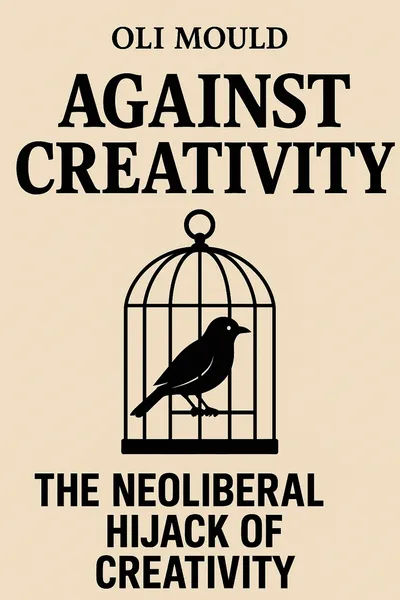
Against Creativity
The neoliberal hijack of creativity
Description
Oli Mould's provocative intervention emerges within contemporary critical geography and urban studies, challenging the pervasive celebration of creativity in academic, policy, and popular discourse. Writing against the backdrop of decades of creative city policies and the creative economy's ascendance, the author positions his work as a necessary corrective to uncritical embraces of creativity as inherently progressive. His geographical expertise and engagement with critical theory inform this systematic deconstruction of creativity's contemporary manifestations.
Mould's central research question asks: How has creativity been transformed from a potentially liberating force into an instrument of neoliberal governance and exploitation? His defended thesis argues that contemporary creativity serves primarily as a mechanism for capitalist accumulation and social control, necessitating its abandonment or radical reconceptualization. The main stake is to expose creativity's complicity in perpetuating inequality and to propose alternative frameworks for understanding human creative potential.
The author's systematic critique demonstrates creativity's transformation from potential liberation tool into sophisticated control mechanism. His analysis successfully reveals the interconnections between creative discourse, neoliberal governance, and spatial politics, providing a comprehensive account of creativity's contemporary functions. The work's intellectual contribution lies in its unflinching examination of creativity's dark side, challenging progressive assumptions about cultural production's inherently positive effects. Mould's geographical perspective proves particularly valuable, illuminating creativity's spatial dimensions often overlooked in purely cultural or economic analyses.
Table of contents
01 The Commodification of Creative Expression
Mould's analysis reveals how creativity has undergone systematic commodification, transforming from organic cultural practice into market commodity. The author demonstrates how neoliberal discourse appropriates creative language to legitimize precarious labor conditions and urban redevelopment projects. This commodification process strips creativity of its subversive potential, converting it into a standardized product serving capital accumulation.

02 Governance Through Creative Discourse
The second analytical axis examines creativity as a governmental technology, following Foucauldian insights into power's productive dimensions. Mould demonstrates how creative discourse shapes subjectivities, encouraging individuals to view themselves as entrepreneurial creative agents responsible for their own success or failure.
This governmental dimension operates through policy frameworks promoting creative entrepreneurship and cultural participation. The author reveals how such policies individualize structural problems, suggesting that unemployment or urban decline can be resolved through enhanced creativity rather than addressing systemic inequalities. Creative discourse thus depoliticizes social problems by rendering them matters of individual creative capacity.
03 Spatial Politics and Urban Creativity
The third thematic development explores creativity's spatial dimensions, examining how creative discourse legitimizes particular forms of urban development while marginalizing others. Mould's geographical expertise proves essential here, revealing how creative city policies serve primarily to attract mobile capital and middle-class residents rather than addressing existing community needs.
04 Resistance and Alternative Possibilities
The final analytical axis addresses possibilities for resistance and alternative configurations of creative practice. Mould acknowledges creativity's continued potential for subversion while arguing that this potential cannot be realized within current institutional frameworks.
The author examines various forms of creative resistance, from tactical media interventions to community-based cultural practices that reject market logics. However, he maintains skepticism about creativity's capacity for fundamental social transformation, given its thorough integration into capitalist accumulation processes.
05 Critical Analysis and Future Directions
Despite its analytical rigor, Mould's work exhibits certain limitations. The blanket rejection of creativity risks overlooking genuinely transformative practices that resist commodification. His analysis occasionally lacks nuance regarding creativity's contradictory nature, potentially reproducing the totalizing logic he critiques.
The work's theoretical framework, while sophisticated, relies heavily on established critical approaches without fully developing novel analytical tools. Additionally, Mould's focus on Anglo-American contexts limits his analysis's global applicability, particularly regarding non-Western creative traditions.
Related books