

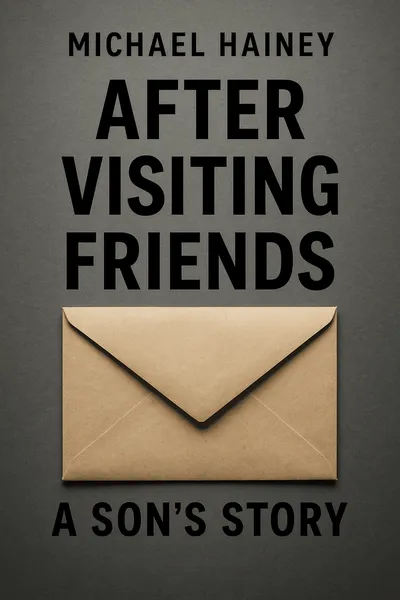
After Visiting Friends
Secrets that shaped a life
Description
Michael Hainey's debut memoir emerges from the intersection of personal tragedy and professional journalism, utilizing investigative techniques to excavate buried family history. Published in 2013, this work represents a significant contribution to contemporary memoir literature that blends personal narrative with journalistic inquiry. The author leverages his editorial expertise and reporting skills to reconstruct events surrounding his father's death in 1970, when Hainey was merely six years old. The memoir operates within the broader context of American family dysfunction narratives while distinguishing itself through its methodical, almost detective-like approach to uncovering truth.
The central research question driving the memoir is: How do family secrets shape identity formation and perpetuate intergenerational trauma within American middle-class families? Through his investigation, Hainey defends the thesis that investigative journalism methodologies can serve as therapeutic tools for processing personal trauma while exposing the destructive power of concealed family truths. The main stake of his work lies in demonstrating that confronting buried family secrets is essential for breaking cycles of emotional dysfunction and achieving authentic self-understanding.
Table of contents
01The Architecture of Concealment
Hainey constructs his narrative around the fundamental tension between surface appearances and hidden realities within suburban American families. His methodological approach reveals how families construct elaborate systems of concealment that protect certain members while psychologically damaging others. The author demonstrates that his father's death, officially attributed to a heart attack while visiting friends, masked a more complex reality involving infidelity and deception.
The theoretical framework underlying this analysis draws from both trauma studies and family systems theory. Hainey illustrates how secrets function as organizing principles within family structures, determining communication patterns, emotional availability, and identity formation processes. His investigation reveals that concealment operates not merely as individual choice but as systemic family behavior that serves protective functions while simultaneously generating psychological harm.

02Intergenerational Transmission of Dysfunction
The author's investigation expands beyond individual trauma to examine how dysfunctional patterns reproduce themselves across generations. Hainey reveals how his mother's response to widowhood—characterized by emotional withdrawal and protective secrecy—shaped his own capacity for intimate relationships and emotional authenticity. This analysis demonstrates how trauma responses become inherited behavioral patterns.
His exploration of family dynamics reveals the complex interplay between protection and harm within intimate relationships. The decision to shield children from painful truths, while well-intentioned, creates emotional voids that manifest as adult relationship difficulties. Hainey's narrative illustrates how incomplete information generates fantasy and projection, preventing healthy identity development.
03Truth as Liberation and Destruction
Hainey's investigation culminates in revelations that simultaneously validate his instincts while destroying cherished family mythologies. His discovery of his father's affair and the circumstances surrounding his death creates a paradoxical liberation through painful knowledge. This dynamic illustrates the complex relationship between truth and healing, suggesting that authentic recovery requires confronting destructive realities.
The memoir explores how truth-seeking can become obsessive behavior that serves both healthy and pathological functions. Hainey's decades-long investigation reveals journalism's potential as both professional methodology and personal compulsion. His narrative demonstrates how the pursuit of truth can become a form of relationship with absent figures, providing connection through investigative activity.
04Ethical Implications of Family Archaeology
The memoir raises significant ethical questions about the rights and responsibilities involved in excavating family secrets. Hainey's investigation implicates living family members and reveals information that some prefer to keep buried. His narrative explores the tension between individual healing needs and collective family protection, questioning whether truth-telling always serves constructive purposes.
His approach demonstrates how journalistic ethics translate imperfectly to family relationships, where objectivity becomes impossible and revelation carries intimate consequences. The memoir illustrates how investigative processes can become forms of emotional violence, forcing unwilling participants to confront suppressed experiences. Hainey's narrative suggests that healing through truth-telling requires careful consideration of collateral damage.
05Critical Analysis and Future Directions
Hainey's memoir successfully demonstrates that family secrets function as powerful organizing forces that shape identity formation and perpetuate intergenerational trauma patterns. His investigative approach reveals journalism's capacity to serve therapeutic functions when applied to personal history, while simultaneously exposing the complex ethical implications of family truth-telling. The work contributes significantly to contemporary memoir literature by illustrating how professional methodologies can be repurposed for personal healing.
The memoir's intellectual contribution lies in its demonstration of how concealed family histories create lasting psychological consequences that extend far beyond initial traumatic events. Hainey's narrative reveals the paradoxical relationship between protection and harm within intimate family relationships, suggesting that well-intentioned secrecy can generate more damage than acknowledged painful truths.